 Naturalistic Paganism
World Refugee Day

World Refugee Day is June 20th (same day as the solstice this year). It is devoted to raising awareness of the situations of refugees across the world.
This year’s theme is “One refugee without hope is too many.”
From Wikipedia:
A refugee is a person who is outside their country of origin or habitual residence because they have suffered persecution on account of race, religion, nationality, political opinion, or because they are a member of a persecuted ‘social group’. Such a person may be referred to as an ‘asylum seeker’ until recognized by the state where (s)he makes his(er) claim.
Refugee women and children represent an additional subsection of refugees that need special attention. For the refugee system to work successfully, countries must be prepared to allow Open borders for people fleeing conflict, particularly for countries closest to the conflict. This is a program that has helped many people, but people still believe there are flaws. Getting to a refugee camp is extremely difficult.
As of December 31, 2005, the largest source countries of refugees are Afghanistan, Iraq, Sierra Leone, Myanmar, Somalia, South Sudan, and the Palestinian Territories. The country with the largest number of IDPs is South Sudan, with over 5 million. As of 2006, with 800,000 refugees and IDPs, Azerbaijan had the highest per capita IDP population in the world.
June Solstice
The Summer Solstice is known in Contemporary Paganism as Litha or Midsummer, as in Shakespeare’s Midsummer Night’s Dream. Nichols (2009) calls this a time when bonfires are lit, people may leap through the fires, and the young stay up all night. Pagan lore often marks this as the moment the sun god meets hi death, though Nichols reserves that event for the coming cross-quarter.
Glenys Livingstone of PaGaian sees this time as the moment when, metaphorically, “the Goddess and God embrace in a love so complete that all dissolves into the single song of ecstasy that moves the worlds. Our bliss, fully matured, given over, feeds the Universe and turns the wheel. We join the Beloved and Lover in the Great Give-Away of our Creativity, our Fullness of Being.” To symbolize this, her ritual script sees flowers, fruit, and the like distributed to participants, who then give away this bounty by casting it into the central fire.
Jon Cleland Host of the Naturalistic Paganism yahoo group suggests kayaking local rivers or lakes, hiking in the woods, and holding a ritual in the forest. He also takes this as a time to celebrate marriage, as well as to consume mead:
Mead is often consumed – celebrating the honey of our marriage and the season. Mead is honey wine, and the full moon closest to Litha is traditionally called the mead moon or the honey moon (hence the name “honeymoon” for the vacation after a wedding). (see files section of yahoo group)
Meanwhile, those in the Southern Hemisphere celebrate the Winter Solstice with Yule.
The HPedia: Meditation
Your help is needed! Please critique this entry from the HPedia: An encyclopedia of key concepts in Naturalistic Paganism. Please leave your constructive criticism in the comments below.
Meditation can mean many things, no doubt due largely to the vast array of different practices that fall under this label. Some of the most common forms relevant to HP include:
- Mindfulness meditations, in which mindful awareness is brought to one or more aspects of immediate experience. This would include varieties of breath meditation common to Buddhist, Yogic, Pagan, and other traditions, as well as Thomas Schenk’s bicycle meditation and Seton Sitting.
- Visualization meditations, in which one visualizes in the mind’s eye an image or series of images (involving any of the five senses, not just vision). These would include many of the guided visualizations common in Pagan circles, some forms of Buddhism, and other traditions. A particularly common Pagan visualization is “grounding” by visualizing a root extending from the the spine down into the earth.
- Ecstatic meditations, in which one is in some sense taken “out of oneself” (from ex- “out” and -histanai “to cause to stand” – Merriam-Webster). These would include the “journey” of Michael Harner’s Core Shamanism, astral traveling, and other forms where one is in some sense taken “out of oneself” (ecstasis = ). Channeling and possession might be related practices, though in these cases one is not taken out of oneself so much as something is taken in.
- Contemplative meditations, in which active reflection and cogitation play important roles. Books which collect short ponderings as “meditations” (such as Marcus Aurelius’ Meditations) may fall into this category.
The Tree of Contemplative Practices is a graphic organizing a variety of practices, most of which could be called meditations of different sorts.
Check out other entries in our HPedia.
Conscious or unconscious: Which is the real you?
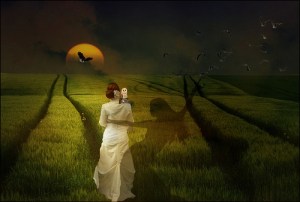
Do you identify more with your conscious or unconscious mind?
– by B. T. Newberg
There are at least two people inside each of us:
- There is the rational, deliberate, conscious mind. It’s the one you can feel or even hear working when you puzzle out a tough math problem.
- And then there is the unconscious, intuitive, instinctive mind. This is the one that does the math, without you ever realizing it, to determine exactly how to high jump over that next hurdle.
The question is, which one is the real you?
This time, instead of a long discussion of context, I thought I’d just keep it simple.
Some food for thought:
- If you do a ritual believing there is no such thing as deity, yet the emotional response rising up from within is as if there were, which is your true belief?
- Western thought since Plato has given us the picture of the rational mind as ruler, but Jung observed that we do not create our thoughts, we are handed them. If it’s the unconscious mind that gives you your thoughts, who’s really in control? Moreover, which one is more rational?
- Many psychologists now recognize that cognition is not only in the brain but also in the muscles and organs; that is, much of it is embodied. This wider cognition is not usually conscious. For example, you may consciously intend to hit the ball with the bat, but you can only witness whether and how you hit it or not. Even farther from consciousness is “cognition” outside the body, such as writing. Some think of this as a kind of cognitive prosthesis, an off-loading of cognition into the environment (see the slideshow below, for example). If you’re willing to go as far as finding cognition outside the body, then what does that mean for self-identity? Is the skin-bag still the boundary of selfhood, or are “you” something much wider, much greater?
- Whichever aspect of the mind you identify with most of the time, are there certain times when you identify with the other more?
I look forward to hearing your comments.
Recent Work
The view from above: A Stoic meditation, by Donald Robertson
What if the universe doesn’t love you back? by B. T. Newberg
Naturalistic Druidry: A retrospective, by WhiteHorse
Next Sunday

Heather explores the intersection between Secular Paganism, Humanism, and her own life.
Am I a Secular Pagan? by Heather Van de Sande
Appearing Sunday, June 23rd, 2013
The HPedia: Divination
Your help is needed! Please critique this entry from the HPedia: An encyclopedia of key concepts in Naturalistic Paganism. Please leave your constructive criticism in the comments below.
Divination is a way of discovering meaning through special ritual methods. Such methods include tarot cards, runes, ogham sticks, omens read in natural events, and so on.
Mirriam-Webster‘s definition doesn’t quite capture the significance in Contemporary Paganism:
the art or practice that seeks to foresee or foretell future events or discover hidden knowledge usually by the interpretation of omens or by the aid of supernatural powers
In contrast to fortune-telling, most Contemporary Pagans seem to lay the emphasis not on seeing the future but on seeing potentialities, paths one may take toward the future. Many also emphasize learning something about the will of deities or spirits via such methods.
From a naturalistic standpoint, any kind of literal fortune-telling or communication with deities seems unlikely, but divination remains a powerful tool for lateral thinking. Divination, which often involves rich symbolism and associative thinking, can be an effective way to stimulate the creative imagination.
An exploration of naturalistic omenry can be found in the article Symbols in the sky.
Check out other entries in our HPedia.
Buy Godless Paganism (paperback)

Buy Godless Paganism (ebook)


Pagan Coming Out Day – May 2nd
 Naturalistic Paganism