Naturalistic Paganism
The HPedia: Resonance
Your help is needed! Please critique this entry from the HPedia: An encyclopedia of key concepts in Naturalistic Paganism. Please leave your constructive criticism in the comments below.
Resonance is a term found in common Pagan expressions of myths or deities which “call to” or “resonate” with one. In such Pagan discourse, “it doesn’t resonate with me” is a perfectly acceptable reason to refrain from engaging with a certain myth or deity, without implying anything a priori negative or unsatisfactory about said myth or deity. Such lack of implied criticism is one of the virtues of the Pagan concept of resonance, and no doubt plays a role in enabling a community of such diversity to thrive together.
On one level, one might describe a certain attraction to an idea, image, or myth by saying “It resonates with me.” On another level, one might describe an experience of oneness or communion with a transcendent other as an experience of resonance.
From a naturalistic perspective, such a feeling might arise in relation to such ego-transcending entities as nature, society, or the psyche. Often it does arise following a mystical, numinous, or visionary experience (see “Numinous”, “Mystical”, and “Visionary”). A sense of resonance with one’s world may even be a goal for naturalists.
It is of crucial note that the experience of resonance does not seem to be at the beck and call of the conscious will, nor is it a product of rational, cognitive deliberation (though such can play a role in its arising). That is to say, we cannot simply will ourselves to experience it. Resonance seems rather to emerge from the unconscious as a response of the total psyche to a situation. To that extent, activities that plumb the unconscious, such as myth, meditation, and ritual, may be required to encourage its emergence.
See also “Numinous”, “Mystical”, “Transcendence”, and “Visionary.”
Check out other entries in our HPedia.
Autumn Cross-Quarter

Samhain altar by Trea Silverwolf (used with permission)
In the Northern Hemisphere, the Autumn Cross-Quarter is celebrated among Neo-Pagans on October 31 as Samhain (pron. saw-in), the Neo-Pagan New Year and origin of modern Halloween. The actual date of the cross-quarter falls about a week later on November 6 or 7. The precise date and time for the cross-quarter can be found at archaeoastronomy.com. Meanwhile, those in the Southern Hemisphere experience this time as Beltaine.
In Neo-Pagan circles, the date is sometimes celebrated as the beginning of winter, although, in the U.S., winter does not officially begin until the winter solstice, and the cross-quarter is the middle of autumn. In some places in the northern hemisphere, the last leaves are clinging to the branches and the harvest is near completion.
NaturalPantheist describes how the traditional Neo-Pagan holiday can be understood to a religious naturalist:
With the revival of Paganism, the practice of venerating ancestors, a practice of the ancient Celts once dead in the western world, has begun to grow in popularity again. As Naturalistic Pantheists, this practice should also be a part of our lives. Samhain is a time of remembrance. It is a time to honour those who have died, whether friends, family or ancestors. It is a time to remember them and to be thankful for the role they have played in influencing our lives. They are not gone, they live on within us through our memories and genes, and within the earth as their atoms are reincarnated into a thousand different creations. Samhain reminds us that one day, we too must die. It is a time take stock of our lives and to meditate on the cycle of life and death, confronting a topic we too often do our best to avoid.
He goes on to suggest some ways in which the day can be honored by naturalists:
It is traditional to celebrate this festival by eating a large feast of late harvest foods e.g. pumpkins, apples, root vegetables and barmbrack bread. It is also the traditional time for remembering our ancestors and those we have loved and lost e.g. by visiting their graves and putting fresh flowers there. Personally, I build an altar and put photos and mementos of those I have lost recently on it. This year I have spent much of the past month researching my family history in order to create a family tree and know more about the ancestors I wish to honour. On Samhain eve I perform a ritual of remembrance, lighting a candle for each person I am remembering and holding a minutes silence in respect. This year that will include both my grandmother and her dog. I am also having a party with friends, decorating the house and eating traditional foods.
NaturalPantheist also describes a Samhain ritual for naturalists here.
Glenys Livingstone of PaGaian Cosmology celebrates the Autumn Cross-Quarter by having her ritual participants bring photos of their old selves, and answer the question: “Who have you been?” The participant holds up the photo and describes the old self, to which the group responds: “Hail to you and your becomings.”
The participants also remember those who have passed on, sharing a feast of lolly snakes while observing:
“We welcome all these, whose lives have been harvested, whose lives have fed our own, and we remember that we too will be consumed, feed others with our lives. May we be interesting food. We also become the ancestors. We are the ancestors.”
Jon Cleland Host of the Naturalistic Paganism yahoo group relates Samhain to events in evolutionary history:
Just as Samhain heralds the dark quarter of the year (Samhain to Imbolc) and then the cold quarter of the year (Yule to Ostara), the Cretaceous extinction started with the dark cloud of ejecta from the asteroid impact, followed by the deadly freeze of a “nuclear” winter. Samhain also works well to commemorate extinction, which has been the fate of over 99.99% of all species that have existed on earth.
He then develops these observations into a seasonal practice:
These extinctions have made room for new species (such as us), and death makes room for new life. Samhain is thus the time to express our gratitude to those who have gone before us, those who have made our lives possible, those who have influenced us, and those who we remember. For this reason our ritual usually includes tributes to our ancestors and others. Photos of the dead can be given a place of prominence leading up to Samhain, and all can be especially remembered, even spoken to, if you like. The meditation to our ancestors can be read (see separate upload [in Naturalistic Paganism files section] for that).
Finally, Host notes that Samhain is also a time for fun:
Samhain (Halloween) parties are good, as is trick-or-treating, bobbing for apples, and decorating. Colors are black, orange, tombstone gray and sometimes bone (off white).
Share your naturalistic traditions in the comments below.
As seen from the sky, by Debra Doggett
Just 16 days left for you to help HP place an ad at The Wild Hunt! Go to HP’s Indiegogo campaign to contribute.
Today we conclude our early autumn theme of “Finding Meaning” with Debra Doggett’s essay, “As seen from the sky”.

How does a shift of perspective change our understanding of who we really are?
I stayed home from work today. The need for a mental health break didn’t come as a surprise but the courage to do it did. All week I’ve been weepy, moping around everything and everyone with unshed tears threatening to pour. Placing the call this morning was my acknowledgement that my system is in dangerous overload.
Though I didn’t understand it at first, my emotional roller coaster held a lesson within itself. For the last two years it has been my quest to develop my awareness of the world that exists around me, to understand the beauty and symmetry of life on a planet that spins through the Universe yet holds me close to its heart. Still I never gave the natural world a thought in all my wonderings about why my emotions were on a bender. Becoming aware of the connection between the inner and the outer self has been my focus and I have sought it in all that I study yet the simple act of connecting my emotions to the world around me got lost in the feelings I couldn’t understand. I looked for answers instead in events and people, in trials and tribulations and found nothing in the way of explanation.
At the end of a quiet, healing day, I remembered there was a meteor shower tonight, one that I’d been told could be seen quite well in my area between dusk and dawn. It was way past dusk but not yet dawn so I went out and looked up. A bit disappointed, I saw a somewhat clear sky with the usual tower and street lights blinking in the dark but little else. No great heavenly show or awe-inspiring vision, nothing on the grand scale my imagination conjured up.
I started to give up and go back inside to mope again but from the corner of my eye I caught a flash, a brief glimpse of light that was gone before I’d really seen it. Stepping back out from the porch, I stared hard at the night canvas. They were winks that came and went fast but they were there. Tiny bursts of light played chase with my eyes, sparkling and gone in a blink.

Hidden beneath the night stretched out above me was the Universe. Hidden beneath my tears and lost feelings was the web that held me earthbound. Does a display of movement millions of miles away cause my heart to cry? Maybe. And maybe it’s just the view of home that pulls at me. Perhaps one of those pieces speeding through the Universe used to be me, or at least a part of me. I have been told I am made of the stars, of the particles and dust of the vast, unending mural of planets, moons and celestial beings. Do I miss the journey through the expanse of space now that I am earthbound? Do I miss seeing the endless sky and the darkened glow of the Universe or is it simply that I feel my own smallness, weeping the tears of a child with the memories of birth still remnant in my mind?
I am tiny, a speck of atoms and muscle on an insignificant globe, living, eating, breathing and one day dying all in a space of time that takes up a nanosecond of eternity. And yet I am light, I am stardust and the journey of those celestial beings pulls at me, urging me to step onto a path of discovery that will one day show me my true ethereal essence as it leaves the physical realm far behind.
This has to do with aging and becoming more aware of how fragile our physical bodies are. But what’s inside has become so much stronger than it was when I was twenty or even thirty. I know most women especially dread turning fifty but I found it to be very liberating in terms of finding who I truly am, what truly exists within a rather fading physical shell. It’s about understanding the ability to transcend physical restraints and still be who you are inside, who you are meant to be.
The Author

Debra Doggett: I’ve been writing for as long as I can remember. Being a writer is more than something I do. It is the way I see the world, the way I process it. I believe in the power of stories. They make us smile, make us think and give us untold moments of enjoyment. My stories come from the landscape around me and the worlds I build in my head. I am proud to be a storyteller, and I hope my work leaves you both satisfied and entertained.
Next Sunday

Next Sunday, we begin our late autumn them, “Death and Life”, with Ken Apple: “Ghost story”.
Even naturalists don’t stay in the grave, by DT Strain
Our theme for early autumn is “Finding Meaning”. Next week, we begin our late autumn theme of “Death and Life”. Today, these themes merge in D.T. Strain’s essay, “Even naturalists don’t stay in the grave.”
This essay was first published at The Humanist Contemplative.
Do not stand at my grave and weep
In 1932, a young Jewish girl (Margaret Schwarzkopf) staying with a florist (Mary Frye) was unable to return to Germany to visit her dying mother because of rising anti-Semitism, and, after Margaret’s mother died, she expressed to Mary regret that she never had a chance to shed a tear by her mother’s grave. Mary was moved to write a poem to Margaret about her thoughts on death, which has come to be known as Do Not Stand at My Grave and Weep. This is the background of the popular poem, as confirmed by the research of Dear Abby columnist Abigail Van Buren, reported in The London Times, and which I first learned of through Wikipedia. The full verse of the poem is as follows:
Do not stand at my grave and weep
I am not there. I do not sleep.
I am a thousand winds that blow.
I am the diamond glints on snow.
I am the sunlight on ripened grain.
I am the gentle autumn rain.
When you awaken in the morning’s hush
I am the swift uplifting rush.
Of quiet birds in circled flight.
I am the soft stars that shine at night.
Do not stand at my grave and cry;
I am not there. I did not die.
Recently, thanks to a post by Pamela Daw on Facebook, I saw a most remarkable musical rendition of the poem by Conor O’Brien of the Irish band Villagers. While other musical versions exist, I think this is my favorite:
Who is “me”?
I have no knowledge of Frye’s beliefs, but from the perspective of a Spiritual Naturalist, Frye’s poem hits home in several ways. The second line reads, “I am not there” which brings up the matter of what we mean when we say “I” or “me”. Naturalists recognize that a person is distinct from merely the atoms that compose the body. Once death has come, there is clearly “something missing”. But since naturalists have no beliefs in a supernatural soul, what is it that’s missing?
Like the Buddhist concept of no-self, naturalists recognize that a person is a composite of many different aggregates, traits, qualities, and functions. There is no single, simple, thing one can point to and say, “that is me”. The person — that thinking being which experiences, has memories, makes choices, and who we come to know and love — is a complex system of activity that takes place in a functioning brain, and grows over a lifetime of experiences. It is a careful balance of chaos and order of the sort complex systems theorists study (see also, The Big Deal About Complexity). When the balance is disrupted and the pattern is disturbed to the point where normal function is impossible, that system ceases to be and the person we know dissolves. So, they are truly not in the grave, but does that mean they are nowhere?
The following lines 3 through 10 of the poem are spent comparing the person to a number of different things in nature: the wind, reflections, sunlight, rain, the flight of birds, and the stars. These are not merely random comparisons to “things we like” because they sound pretty. Nor are they the kind of talk about death one would hear from the traditional religious viewpoint of souls and the afterlife. There is a very careful perspective being expressed here — one that is deeply profound and which can be found in some of the most sophisticated philosophies throughout human history. I do not know precisely what that florist with no formal education in 1932 knew of such things, but the Times described her as an avid reader with a remarkable memory. Is it possible she had been influenced by several philosophies? That is certainly possible and it is also possible that Mary Frye was perceptive enough on her own to pick up on some important truths about her world, just as many early thinkers did.
“I am the swift uplifting rush”
On the most basic level, the comparisons of the person with nature work as metaphor because, when we view the beautiful things around us, we are reminded of the beautiful qualities of the person we knew and the times we had with them.
“I am the soft stars that shine at night”
Another angle would be, as Carl Sagan eloquently pointed out, we are made of “star stuff” and all of our particles were at one time a part of the cosmos, and return to that awe-inspiring mix.
“Of quiet birds in circled flight”
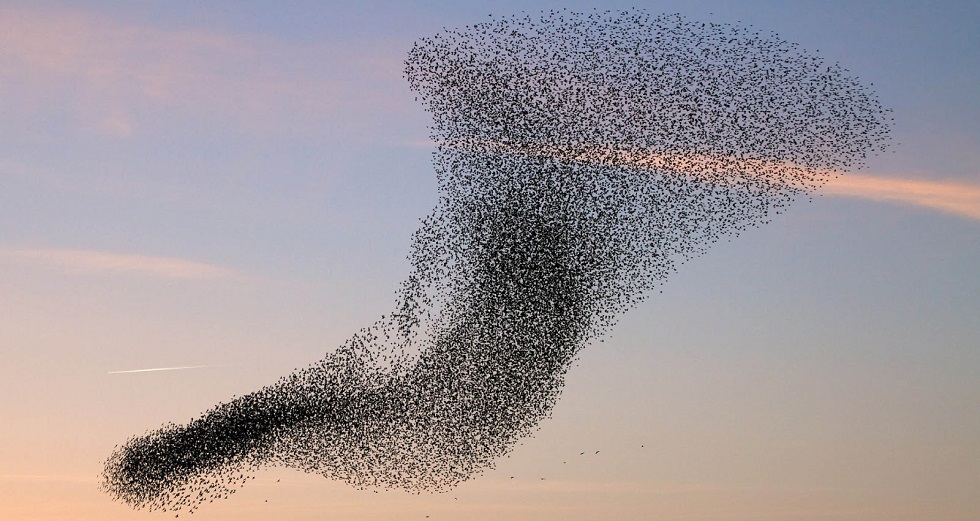
But even more profoundly, there is a recognition that the intricate maelstrom of relationships that make a person possible, are based on the same universal principles that make possible all of the universe. I mentioned complex systems theory before, and it is apropos that one important series of studies in complexity theory has been on the movement of birds in flock behavior. It is a study of how higher orders of complexity and coordinated operations arise spontaneously from simpler interacting components. These are the very principles that underlay not only bird flocks, but hurricanes, galaxy formations, living organisms, societies, and persons themselves. That means, when I breathe in and out, that motion of air is happening for the same ultimate reason the wind moves through the trees, or the waves of the ocean crash upon the shore. So, comparisons of those found in Frye’s poem are more than mere analogy or metaphor.
The Divine Flux
These are the aspects of nature that caught the eye of early Taoist thinkers. They lend themselves to the Stoic notion of the Divine Fire – that tumultuous flux and inherent creative force out of which all things rise. The Stoics knew that to live in accordance with Nature meant, among many things, to understand deeply that those things which bring death are the very same things that make life and all the things from which we benefit possible. This is the Logos — the pervasive underlying rational order on which the universe is based, and which can be found in persons as well. Like complexity theorists today, Heraclitus knew we could not step twice in the same river because it is in a constant state of replacement, and the Buddhists teach us to lie in that river and, instead of grasping at every attachment that passes our way, experience the bliss of the moment as it flows by us, always letting go and ready for what lies ahead.
And, if persons are patterns, then patterns repeat, and in more ways than merely the meme. Through their actions and interactions in life (what Buddhists call karma) people are like the Chaos Theory thought experiment of the butterfly that can affect the course of a hurricane. Our loved ones create causes and effects which ripple outward in uncountable and unimaginable ways that cannot be contained. Just one of those ways is in their impressions upon us, which recreate similar patterns in our minds through communication and our deep knowledge of them. Thus, if naturalists remain consistent in their definition of the essence and end of personhood within a complex causal world, then it is true our loved ones are not in the grave. We, quite literally, carry a part of them within us, and so on to others. If that is so then, as Mary Frye says, in many important ways they did not die.
The author

DT Strain is a Humanist Minister, certified by the American Humanist Association (AHA) and a Spiritual Naturalist. A writer for the Houston Chronicle, and other sites, Rev. Strain speaks and writes on a wide variety of philosophic concepts and participates in several organizations. He is an enthusiast of Stoicism, Buddhism, and other ancient philosophies; seeking to supplement modern scientific and humanistic values with these practices. As such, he often attends the Jade Buddha Temple, writes on Stoicism, and organizes the Humanist Contemplatives Houston Meetup group.
Strain is former president of the Humanists of Houston (HOH), and has served as vice-chair on the Executive Council of AHA’s Chapter Assembly, on the Education Committee of the Kochhar Humanist Education Center, and as a member of the Stoic Council at New Stoa.
His writings have appeared in magazines, newsletters, and in the AHA national publication “Essays in the Philosophy of Humanism”. He has been a guest speaker on the Philosophy of Religion panel discussion at San Jacinto College. Rev. Strain has also appeared as a panelist on the Houston PBS television program, The Connection, discussing religious belief and non-belief.
DT Strain is the founder of The Spiritual Naturalist Society, a new organization that cuts across traditional lines, and bring together naturalistic Humanists, Buddhists, Pagans, Jews, Taoists, and more. It’s purpose is to spread awareness of spiritual naturalism, and provide a place for education and fellowship for spiritual naturalists.
This Wednesday
This Wednesday, we conclude our early autumn theme of “Finding Meaning” with Debra Doggett: “As seen from the sky”.
The theme for late autumn here at HP is “Death and Life”. Send your writing and art to humanisticpaganism [at] gmail.com by November 6, 2013.
What to look forward to in November at HP
21 days left for you to help HP place an ad at The Wild Hunt. Go to HP’s Indiegogo campaign to contribute.

Photo by Laura Stevens
This month, we conclude our theme of “Finding Meaning”, and with the Autumn Cross-Quarter on November 7, we begin our new theme of “Death and Life”.
This Month at HP
Nov 3 “Even naturalists don’t stay in the grave” by D.T. Strain
Nov 6 “As seen from the sky” by Debra Doggett
Nov 7 Autumn equitherm/cross-quarter
Nov 7 New theme begins: “Death and Life”.
Nov 10 “Ghost story” by Ken Apple
Nov 13 Mid-Month Meditation: “Panthea” by Oscar Wilde, read by Annika Garratt
Nov 17 “Seasons and heartbeats” by Brock Haussamen
Nov 24 “Thoughts on Death and the Afterlife” by NaturalPantheist
Nov 27 Postpagan Ceremony & Ecology by Glen Gordon
Humanistic Paganism Calendar for October
Nov 3 First Sunday in November Daylight Savings Time ends in U.S.
Nov 3 Hybrid solar eclipse [external link]
Nov 7 Autumn equitherm/cross-quarter
Nov 8 Cosmic Calendar: First complex cells (eukaryotes) emerge 2 bya
Nov 9 Carl Sagan’s birthday
Nov 16 International Day of Tolerance
Nov 21 (third Thurs) World Philosophy Day
Nov 24 Spinoza’s birthday
Nov 25 International Day for the Elimination of Violence Against Women
Nov 28 Comet ISON makes its closest approach to the Sun* [external link]
Nov 30 John Toland’s birthday
* The newly discovered comet ISON will make its closest approach to the Sun on Nov. 28. If the comet survives its encounter with the Sun, it could be one of the brightest comets in recent memory. Some astronomers estimate that it could even be bright enough to be seen during daylight hours. In October it will start to be visible to the naked eye and will continue to get brighter until November 28. If the comet survives, it will be visible in the early morning and early evening sky and could be nearly as bright as the full Moon. Some astronomers are calling it the “comet of the century”.
Buy Godless Paganism (paperback)

Buy Godless Paganism (ebook)


Pagan Coming Out Day – May 2nd