 Naturalistic Paganism
The HPedia: Pagan
Your help is needed! Please critique this entry from the HPedia: An encyclopedia of key concepts in Naturalistic Paganism. Please leave your constructive criticism in the comments below.
There are generally four different uses of “Pagan” floating about, in order from most restricted to most broad:
- Someone belonging to a range of contemporary religions/spiritual paths inspired by pre-Christian Indo-European or Mediterranean traditions, though not necessarily attempting to recreate them exactly as they were. This meaning can be more precisely denoted by “Contemporary Pagan” or “Neopagan”, but Pagan rolls off the tongue better and serves as a nice shorthand.
- Someone belonging to such a contemporary religion or a historical person belonging to said pre-Christian Indo-European/Mediterranean traditions from those times, e.g. Roman polytheists of Classical times, Norse, Greeks, Egyptians, Indians, etc. This usage is somewhat anachronistic as the ancient peoples did not call themselves Pagan but were called that derogatorily by Christians in the late Roman era. Nevertheless, the term has been reclaimed by moderns and now serves to emphasize the link between those moderns and their spiritual ancestors.
- Someone belonging to a contemporary religion or path which shares certain things in common with Neopagans, such as an earth-centered nature-based path or an interest in the Occult. E.g. Gaians might be covered under this meaning.
- Anyone belonging to a non-Abrahamic religion.
HP used to use “Pagan” to refer primarily to the first two, and sometimes a little more inclusively to include the third, with the fourth being considered too broad to be of much use. However, in 2013 popular opinion found this usage unnecessarily restrictive, so “Pagan” has now opened up to include the fourth meaning.
Halstead has analyzed Contemporary Paganism in terms of three partially-overlapping centers of interest, resulting in some tension and conflict in the community:
- The Three Centers of Paganism (adapted from Halstead)
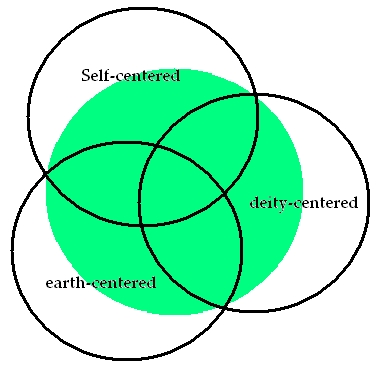
Recently, controversy has raged over the definition of “Pagan”, mainly as a matter of identity in the community. Essential characteristics, as well as who/what to include or exclude have been central issues. There have been notable debates over the appropriateness of Atheist Pagans and “Christo-Pagans” under the Pagan umbrella.
Check out other entries in our HPedia.
Truth and compassion: Which takes priority?

When push comes to shove, which do you value more – truth or compassion?
– by B. T. Newberg
In a recent guest post at The Friendly Atheist, Marcus Mann posed a question:
“I have to ask to what degree correctness crowds out other values important to me, particularly that part of me that strives to be kind… atheists need to be wary of valuing correctness over the much more important values of kindness, sobriety, and pluralism.”
In that spirit, I want to ask: Which is more essential to you, truth or compassion?
By truth I mean factual accuracy, fidelity to reality, or tracking what’s objectively “out there.” I realize there are other kinds of truth, such as poetic truth, but today let’s stick to factuality. By compassion I mean non-suffering, non-harm, or the promotion of well-being for others and yourself.
Most of the time these two enjoy happy agreement, but occasionally they may conflict. In those cases, which takes priority?
Precedents in Paganism
The priority of truth in Paganism has precedent. For example, the myth of matriarchal prehistory, though important to many and no doubt painful to give up, has largely been discarded. So have many of the more fantastical notions about our past, thanks in no small part to the work of Reconstructionists. Many polytheists today value accuracy of historical fact over fanciful invention, no matter how warm and fuzzy it may make one feel. They draw a line (rightly, in my opinion) at the reality of the gods beyond which they will fight for their views vociferously.
The priority of compassion also enjoys precedent. The principle of non-harm, encapsulated in the popular counsel “Harm none, do as you will”, puts the wellbeing of others on center stage, alongside the freedom to pursue one’s path regardless of what others may think. Buddhism is also well-known for making compassion, alongside wisdom, one of its highest values. Read More
Love a Tree Day
 Today, May 16th, is Love a Tree Day.
Yes, it’s a real holiday (what a great idea, eh?).
Check out a list of the five best ways to celebrate Love a Tree Day.
The HPedia: Nature
Your help is needed! Please critique this entry from the HPedia: An encyclopedia of key concepts in Naturalistic Paganism. Please leave your constructive criticism in the comments below.
This often taken-for-granted term is by no means easy to define. Yet, since it fills a crucial role in naturalism by designating the realm of the natural, over and against the ream of the supernatural, it demands articulation.
Generally speaking, the myriad popular definitions of nature can be broken down into three broad categories:
- that which is (perceived to be) beyond human influence; i.e. the non-artificial
- that which is other than the realm of God or gods; i.e. the non-supernatural
- all that is; i.e. the cosmos in its entirety
This poor and unsatisfactory formulation provides at least a starting point for making sense of the uses of “nature.”
Mainstream science, as well as naturalism, generally follows the third definition, but with an explicit exclusion of supernatural causes related to the second definition. Western religions (mainly Abrahamic) generally follow the second definition.
However, this split doesn’t do justice to common Pagan conceptions of nature (of which there are many, but for the moment we’ll focus on a highly typical view). Pagans commonly consider deities entirely natural, even if outsiders might call them supernatural. For example, see the position of Star Foster (who no longer identifies with the “Pagan” label, but did at the time of her writing). An exploration of the complications of this position on nature is available here. Parallel with the question of deities is that of magic, which Pagans may also consider natural, though not yet discovered by science (for example, see Bonewits).
The disagreement may result from the legacy of traditional Abrahamic mythologies, in which a transcendent God creates nature and remains distinct from it (supernatural). Mainstream Western science and naturalism historically emerged from within an Abrahamic paradigm and still bears that mark, even though it no longer invokes supernatural causes such as a transcendent Creator. Pagan mythologies, by contrast, generally portray nature as self-existing, with the gods emerging from it. Thus, the gods, coming from nature, would seem to be natural. Magic, too, is portrayed as within nature. Yet the result is a nature populated by beings and energies which a) appear in many respects similar to those commonly considered supernatural through an Abrahamic lens as well as through a mainstream scientific one; b) have not been verified or falsified by scientific investigation; and c) may in principle be incapable of verification or falsification by science.
This suggests the key difference between common Pagan and mainstream scientific concepts of nature may be a question of method: must a thing be open, in principle, to scientific investigation for it to be considered natural? If evidence for it comes instead from some kind of mystical or magical intuition, or from claimed direct experience which is not verifiable by a third party, is it therefore supernatural? The question is all the more complicated since it may pose difficulties for some phenomena which most philosophers of science would probably like to be included in nature, such as consciousness, that have not yet acquired a scientific explanation which satisfies a consensus (see hard problem of consciousness).
Despite these complications, this cannot be considered a case of equally-likely competing theories. The mainstream scientific view can base its claims in systematic investigation among a wide array of experts with multiple avenues of evidence mutually converging on a picture of the world that tends toward consilience across disciplines; and though scientists are as fallible as any humans, a system of rigorous peer critique endeavors to reduce human bias as much as humanly possible. The common Pagan view of deities and magic, by contrast, is generally supported by claims of direct experience and anecdotal evidence, with (to my knowledge) no systematic means of verification or falsification as of yet, and no systematic means of reducing bias as far as possible (while there is no dogma against rigorously critiquing another’s beliefs or magical claims, neither is it necessarily welcomed). Thus, it would appear the probable truth-content deriving from the mainstream scientific view and the common Pagan view is unlikely to be the same.
In any case, naturalistic Pagans tend toward a position consistent with mainstream science rather than the common Pagan position outlined above. Indeed, this is one of the defining features that set naturalistic Pagans apart from many other kinds of Pagans.
The ancient Greeks conceived of nature as physis, from which we derive our words “physics” and “physical.” For the Greeks, physis referred to a thing’s origin and development over time.
Nature can be an object of naturalistic transcendence, insofar as it is greater than the individual in both degree and kind, even as the individual participates in it. In this case, the reference is not to transcendence of nature, but rather to transcendence as nature, i.e. the individual’s realization of his or her full participation in the natural world. Nature is one of the “Three Transcendents”, along with community and mind.
See also “Deity”, “Supernatural”, “Three Transcendents”, and “Transcendence.”
Check out other entries in our HPedia.
Participatory reverence, by Hypatia’s Girl

“I find it in the endless ebb and flow of seasons, in the waxing and waning of the moon. A reverence and a resonance.”
Magic is the art of changing consciousness at will – Dion Fortune
My relationship with religion has always been… fraught. To be more specific, my relationship with systems of belief has always been complicated. From the beginning, from my nice, Catholic baptism where I, to hear my mother tell it, spent the ceremony happily blowing raspberries at the priest.
Trying to believe
Which isn’t to say that I haven’t tried to believe. When I was in grade school we went to church. I went to Sunday school, got my First Communion and First Reconciliation. I learned my catechism. And I tried to believe.
I have a vivid memory of kneeling at a pew, during mass trying so hard to pray. Closing my eyes and picturing my heart with perforations that would break open and let Jesus in. But I never felt anything. I can remember, as well, the profound sadness at my failure. And I can remember looking at the other parishioners, dressed in their Sunday-best, kneeling at their pews, with their eyes closed, praying. And I wondered if they were just acting. I knew that I was. Read More
Buy Godless Paganism (paperback)

Buy Godless Paganism (ebook)


Pagan Coming Out Day – May 2nd
 Naturalistic Paganism