Naturalistic Paganism

“Four strategies for naturalizing religion” by David Chapman

David Chapman discusses four strategies by which religion can be naturalized. He uses Buddhism as an example, but his discussion applies well to any religion. As you read, think about which strategies, or combination of strategies, Humanistic and Naturalistic Pagans might use most profitably.  (Note: This essay originally appeared at David Chapman’s blog, Meaningness.)

I’ve noticed four strategies for “naturalizing” a religion—for making it compatible with the scientific worldview.

Two strategies get rid of supernatural aspects: ignoring and denying. Two other strategies reinterpret supernatural aspects in natural terms: psychologizing and mythologizing.

My aim is to naturalize Buddhist tantra, but these apply to any religion. The innovators who naturalized Sutrayana (mainstream Buddhism) used all four strategies. All four can be useful for Vajrayana (tantric Buddhism) too.

Interestingly, the first two strategies correspond to the fundamental method of Sutrayana: renunciation, or rejection of harmful stuff. The second two correspond to the fundamental method of Vajrayana: transformation of harmful stuff into helpful stuff. This makes me think reinterpretation strategies may be particularly useful in naturalizing Buddhist tantra.

Renunciative strategies for naturalization

Modern Buddhism simply ignores most supernatural parts of traditional Buddhism. Teachers rarely mention the Pali Canon’s discussions of the magical powers attainable through meditation, like walking on water. As long as students don’t know or don’t care about these, it’s mission accomplished.

Most of the supernatural parts of traditional Vajrayana can also just be ignored. For example, some tantric scriptures are full of spells for practical magic, like how to fly on the back of a vampire by drawing a magic symbol on its chest. Probably nothing needs to be said or done about this, because no one is going to ask “can you really do that?”

When a question about the supernatural does come up, it can be denied explicitly. All modern teachers will deny that hell is a cave, inhabited by demons, that you could get there by digging in the ground—although Buddhist scriptures clearly say so.

To naturalize Vajrayana, we might issue a blanket denial of all its supernatural traditions, and reconstruct it without any mention of them. That would be the hardline approach. We’d get a squeaky-clean, sleek, modern religion that way—which many people might like.

Is this possible? From a naturalistic point of view, if Vajrayana practices work, they work naturally. Perhaps they don’t work at all—but I think they do. So I believe a “renunciative” approach, rigorously purifying the religion of all contaminating hints of the supernatural, is possible. In later posts, I’ll sketch how this might work.

This might be the most broadly-accessible presentation for modern Vajrayana. It is not my preferred option.

Some might say removing all mention of the supernatural throws the baby out with the bathwater. I’d say it is more like a stew. If you fish the potatoes out of the pot and wash them off carefully, you’ll have an edible meal—but the potatoes by themselves are not very tasty, and you’ll waste most of the stew’s nutritional value.

Psychological transformations

Psychological transformations of Buddhist traditions are common, in both Sutrayana and Vajrayana. For example, Lama Tsultrim Allione’s Feeding Your Demons is a psychological reinterpretation of the tantric chöd practice:

[A] demon might be addiction, self-hatred, perfectionism, anger, jealousy, or anything that is dragging you down, draining your energy. To put it simply, our demons are what we fear… anything that blocks complete inner freedom is a demon.

In general, we can reinterpret tradition’s external, supernatural entities as internal, mental ones. This may have great value for modern people, because we find ourselves shattered into fragments that can be hostile and uncommunicative. (That is much less true for people in traditional societies.) We can translate supernatural realms (such as the heavens and hells) into psychological states or ways of being. Supernatural powers and mysterious forces become metaphors for emotional energies.

There’s no obvious reason this should work. Why would concepts and practices concerning imaginary external beings prove useful when applied in an entirely different domain?

Some say it is because the supposed demons were always internal: tradition misunderstood mental phenomena as supernatural ones. Shamanic systems such as Vajrayana were primitive forms of psychotherapy. They developed methods by trial and error that may be powerful and useful, despite their total misunderstanding of what they were up to. I’m somewhat skeptical about this explanation; it’s too tidy.

In any case, it’s more important to know whether these psychological transformations work than why. Many people’s experience—including mine—suggests they do. Still, I’d be happier with stronger evidence than anecdotes.

Mythologizing

The fourth naturalization strategy is to declare supernatural parts of Buddhism to be myths: religious fictions. Mythologization is close to my heart, and I believe it has enormous potential. It’s a complex topic, and little understood in modern Buddhism, so I’ll say a bit here, and more in future posts.

Myths are stories about religiously significant events that did not actually happen, usually involving people who did not actually exist. As statements of objective fact, myths are false. That does not mean they are worthless.

Christianity (especially modern Protestantism) is obsessed with the claim that its mythology is actually true—and that’s what makes Christianity special. Westerners unconsciously transfer this silly idea to other religions. Having realized the Christian myths are untrue, they go looking for true ones. This misses the point. Truth and belief are irrelevant for most religion.

Novels, dramas, and paintings are not true, but the best have great aesthetic value. Myths are not true, but the best have great religious value. Religious and aesthetic value are not the same, although the best myths have both. Myths are not mainly entertainment, although they may be that too.

Myths unclog energy by provoking wonder. “Wonder” is the union of passionate interest and open receptivity. I have defined the path of tantra as “unclogging energy by unifying passion and spaciousness”—so you can see why myth is particularly important here!

You do not need to believe in magic to be inspired, moved, and perhaps permanently transformed by The Lord of the Rings or Star Wars. Their creators were both deliberately making modern myths. These fictions are major influences on many people’s spirituality—though not many recognize that.

Still, both have limited religious impact—and not only because they are taken to be mere entertainment. The religious/philosophical ideas their authors used as backgrounds to their stories were limited and muddled.

In following posts, I’ll explain that myths, as stories about people doing things together, are particularly important for tantra—which is about how to do things together. And I’ll explain ritual as the enactment—the doing—of myths, so they are felt in the body.

The Author

David Chapman


I write several web sites about Buddhism, society, and what might be called philosophy.

Each of these sites presents the same set of ideas, but in radically different styles, for different audiences.

Those style differences make it difficult to write a biography for myself. Indeed, one of the main ideas I explore is the fluid, ambiguous nature of self-ness. Since we are all also subject to extensive delusions about ourselves, probably you can learn more about me from reading my Buddhist vampire romance than from any supposedly non-fictional account I might give.

Nevertheless…

Describing myself as a Buddhist, engineer, scientist, and businessman, I have a short biography on my Approaching Aro site.

And as a pop spiritual philosopher: Ken Wilber, my colleague in that endeavor, has writtena psychedelic novel which may be about my early work. I have written a psychedelic commentary on it. Whether Wilber’s book is about me or not, my commentary discusses that work in some detail.

To avoid spam, I’m not posting an email here, but if you use this web contact form, I’ll email you back.

You can also find me on Twitter and Google+.

The Wheel of Evolution, by Eric Steinhart: Litha

Today, we introduce a new column, The Wheel of Evolution by Eric Steinhart. Dr. Steinhart draws on his philosophical background to create a naturalistic foundation for the Pagan Wheel of the Year.

Goryu Dake peak, Japan

At Litha, the power of the sun reaches its maximum. Litha therefore signifies the prime of life, the climax of cosmic complexity. As far as we can tell, we are the most sophisticated things to evolve in the universe. Of course, this happy self-assessment needs to be tempered by the recognition that our existence is merely an evolutionary accident. We are not the goal of the cosmos. Furthermore, it seems likely that our universe either already contains or will contain forms of life far more complex than humans. If we ever learn about them, we will need to revise our assessments of ourselves. But until then, it is reasonable for us to provisionally situate ourselves at the peak of cosmic evolution.

The beginning of Litha signifies the prime of humanity, and therefore marks the transition from waxing to waning. After the Summer Solstice, at least as far as we are concerned, the wheel of cosmic evolution begins to roll downhill. The light declines. But Litha takes its place on the wheel in sacred time, and we do not know its location in profane time. Perhaps we have already passed our prime. Pessimists say we have already wrecked our future. Global climate change and environmental degradation now spell an irreversible degeneration. But perhaps these pessimists are wrong. Perhaps we will not reach our prime for hundreds or thousands of years. Optimists say we will continue to flourish and thrive for a long long time. Since we cannot presently know when humanity will reach its prime, and since human civilization has reached a very advanced state of progress, it seems appropriate to let Litha stand for the present human age, right now.

The ascent of humanity comes at the expense of many other forms of life. We are now almost certainly causing the sixth great mass extinction. Our progress entails massive suffering across the whole earthly ecosystem. We kill both individual organisms as well as entire biological species. The death of the last member of some species entails the loss of the value of both that last organism and its biological form. The dying organism makes its axiological demands*: it demands to continue to live, to reproduce, to flourish. But the dying species, immanent in the dying organism, also makes axiological demands. Reproduction aims at infinity; so every species demands to be eternally instantiated. Every axiological demand selects a set of possible universes, universes in which it is satisfied. So every dying species selects the set of possible universes in which it flourishes.

At the climax of humanity, the earth has clothed itself with suffering. All the cruelties which human animals have inflicted on themselves and on others protrude abstractly from our earth, and from our universe, like the painful spikes on a cactus. But these painful spikes blossom into flowers, whose seeds are utopias. Our universe is a plant, whose utopian seeds contain the genotypes of better possible universes. Or, better yet, our universe is a nest, designed and created by a divine phoenix, on fire and burning out, and its utopias are its feathers. These glowing feathers, sparks lifted by the axiarchic* wind, come to rest on the higher slopes of Mount Improbable. From each of these feathers, a greater phoenix will be born, a brighter bird more divine, which will build its own new nest.

*Axiarchism is a philosophical theory which states that reality is ultimately defined by some kind of value. The demands made by value are axiological demands. An axiological demand is a proposition whose truth follows from the nature of the thing which makes it.


The Author

Eric Steinhart is a professor of philosophy at William Paterson University. He is the author of four books, including Your Digital Afterlives: Computational Theories of Life after Death. He is currently working on naturalistic foundations for Paganism, linking Paganism to traditional Western philosophy. He grew up on a farm in Pennsylvania. He loves New England and the American West, and enjoys all types of hiking and biking, chess, microscopy, and photography.

Summer Solstice

Today is this summer solstice.

Bart Everson of A Celebration of Gaia observes how those in the United States have forgotten the meaning of the summer solstice:

“Sadly, most Americans are ignorant of this seasonal moment. We seem marginally more familiar with the winter solstice, probably because of the vast commercial pressures that have accreted around that time in late December. Even so, most of us remain unaware that the winter solstice, our time of maximum tilt away from the sun, is the inverse, the opposite, the antithesis of the summer solstice. Six months removed from one another, we might regard these two celestial events as antipodes, points on opposite sides of a circle representing the cycle of the seasons.

“The poetics of the winter solstice are perhaps slightly better understood in our popular culture: the birth of light in the depths of darkness. What, then, are the poetics of the summer solstice? If it is truly the inverse of the winter solstice, then it stands to reason that it must be the birth of dark at the peak of lightness, or the dying of the light at its very summit.

“Perhaps this is why Americans have forgotten the summer solstice and the Midsummer holiday. We love summer, with its connotations of fun in the sun and trips to the beach. You’d think we’d be interested in celebrating this moment when the sun is at its zenith. But at this moment of the sun’s greatest power, it begins to decline, to wane, to die. There’s something subversive about recognizing this, something almost offensive to our national character. Our nation is caught up in a fantasy of endless growth and constant improvement. Acknowledging limits established by nature goes against our grain”

The Summer Solstice is known in Contemporary Neo-Paganism as Litha or Midsummer. Neo-Pagan mythology often marks this as the moment the sun god meets his death, though sometimes that event is reserved for the cross-quarter in August or the autumnal equinox in September.

Glenys Livingstone of PaGaian Cosmology writes:

“This is the time of Summer Solstice – the time when the light part of the day is longest. In our part of the world, light is in Her fullness. She spreads Her radiance, Her fruits ripen, Her greenery is everywhere, the cicadas sing. Yet as Light reaches Her peak, our closest contact with the Sun, She opens completely, and the seed of darkness is born.

“As it says in the tradition, this is the time of the rose, blossom and thorn, fragrance and blood. The story of Old tells that on this day Goddess and God embrace, in a love so complete, that all dissolves, into the single Song of ecstasy that moves the worlds. Our bliss, fully matured, given over, feeds the Universe and turns the wheel. We join the Beloved and Lover in the Great Give-Away of our Creativity, our Fullness of Being.”

To symbolize this, Livingstone distributes flowers, fruit, and the like to ritual participants, who then give away this bounty by casting it into the central fire.

NaturalPantheist of the Nature is Sacred blog recites the following from ADF Solitary Druid Fellowship ritual on this day:

“As I stand here on this celebration of Litha, the sacred wheel of the year continues to turn. As my ancestors did in times before and my descendants may do in times to come, I honour the old ways. This is the time of the Summer Solstice, Alban Heruin, the Light of the Shore. On this longest day of the year, when the warm sun has reached its height and the world around me is abundant and green, it is time to honour great Sol as it shines down brightly upon the earth. In the midst of the warmth, light and beauty of the summer sun, it is a time to look forward and to anticipate the coming harvest as the days begin to shorten and we head once again towards winter. I give thanks for the blessings of the great star.”

Jon Cleland Host of the Naturalistic Paganism yahoo discussion group suggests kayaking local rivers or lakes, hiking in the woods, and holding a ritual in the forest. He also takes this as a time to celebrate marriage, as well as to consume mead:

“Mead is often consumed – celebrating the honey of our marriage and the season. Mead is honey wine, and the full moon closest to Litha is traditionally called the mead moon or the honey moon (hence the name “honeymoon” for the vacation after a wedding).”

Áine Órga of HeartStory.org writes how the summer solstice is a time for harnessing the energy of the season:

“I often conceive of life as being a wild and dangerous dance. It starts slow, speeds over time, careening wildly, until it gradually slows from exhaustion, and finally dies. This pattern is visible in human and animal life, but also in the changing seasons on Earth, and throughout Cosmos as stars and planets are born, collide, and die, only to be reborn again.

“The Summer Solstice is the peak of the dance. It is that time in your time, that moment on Earth, those millennia in the life of a star, when performance and creativity are at their most prolific. It is the time when dreams are manifested, art created, offspring born.

“Beyond it is the inevitable spiral back down. But right now is the time to dance.”

A Pedagogy of Gaia, by Bart Everson: “Flowers to Flame”

What can we learn, and how can we teach, from the cycles of the Earth — both the cycles within us, and the cycles in which we find ourselves?

This essay was first published at Celebration of Gaia.

For Glenys

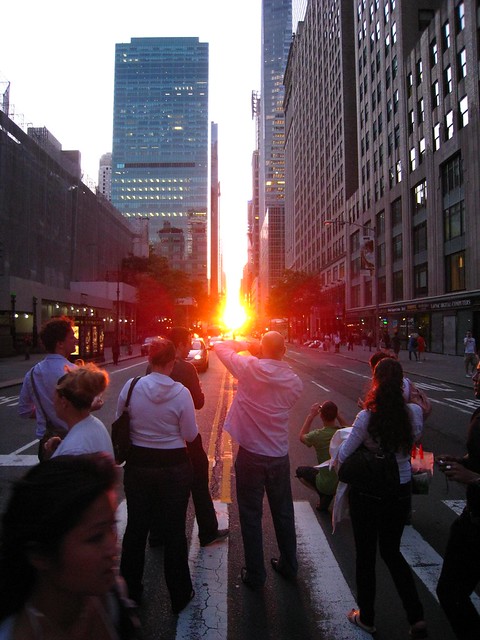
Manhattanhenge

American Midsummer

We all notice seasonal variation, yet most of us can’t account for it. It is perhaps the most common scientific misconception. Contrary to popular belief, we do not experience summer because the Earth gets closer to the sun. It’s because the Earth is tilted on its axis. When our hemisphere tilts toward the sun, we get more light and things warm up and we call that summer. Our planet does not actually rock back and forth on its axis; it only seems that way, maintaining the same tilt as it revolves around the sun. That point of maximum tilt toward the sun occurs in late June for the northern hemisphere. It’s the summer solstice, also known as Midsummer.

Sadly, most Americans are ignorant of this seasonal moment. We seem marginally more familiar with the winter solstice, probably because of the vast commercial pressures that have accreted around that time in late December. Even so, most of us remain unaware that the winter solstice, our time of maximum tilt away from the sun, is the inverse, the opposite, the antithesis of the summer solstice. Six months removed from one another, we might regard these two celestial events as antipodes, points on opposite sides of a circle representing the cycle of the seasons.

The poetics of the winter solstice are perhaps slightly better understood in our popular culture: the birth of light in the depths of darkness. What, then, are the poetics of the summer solstice? If it is truly the inverse of the winter solstice, then it stands to reason that it must be the birth of dark at the peak of lightness, or the dying of the light at its very summit.

Perhaps this is why Americans have forgotten the summer solstice and the Midsummer holiday. We love summer, with its connotations of fun in the sun and trips to the beach. You’d think we’d be interested in celebrating this moment when the sun is at its zenith. But at this moment of the sun’s greatest power, it begins to decline, to wane, to die. There’s something subversive about recognizing this, something almost offensive to our national character. Our nation is caught up in a fantasy of endless growth and constant improvement. Acknowledging limits established by nature goes against our grain. Quite frankly it gives us the willies.

Elsewhere things are different. Midsummer is still the second biggest holiday of the year in the Nordic countries, especially Sweden and Finland, and also in Estonia and Latvia. (Yule may be bigger, but the Midsummer celebrations are more distinctive.) In Britain a certain bard wrote a rather famous play set on Midsummer Night. Also famous is the monument known as Stonehenge, which marks several astronomical events but seems to be primarily oriented to the summer solstice. It is one of many monuments around the world which honor the day. If ancient people shared our qualms, it did not stop them from observing the solstice. And there are indications that this is slowly changing in America now, as with every year various communities and municipalities are rediscovering the holiday and celebrating it in diverse fashions.

Hot Summer Sun

The Day of Days

And how can we characterize the day itself? To us on the surface of the planet, it seems that the sun is rising ever higher in the sky, and on this day it reaches its highest point, seeming to stand still in its march across the sky. (The word solstice derives from Latin for sun standing.) The days have been getting longer, but this is the longest day of the year. If you like natural light, rejoice. This day has more of it than any other — provided the weather cooperates, of course. In New Orleans and similar latitudes, it’s over 14 hours from sunrise to sunset. Anchorage clocks in at 19 hours and 21 minutes. At the arctic circle, the sun stays up all day.

It is not difficult to make an association between summer and sunlight and life. We know that virtually all life forms on our planet are dependent upon energy received from the sun, either directly or indirectly. The summer season in general and the longest day in particular might be be said to represent or embody life in all its fullness. Indeed, our word day derives from the Old English dæg which also meant “lifetime.” It’s related to the Lithuanian dagas, meaning “hot season,” and the Old Prussian dagis, meaning “summer.” Today we recognize at least two distinct meanings for the word “day.” It refers to the 24-hour period, of course, but that’s a relatively recent definition. The older meaning, still with us, is “the daylight hours,” the opposite of night. These associations suggest that Midsummer might well be regarded as the ultimate day of the summer season, the day of life, the day of days.

Sometimes we might complain about all this energy the sun sends our way, especially if we get sunburnt or overheated. But the truth is we capture only a tiny fraction of the sun’s awe-inspiring energy. Only about one-billionth of the sun’s energy enters earth’s atmosphere. Even so, this tiny fraction of solar energy is so vast that just one year’s worth is equivalent to all our planet’s non-renewable resources: all the coal, all the oil, all the natural gas, all the uranium. Combined. We seem bent on consuming these resources as quickly as possible; when they’re gone, the sun will still be shining. Midsummer is the propitious time to recognize and celebrate this superabundance of energy, to consider what it means for for us and how we might respond.

Yet it would be facile and simplistic to imagine that Midsummer is all about sunshine. Precisely at this supreme moment, at the very pinnacle of light and power, the decline begins. As Glenys Livingstone writes, “the seed of darkness is born.” How could it be otherwise? All extremes contain within them their opposites, necessarily, else they would not be extremes. This idea is enshrined in the sacred symbol of the Yin-Yang. In Chinese traditional medicine, Yin is held to begin with the summer solstice, when Yang is at its peak. In the light we find the darkness, in the masculine we find the feminine, in the heavens we find the Earth, in the fullness we find the void. Midsummer is also a time to reflect on this mystery.

sunflowers

Flower Power

Flowers are a fine symbol of summer. The sunflower especially comes to mind, with its solar petals and seeds of darkness. Calendula, verbena, elder flowers, St. John’s Wort and many others have been associated with the day. The rose in particular has been imbued with deep mystical significance. Perhaps it’s the combination of beauty, perfume, and sharp thorns. English folklore holds that a rose picked at Midsummer will stay fresh ’til Yuletide, at which point it may be used to magically divine a young woman’s future husband.

As the romantic floral connotations suggest, Midsummer has long been a day for love and lovers. According to some statistics, July and sometimes August have surpassed June for weddings in the United States, but this is a very recent phenomenon, dating since 2006, and may be more of an anomaly than a long-term trend. For centuries, June has been far and away the most popular month for weddings. The very name of the months derives from the Roman goddess Juno, queen of the gods but also goddess of marriage. This is the time to celebrate union, and not just the young, passionate, lusty desires of May, but also the more mature, stable, lasting commitment, the intimate, deep commingling of self and other.

There are few events more happy than a wedding, and no season so conducive to happiness as summer. Midsummer is a time to contemplate all the good things that make us happy. John Crowley writes in his sprawling novel Little, Big, “The things that make us happy make us wise.” (The book contains a fantastic Midsummer wedding scene.) Go out into wild nature if you can. Glory in the beauty of Gaia untamed, in the thriving vitality of life. Gather some wildflowers, inhale their fragrance, make a garland, dance, drink honey mead, take a nap. Let yourself dissolve in the warm bliss of the longest day.

Starhawk calls the it “the Give-Away time of the Sun.” The superabundance of solar energy that makes possible our ecosystem, the radiant light that sustains Gaia, the very web of life of which we take part: This is a gift. We enjoy all this richness freely, nor are we merely recipients of this beneficence. We also participate in it. Like the flowers, we can flourish, creating something new and beautiful. The Give-Away is not just to us, but of us.

Still Life with Fruit and Flowers; van Brussel (1787)

Creativity

The artist Annabelle Solomon has created a series of quilts based on the cycle of seasons. As part of this work she has mapped the creative process onto the seasonal cycle. According to her scheme, Midsummer corresponds to the time of “fruiting” or “coming into full form.” (Livingstone casts this as “realized creativity.”) This is when “light reaches the fullness of expression in the accompanying abundance” of life on Earth. She recognizes the solstice as a time to pause, reflect, and celebrate: “At this halfway point in the cycle, there is the momentary pause to admire the teeming fullness of life.”

Fruits become sweeter and softer and better for us to eat through the process of ripening. Enzymes within the plant called pectinases break down cell walls in the fruit, making it softer. Enzymes called amylases change the carbohydrates in the fruit into simple sugars, making it sweeter. Enzymes called hydrolases reduce the chlorophyll levels in the fruit, changing the color. We can tell a fruit is ripe by sight, touch, smell and taste. Who doesn’t love a ripe strawberry or juicy peach? We enjoy ripe fruit because the plant developed it for us, so that we animals would disperse their seeds.

All of these changes in the ripening process are triggered by ethylene gas. This is why placing certain fruits in a paper bag causes them to ripen more quickly. The fruit produces ethylene gas; the bag concentrates it. The fruit in the bag will ripen even more quickly if warmed by the sun. There’s a poetry here, perhaps, for the sun is also the source of the energy that grew the plant that bore the fruit. But then, the sun is the source for all our energy, including the energy it took to pick the fruit and put it in the bag, to say nothing of the manufacture of the bag itself. All creativity can be traced back to the sun, from the ripened fruit, to the work of the artist who paints the fruit — or eats it.

There’s a creative power at work in the plant’s transformation of solar energy into delicious fruit. Humans also have this power. We partake in a similar process. We don’t have to be professional artists to realize and celebrate our creativity. The key question for us is how we’re going to use it. We know what we’ve received. We can feel the diverse processes of nature flowing through our lives. But the outcome of our efforts is far less predetermined than the fruit of the plant. We might produce almost anything. What shall we do? What shall we make? What shall we give back? What shall we become? At the end of our lives, we become food for other life, if our bodies are allowed to decompose and return to the ecosystem. Should we not aim to contribute something at least that substantial before our inevitable demise?

And when the work is realized, ripened and consumed, we enjoy a momentary respite, a blissful relief from the churning cycle, a sweet release. Only by letting go do we discover the true purpose of our efforts. We only think we know what we’re doing as we plan and plot and scheme. Only in the living act, the undoubted deed, do we learn the truth.

Flame and Flower

Into the Flame

Bonfires are an age-old tradition for the summer solstice. Throwing flowers into those fires is also a tradition that goes back hundreds of years. The symbolism of such ancient rituals is multifaceted. Perhaps the act represents a way of offering the beauty of the Earth back to itself. Perhaps it represents the impending diminishment of the sun’s power. Perhaps the scent of burning petals is intoxicating. Try it yourself and see.

Flowers given over to flame. A day given over to love and dreams. A season given over to life and light. And what about us? We can be given over as well. We can give ourselves over. But to what? To what powers will we devote ourselves? What processes will we further?

Creation is not finished. The world was not wound up like clockwork by some divine watchmaker and left to ticktock forward on its own. Creation is ongoing, continuing to unfold and develop right now. And we are a part of it.

Consider our ancestors. If you’ve dabbled in genealogy, you may have traced your family tree back for several generations. If we were able to continue that process, going further back in time before the advent of written records, some ten thousand or so generations ago we would find our matrilineal common ancestor, the Lucky Mother from whom all living humans are descended. Yet further back in time — 600,000 years, a million years, 2.5 million years ago — we find ancestors who were not fully human but who were very close, represented by such skeletal remains as Boxgrove Man, Turkana Boy and Twiggy. 15 million years ago we find our ancestors in the great apes. About 60 million years ago we find Purgatorius, a little tree-dwelling mammal, the probable ancestor of all primates. Before that we have the first mammals coming from the cynodonts, who in turn came from the earliest mammal-like reptiles, the synapsids, some 250-odd million years ago. And we can continue back 390 million years ago to the appearance of four-limbed vertebrates, the tetrapods, the earliest of which were probably aquatic. 530 million years ago we find Pikaia gracilens, a leaf-shaped creature swimming in the waters of the Precambrian period, which may well have been the ancestor of all modern vertebrates. Further still: acorn worms, flatworms, sponges, back to one single-celled organism that lived 3.5 billion years ago — a single simple cell from which all we are all descended.

When we were children, the world and humanity may have seemed like permanent fixtures. Once we gain an understanding of history, we learn just how much things have changed. What does all this past portend? It would be the height of foolishness to suppose that it’s all ground to a halt in our modern moment. Indeed not. We humans can no more stop the continual flux than we can stop the solar furnace. Yet we’re not mere jetsam buffeted by the stream. We have a unique ability to shape our own future. This is the ultimate question for our species. Whither humanity?

The challenges before us seem immense, but we cannot allow ourselves to be paralyzed by fear. Instead, let us emulate the natural processes of the Earth. Start small. Plant seeds. Plant deeply, wisely, and well. Nurture the new growth that emerges.

Start with the self. As within, so without. Our own self-realization will not transform the world, nor need we achieve some imagined inner perfection before we can take action. But it’s a good place to begin. As Gandhi said, “We but mirror the world. All the tendencies present in the outer world are to be found in the world of our body. If we could change ourselves, the tendencies in the world would also change. As a man changes his own nature, so does the attitude of the world change towards him. This is the divine mystery supreme. A wonderful thing it is and the source of our happiness. We need not wait to see what others do.” Let the transforming fire flower in our hearts, and spread.

The gate to summer

The Ω Gate

Here, in the hills of ages
I met thee face to face;
O mother Earth, O lover Earth,
Look down on me with grace.
Give me thy passion burning,
And thy strong patience, turning
All wrath to power, all yearning
To truth, thy dwelling-place.

— Julian Grenfell

Modern humans have achieved a remarkable independence from some natural cycles. We may experience this as liberating or crippling or both. Yet however alienated we may be from the natural rhythms and cycles of the Earth and our biology, however artificial our lived environment of climate-controlled cityscapes may seem, we remain inextricably and undeniably a part of the web of life here on our planet. It’s a plain, simple, profound fact, a truism so basic that we may easily forget it in the hustle and grind of our daily lives. Yet on occasion this reality is made manifest, the evidence becomes evident, the truth we’ve always known becomes clear, and we meet the Mother “face to face.” Such meetings may be terrifying or empowering or both.

Midsummer is a time to celebrate such encounters, to commune with nature, to enter into communion, to celebrate our mutual participation through an act of sharing, an intimate fellowship, a closer rapport. You may wish to share your feast with family, friends, strangers and the Earth, as we mark our revolution around the sun.

It’s the nature of cycles that they have no beginning or end. They simply loop back on themselves again and again. A helix is more accurate than a loop, for each iteration of the turning is different than the one before or after. As humans we find ourselves compelled to mark the turning in some way, to say here, now, again. Here we are now again. All holidays serve this purpose, and thus any one is a candidate for marking the new year. Our calendar marks the turning of the year shortly after the winter solstice, at the end of December. Yet a case could be made for the summer solstice as the best time to mark the new year. The ancient Egyptian new year began around this time. In the modern West, the academic year gives form to a good portion of our lives, beginning in the fall and ending in the spring. The summer forms a natural break, a time for vacation and recreation. To vacate and recreate: to leave the old behind and make a new self.

Glenys Livingstone observes that a fitting symbol for this day is the final letter of the Greek alphabet, the omega, which resonates on many levels. The letter Ω is shaped like a gateway, and Midsummer is the passage from one year to the next. Its yonic shape is also suggestive of the Great Mother. Its finality suggests the “birth of the dark” which happens at this time. It is the end of the beginning and the beginning of the end.

We celebrated the lively quickening of desire on May Day. We will celebrate dissolution and harvest at Lammastide. For now we may celebrate the fullness of being at Midsummer.

summer greetings

References

Photos

  1. Manhattanhenge / CC BY-NC-SA 2.0
  2. Hot Summer Sun / CC BY-NC-SA 2.0
  3. sunflowers / CC BY-NC-ND 2.0
  4. Still Life with Fruit and Flowers; van Brussel (1787) / CC BY-NC 2.0
  5. Flame and Flower / CC BY-SA 2.0
  6. The gate to summer / CC BY-SA 2.0
  7. summer greetings / CC BY-NC-ND 2.0

The Author

Bart Everson

In addition to writing the A Pedagogy of Gaia column here at HumanisticPaganism, Bart Everson is a writer, a photographer, a baker of bread, a husband and a father. An award-winning videographer, he is co-creator of ROX, the first TV show on the internet. As a media artist and an advocate for faculty development in higher education, he is interested in current and emerging trends in social media, blogging, podcasting, et cetera, as well as contemplative pedagogy and integrative learning. He is a founding member of the Green Party of Louisiana, past president of Friends of Lafitte Corridor, sometime contributor to Rising Tide, and a participant in New Orleans Lamplight Circle.

See A Pedagogy of Gaia posts.

See Bart Everson’s other posts.

 

Musings of a Pagan Mythicist, by Maggie Jay Lee: “Michael Dowd and Religion 3.0”

I would like to share with you a video by Michael Dowd titled “Religion 3.0: Inspiring Science, Realistic Hope”. Michael Dowd is a naturalistic Christian and the author of Thank God for Evolution. He and his wife and collaborator Connie Barlow have been traveling around North America spreading the good news of evolution since 2002. This video is a guest sermon he gave at Granite Peak Unitarian Universalist Congregation in Prescott, Arizona on April 13, 2014. It really sums up some of my own core beliefs and values.

Dowd’s religion 3.0 is not a new religion, but a new way of understanding, validating and drawing forth new meaning from religious traditions. It is a religious orientation, grounded not in the authority of elders or written scriptures, but in our best evidentiary understanding of reality as collectively interpreted. It is a religious orientation, deeply engaged with the revelations of science, with what it means to be part of an evolving 13.8 billion year Universe.

Dowd lists six things that make up his personal religious credo, his what, why and where of religion, which I think will resonate with most naturalistic pagans.

Michael Dowd’s religious credo:

(1) Reality is my God;

(2) Evidence is my scripture;

(3) Big History is my creation story;

(4) Ecology is my theology;

(5) Integrity is my salvation;

(6) Ensuring a just and healthy future is my mission.

Doing Religion 3.0 requires that we seek to understand and strive to be in right relationship with Reality, with the World as it really is. Dowd list three important aspects of Reality: Nature, Time and Mystery. I really like that he includes Mystery. Mystery is that part of reality that we are unaware of, that we may never be aware of, or as Dowd says “all that we don’t even know that we don’t know”. Without an acknowledgement of Mystery, there can be no reverence, and without reverence, religion is hollow.

Although science does offer us our best understanding of Reality, getting in right relationship with Reality requires more than the acquisition of knowledge. I believe it is rather something that grows out of cultivating the right attitude, the right way of being in the World. According to Dowd, to be in right relationship we must cultivate what Martin Buber called an I‐Thou, rather than an I‐It, relationship with Reality.

“Humanity has been out of right relationship with Reality because we have related to Nature, Time and Mystery not as Divine; so we have been treating Nature as an It to be exploited and used by us, rather than a Thou to be related to in an honorable, respectful way. Martin Buber, the famous Jewish theologian, wrote a book called I and Thou, and what he said was that, if you treat any person or aspect of Nature as an It to be exploited and used by you, rather than a Thou to be related to in an honorable, respectful way, then the Divine is not present, God is not present.” ‐ Michael Dowd, “Religion 3.0: Inspiring Science, Realistic Hope” video, at 7:05

Relating to Nature, Time and Mystery as a Thou requires extending the sense that we feel in our selves, that sense of being fully alive, to the world around us, so that the World is not a dead thing, but a living presence. To do this is to personify the World, even if only subtly. Sacred personification is not a false romantic pretense put on Nature, but is rather a metaphor which points to that which cannot be stated explicitly without a loss of meaning. Sacred personification is the heart of all religions, including version 3.0.

Thomas Berry said that: “We will never enter a just, healthy, and life sustaining future on the resources of the existing religious traditions, and we cannot get there without them.” (as quoted by Dowd, at 14:04). I believe we humans still need religion, maybe more than ever, but we need a different sort of religion from what has come before. We need religion 3.0 and Naturalistic Paganism is a part of this religious revolution.

The Author

M. J. Lee
In addition to writing the Musings of a Pagan Mythicist column here at HumanisticPaganism, Maggie Jay Lee is interested in growing a new religious culture grounded in the everyday shared world and the public revelations of science, that celebrates our relationship with Cosmos, Earth and each other, and strives to bring us into right relationship with the Nature inside and outside of us. She draws inspiration from modern cosmology, evolutionary psychology, and the myths and wisdom traditions of ancient Hellas. M. Jay is a member of the Universal Pantheists Society and the Spiritual Naturalist Society, and she has studied with Glenys Livingston author of PaGaian Cosmology: Re-inventing Earth-based Goddess Religion. She celebrates the creative unfolding of Gaia in west Tennessee, where she lives with her husband, two dogs and cat.