 Naturalistic Paganism
Help Us Publish “Godless Paganism: Voices of Non-Theistic Pagans”

We are gathering writings of atheist and other non-theistic Pagans for publication of the first ever anthology of writings by and about non-theistic Pagans.
“But ‘atheist Pagan’ is a contradiction in terms!” Maybe you have heard this or something like it before. Maybe you are an atheist Pagan and you’ve kept it a secret because you thought you were the only one. The truth is that atheist Pagans exist! Together with other non-theistic Pagans, like humanists, naturalists, animists, pantheists, and Gaians, atheist Pagans are part of a growing and vibrant community within the larger Pagan umbrella.
Non-theistic Pagans are Pagans who do not believe in the literal existence of personal gods. But beyond that definition, “non-theistic Pagan” may refer to a variety of theological orientations. For some, gods play no role in their spiritually at all. For others, gods are seen as mere metaphors or as numinous archetypes. Some are pantheists or animists. Most non-theistic Pagans share a love of Pagan ritual and myth and experience a deep sense of awe or reverence in nature.
What We Need
- What we need: $687 ($624 publishing costs + $63 platform and transaction fees) CLICK HERE TO CONTRIBUTE.
- Essays and articles on the meaning and practice of non-theistic Paganism. Poetry, photography and other art is also welcome. Send to humanisticpaganism@gmail.com
What You Get
- All contributions of $20 or more will get a copy of “Godless Pagans: Voices of Non-Theistic Pagans” hot off the press (hard copy plus ebook/pdf).
- All contributions of $45 or more will their name or the name of the organization of their choice listed on the acknowledgments page of the book AND a copy of “Godless Pagans: Voices of Non-Theistic Pagans” hot off the press(hard copy plus ebook/pdf).
- All contributions of $100 or more will get a graphical ad (165×165) at HumanisticPaganism.com linking to the website or blog of their choice AND their name or the name of the organization of their choice listed on the acknowledgments page of the book AND a copy of “Godless Pagans: Voices of Non-Theistic Pagans” hot off the press (hard copy plus ebook/pdf).
Shipping outside the U.S. can be arranged by contacting humanisticpaganism@gmail.com directly.
(If we do not reach our goal, your contribution will go toward a more limited publishing run and you will still get your perks.)
Other Ways You Can Help
- CLICK HERE TO CONTRIBUTE.
- Send your articles and essays about non-theistic Paganism to humanisticpaganism@gmail.com for consideration for inclusion in the book. It can be something you have shared before or something new. Poetry, photography, and other art is also welcome.
- Share this on Facebook and other social media.
[Rotting Silver] “Simile of the Open Queen” by B. T. Newberg

This Earth may be compared to a queen who declared her body’s love open to all.
She sent her animals to call those who had been invited to her bed, but none would come.
Again, she sent her servants, saying, “Tell those who have been invited: Look, I have prepared my bed with green leaves, I have lined my eyes with dew, sweetened my breath with daffodils, and decorated my dark skin with sprouting things.”
Then nine came to call upon the Earth. Of the nine, one neglected her while another took her roughly. A third took her weight and measure, and a fourth sang of her from afar. The fifth and sixth fought over her. The seventh cut the locks of her hair. The eighth made her lie down to be walked upon as a carpet. And the ninth made poetry and went away.
For the Earth has many callers, but few lovers. The nine left her tired, worn out, bitten, and bedraggled. Yet the servants are still spreading her promise:
“Look, I have prepared my bed for all. Come. None shall I refuse.”
Rotting Silver is a column devoted to this Earth in all its tarnished radiance: poetry, prose, and parables of ugliness alloyed with joy.
This piece was first published at The Witch’s Voice.
The Author

B. T. Newberg: Since the year 2000, B. T. has been practicing meditation and ritual from a naturalistic perspective. He currently volunteers as Education Director for the Spiritual Naturalist Society, where he is creating an online course in naturalistic spirituality. His writings can also be found at Patheos and Pagan Square, as well as right here at HP.
Professionally, he teaches English as a Second Language. After living in Minnesota, England, Malaysia, Japan, and South Korea, he currently resides in St Paul, Minnesota, with his wife and cat.
After founding HumanisticPaganism.com in 2011 and serving as managing editor till 2013, he now serves as advising editor, and feels blessed to be a part of this community.
“The Mythology of Nature” by Xia
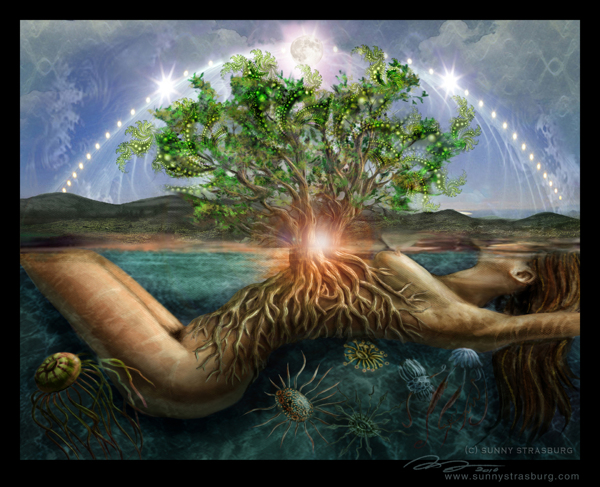
Originally presented as a paper at the Conference for Current Pagan Studies at Claremont College in 2005. Art:”Ophelia/Emergent Psyche” by Sunny Strasburg.
The old gods are dead or dying and people everywhere are searching, asking: What is the new mythology to be, the mythology of this earth as of one harmonious being?
Do we need nature? That was the subject of an essay contest sponsored by Shell Oil and The Economist magazine in August of 2003. Issues for the essay included genetic modification, biodiversity, gene therapy, nuclear power and renewable energy. The essays were to focus on the difficult choices to be made in politics, economics, society, and public policy between actions, or inactions, that seek to increase man’s control over nature and those that seek to reduce it, those that seek to bypass nature and those that hope to work with it, those that put a higher value on human development and those that value the preservation or even reconstitution of nature.
Do we need nature? To Pagans, who address air, fire, water, earth, and spirit–the essentials of life on the planet–in our opening and closing prayers, that seems like an absurd question. It’s like asking do we need the air we breathe, the water we drink. Do we really need to eat? These simple gifts of nature are mostly taken for granted. We eat, drink, and breathe without thought for nature, the source of our life-giving essentials. This thoughtlessness, this lack of consciousness regarding nature, bleeds into every aspect of life on the planet.
Now as we contemplate our role in nature and ponder the evolutionary path before us, what are the questions we should be asking? Are the problems, as the Shell/Economist essay implies, whether to bypass nature or embrace and work with it? Are we trapped between the dualities of increasing or reducing man’s control over nature? Are we left with the singular choice of valuing human development or preserving nature? Is humanity condemned to the limitations of these struggling dualities or is salvation found in the balance of these polarities? How do we find this balance? In the wake of potential environmental devastation in the not too distant future, must we not first look at how we got here? How has our society become so disconnected, so cut off from nature? What are the attitudes that have sped us toward the increasing deterioration of our environment?
[A Pedagogy of Gaia] “Awakening to Gaia” by Bart Everson

(Image by Alex Grey)
Can I share a secret with you? It’s my own personal vision statement, formulated back in January as part of a visioning workshop I facilitated. (If you’re interested in clarifying your own vision, I’ve collected a few resources that may be helpful.) I was amazed that I could boil it down to three words: “Awakening to Gaia.”
There’s a bit more. It continues thusly: “a transformation of consciousness in myself and others, toward an ecocentric perspective and a sense of divine possibility in life.” But those first three words really encapsulate it all for me. Read More
“Concepts of Gaia” by Bart Everson

A guest lecture given by Bart Everson at Loyola University, April 2015. Click on the player below to begin.
Concepts of Gaia from Editor B on Vimeo.
About Bart Everson
 In addition to writing the A Pedagogy of Gaia column here at HumanisticPaganism,Bart Everson is a writer, a photographer, a baker of bread, a husband and a father. An award-winning videographer, he is co-creator of ROX, the first TV show on the internet. As a media artist and an advocate for faculty development in higher education, he is interested in current and emerging trends in social media, blogging, podcasting, et cetera, as well as contemplative pedagogy and integrative learning. He is a founding member of the Green Party of Louisiana, past president of Friends of Lafitte Corridor, sometime contributor to Rising Tide, and a participant in New Orleans Lamplight Circle.
Buy Godless Paganism (paperback)

Buy Godless Paganism (ebook)


Pagan Coming Out Day – May 2nd

 Naturalistic Paganism