 Naturalistic Paganism
Even naturalists don’t stay in the grave, by DT Strain
Our theme for early autumn is “Finding Meaning”. Next week, we begin our late autumn theme of “Death and Life”. Today, these themes merge in D.T. Strain’s essay, “Even naturalists don’t stay in the grave.”
This essay was first published at The Humanist Contemplative.
Do not stand at my grave and weep
In 1932, a young Jewish girl (Margaret Schwarzkopf) staying with a florist (Mary Frye) was unable to return to Germany to visit her dying mother because of rising anti-Semitism, and, after Margaret’s mother died, she expressed to Mary regret that she never had a chance to shed a tear by her mother’s grave. Mary was moved to write a poem to Margaret about her thoughts on death, which has come to be known as Do Not Stand at My Grave and Weep. This is the background of the popular poem, as confirmed by the research of Dear Abby columnist Abigail Van Buren, reported in The London Times, and which I first learned of through Wikipedia. The full verse of the poem is as follows:
Do not stand at my grave and weep
I am not there. I do not sleep.
I am a thousand winds that blow.
I am the diamond glints on snow.
I am the sunlight on ripened grain.
I am the gentle autumn rain.
When you awaken in the morning’s hush
I am the swift uplifting rush.
Of quiet birds in circled flight.
I am the soft stars that shine at night.
Do not stand at my grave and cry;
I am not there. I did not die.
Recently, thanks to a post by Pamela Daw on Facebook, I saw a most remarkable musical rendition of the poem by Conor O’Brien of the Irish band Villagers. While other musical versions exist, I think this is my favorite:
Who is “me”?
I have no knowledge of Frye’s beliefs, but from the perspective of a Spiritual Naturalist, Frye’s poem hits home in several ways. The second line reads, “I am not there” which brings up the matter of what we mean when we say “I” or “me”. Naturalists recognize that a person is distinct from merely the atoms that compose the body. Once death has come, there is clearly “something missing”. But since naturalists have no beliefs in a supernatural soul, what is it that’s missing?
Like the Buddhist concept of no-self, naturalists recognize that a person is a composite of many different aggregates, traits, qualities, and functions. There is no single, simple, thing one can point to and say, “that is me”. The person — that thinking being which experiences, has memories, makes choices, and who we come to know and love — is a complex system of activity that takes place in a functioning brain, and grows over a lifetime of experiences. It is a careful balance of chaos and order of the sort complex systems theorists study (see also, The Big Deal About Complexity). When the balance is disrupted and the pattern is disturbed to the point where normal function is impossible, that system ceases to be and the person we know dissolves. So, they are truly not in the grave, but does that mean they are nowhere?
The following lines 3 through 10 of the poem are spent comparing the person to a number of different things in nature: the wind, reflections, sunlight, rain, the flight of birds, and the stars. These are not merely random comparisons to “things we like” because they sound pretty. Nor are they the kind of talk about death one would hear from the traditional religious viewpoint of souls and the afterlife. There is a very careful perspective being expressed here — one that is deeply profound and which can be found in some of the most sophisticated philosophies throughout human history. I do not know precisely what that florist with no formal education in 1932 knew of such things, but the Times described her as an avid reader with a remarkable memory. Is it possible she had been influenced by several philosophies? That is certainly possible and it is also possible that Mary Frye was perceptive enough on her own to pick up on some important truths about her world, just as many early thinkers did.
“I am the swift uplifting rush”
On the most basic level, the comparisons of the person with nature work as metaphor because, when we view the beautiful things around us, we are reminded of the beautiful qualities of the person we knew and the times we had with them.
“I am the soft stars that shine at night”
Another angle would be, as Carl Sagan eloquently pointed out, we are made of “star stuff” and all of our particles were at one time a part of the cosmos, and return to that awe-inspiring mix.
“Of quiet birds in circled flight”
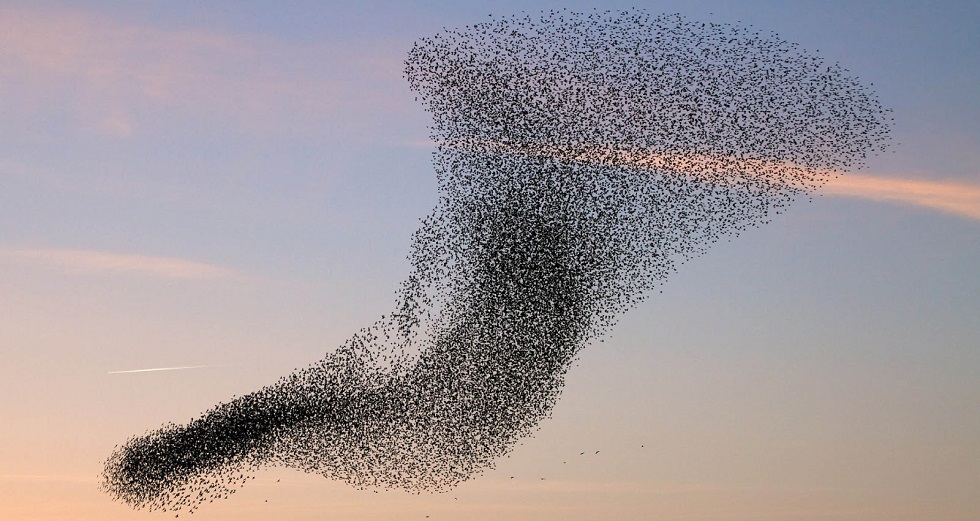
But even more profoundly, there is a recognition that the intricate maelstrom of relationships that make a person possible, are based on the same universal principles that make possible all of the universe. I mentioned complex systems theory before, and it is apropos that one important series of studies in complexity theory has been on the movement of birds in flock behavior. It is a study of how higher orders of complexity and coordinated operations arise spontaneously from simpler interacting components. These are the very principles that underlay not only bird flocks, but hurricanes, galaxy formations, living organisms, societies, and persons themselves. That means, when I breathe in and out, that motion of air is happening for the same ultimate reason the wind moves through the trees, or the waves of the ocean crash upon the shore. So, comparisons of those found in Frye’s poem are more than mere analogy or metaphor.
The Divine Flux
These are the aspects of nature that caught the eye of early Taoist thinkers. They lend themselves to the Stoic notion of the Divine Fire – that tumultuous flux and inherent creative force out of which all things rise. The Stoics knew that to live in accordance with Nature meant, among many things, to understand deeply that those things which bring death are the very same things that make life and all the things from which we benefit possible. This is the Logos — the pervasive underlying rational order on which the universe is based, and which can be found in persons as well. Like complexity theorists today, Heraclitus knew we could not step twice in the same river because it is in a constant state of replacement, and the Buddhists teach us to lie in that river and, instead of grasping at every attachment that passes our way, experience the bliss of the moment as it flows by us, always letting go and ready for what lies ahead.
And, if persons are patterns, then patterns repeat, and in more ways than merely the meme. Through their actions and interactions in life (what Buddhists call karma) people are like the Chaos Theory thought experiment of the butterfly that can affect the course of a hurricane. Our loved ones create causes and effects which ripple outward in uncountable and unimaginable ways that cannot be contained. Just one of those ways is in their impressions upon us, which recreate similar patterns in our minds through communication and our deep knowledge of them. Thus, if naturalists remain consistent in their definition of the essence and end of personhood within a complex causal world, then it is true our loved ones are not in the grave. We, quite literally, carry a part of them within us, and so on to others. If that is so then, as Mary Frye says, in many important ways they did not die.
The author

DT Strain is a Humanist Minister, certified by the American Humanist Association (AHA) and a Spiritual Naturalist. A writer for the Houston Chronicle, and other sites, Rev. Strain speaks and writes on a wide variety of philosophic concepts and participates in several organizations. He is an enthusiast of Stoicism, Buddhism, and other ancient philosophies; seeking to supplement modern scientific and humanistic values with these practices. As such, he often attends the Jade Buddha Temple, writes on Stoicism, and organizes the Humanist Contemplatives Houston Meetup group.
Strain is former president of the Humanists of Houston (HOH), and has served as vice-chair on the Executive Council of AHA’s Chapter Assembly, on the Education Committee of the Kochhar Humanist Education Center, and as a member of the Stoic Council at New Stoa.
His writings have appeared in magazines, newsletters, and in the AHA national publication “Essays in the Philosophy of Humanism”. He has been a guest speaker on the Philosophy of Religion panel discussion at San Jacinto College. Rev. Strain has also appeared as a panelist on the Houston PBS television program, The Connection, discussing religious belief and non-belief.
DT Strain is the founder of The Spiritual Naturalist Society, a new organization that cuts across traditional lines, and bring together naturalistic Humanists, Buddhists, Pagans, Jews, Taoists, and more. It’s purpose is to spread awareness of spiritual naturalism, and provide a place for education and fellowship for spiritual naturalists.
This Wednesday

This Wednesday, we conclude our early autumn theme of “Finding Meaning” with Debra Doggett: “As seen from the sky”.
The theme for late autumn here at HP is “Death and Life”. Send your writing and art to humanisticpaganism [at] gmail.com by November 6, 2013.
What to look forward to in November at HP
21 days left for you to help HP place an ad at The Wild Hunt. Go to HP’s Indiegogo campaign to contribute.

Photo by Laura Stevens
This month, we conclude our theme of “Finding Meaning”, and with the Autumn Cross-Quarter on November 7, we begin our new theme of “Death and Life”.
This Month at HP
Nov 3 “Even naturalists don’t stay in the grave” by D.T. Strain
Nov 6 “As seen from the sky” by Debra Doggett
Nov 7 Autumn equitherm/cross-quarter
Nov 7 New theme begins: “Death and Life”.
Nov 10 “Ghost story” by Ken Apple
Nov 13 Mid-Month Meditation: “Panthea” by Oscar Wilde, read by Annika Garratt
Nov 17 “Seasons and heartbeats” by Brock Haussamen
Nov 24 “Thoughts on Death and the Afterlife” by NaturalPantheist
Nov 27 Postpagan Ceremony & Ecology by Glen Gordon
Humanistic Paganism Calendar for October
Nov 3 First Sunday in November Daylight Savings Time ends in U.S.
Nov 3 Hybrid solar eclipse [external link]
Nov 7 Autumn equitherm/cross-quarter
Nov 8 Cosmic Calendar: First complex cells (eukaryotes) emerge 2 bya
Nov 9 Carl Sagan’s birthday
Nov 16 International Day of Tolerance
Nov 21 (third Thurs) World Philosophy Day
Nov 24 Spinoza’s birthday
Nov 25 International Day for the Elimination of Violence Against Women
Nov 28 Comet ISON makes its closest approach to the Sun* [external link]
Nov 30 John Toland’s birthday
* The newly discovered comet ISON will make its closest approach to the Sun on Nov. 28. If the comet survives its encounter with the Sun, it could be one of the brightest comets in recent memory. Some astronomers estimate that it could even be bright enough to be seen during daylight hours. In October it will start to be visible to the naked eye and will continue to get brighter until November 28. If the comet survives, it will be visible in the early morning and early evening sky and could be nearly as bright as the full Moon. Some astronomers are calling it the “comet of the century”.
Samhain Special: Why Witch? by Telmaris Green
We have reached 20% of our goal! There are 22 days left for you to help HP place an ad at The Wild Hunt. 20 contributions of $20 will get us there. Contribute $25 or more and HP will link to the website or blog of your choice. Go to HP’s Indiegogo campaign to contribute.
In honor of the Neo-Pagan holiday, Samhain, today we hear from self-described “atheist feminist solitary eclectic witch” Telmaris Green.


Gerald Gardner, Daily Dispatch (London), August 5, 1954
I’m not a scholar. I once tried to be, but I wanted babies more than I wanted the degree, and in the end I couldn’t do both well.
So now I have a smattering of outdated knowledge of Medieval and Renaissance literature rattling around in my head, along with the things I was reading when I should have been working on the lit degree (mostly theology and spirituality), the things I read in second-career-grad-school (psychotherapy related, plus more theology), lots of rock songs and gardening info–and the experience of marriage and child rearing.
I’ve been Catholic, agnostic, Catholic again, then atheist; Democrat, Republican, and Democrat again; feminist, traditional, feminist again. I’ve made the acquaintance of Zen Buddhism, read a little Rumi, and now, against all odds, I have taken an interest in Wicca … sort of.
I’m basically an atheist feminist solitary eclectic witch.

W.I.T.C.H protest in support of the Chicago Eight in 1969
Finding a label that fits
Why “witch”?
For starters, because I want to remember the women who, under that label, were killed for standing out–-including, btw, my Catholic patron saint. But I’ve settled on “witch” as perhaps the least misleading of all the misleading terms I could apply to myself. I’ve been googling “Witch,” “Wiccan,” and “Pagan” for some time, trying to figure out if I’m flesh or fowl or good red herring. The world of Wicca sounds a little more organized than I’m comfortable with at present–-though you can practice as a solitary, and there is no orthodoxy police. There’s a hierarchy, and steps involved in joining and advancing (if that’s the right word) in a coven, and, as Huck Finn would say, “I been there.” It may be very different from the hierarchies I’ve dealt with so far, but–-call me phobic–-I don’t want to join another damn community of believers till I’m very, very sure what I want, and what are my cues to leave.
I’m also too much of an atheist to comfortably refer to “the goddess” or “the Lord and Lady” without an asterisk and an explanation that I am, of course, just personifying some positive trend in myself, my history, or the world.
“I’m also too much of an atheist to comfortably refer to ‘the goddess’ or ‘the Lord and Lady’ without an asterisk and an explanation that I am, of course, just personifying some positive trend in myself, my history, or the world.”
As for “Pagan” … you may, if you’re old and a former Catholic like me, remember when “buying a pagan baby” (i.e., sponsoring a foreign child in a Catholic mission) was a popular classroom charity. And then there were the textbook pagans, people in fancy antique garb who bullied Christians in sandals. They were the “other” team, the guys whose ways we were not to adopt. Even as an atheist, it sometimes feels creepy to me to be doing stuff that “pagans” did.
But even setting aside the remnants of an old prejudice, “Pagan,” like “Wiccan,” seems to be too bound up with deities. As for “secular Pagan,” while I do recycle, I’m less focused on green politics than they seem to be (though I am an ardent fan of Jethro Tull’s Songs from the Wood album, and that should count for something).

Llewellyn Publication’s image of a modern Witch in the 1980s
What is a Witch?
So, you ask, “witch” is not misleading?
Well, yes, and the Neo-Pagan definitions I’ve read involve such a broadening of the term that it is barely recognizable. A witch, I’ve read, is anyone who does witchcraft, and witchcraft is any use of energy to manipulate the natural world in a way that brings about change. So, for instance, a doctor, a cook, and an artist are all practicing witchcraft. And as a psychotherapist, so am I. There’s nothing objectionable in that, but also nothing much resonant with the flavor of the word “witch.” Why adopt it, then?
Initially, I labored under the misconception that “witch” came from the same root as “wizard” and “wise,” as well as “wicked.” In fact, some source I can’t remember claimed that, at one point, the English language did not distinguish between a “witch,” a “wise woman,” and a “wicked woman.” As the bumper sticker says, “well-behaved women rarely make history,” and indeed, educated and unconventional women were popular targets for witch hunters.
But as cool as that bogus etymology is, it’s wrong. “Witch” and “Wicca” come from the Anglo-Saxon word for “to bend.” Witchcraft is about bending, shaping, reality. And this is cool in its own way–-Witchcraft is not about breaking, ignoring, or violating nature or ourselves; it’s about working with it, within its capacities, to influence it in whatever constructive ways we can.
“… Witchcraft is not about breaking, ignoring, or violating nature or ourselves; it’s about working with it, within its capacities, to influence it in whatever constructive ways we can.”

Llewellyn Publication’s image of a 21st century Witch
What is magic?
And “magic”? The term comes up in Wicca, Witchcraft, and Paganism. I’m too lazy to drag out the OED, so I’ll wing it. Magic … Magi: the three “wise men” of the nativity story, but the root isn’t about wisdom. Magister … it’s about mastery, mastering something. From my lit days, I remember C. S. Lewis pointing out that in the Renaissance, both “magic” and “science” were about the mastery of nature–-but in the sense of domination, or even, if you will, rape. They were about getting minerals or demons or chemicals or people to do your bidding, against their will, if need be.
But there are other ways of “mastering” a skill or a situation. Through understanding. Through attunement. Through patient negotiation. This is the “magic” of the horse whisperer, or a good parent. Modern Witches, Wiccans and Pagans tend toward this kind of magic. The wise-craft of a Witch, then, would ideally be a skillful understanding of herself and others, and a skillful adaptation to her surroundings that helps bring about change. Good change.
Now that’s a Witchcraft I can get behind.
The atheist feminist solitary eclectic witch at work
And why the blog? The only point, apart from my needing to think out loud, is this: The major religious traditions are all rooted in patriarchy. Moreover, history shows that goddess worship does not guarantee respect for real, living women. Feminist-Pagan-Wiccan-Witches are trying to build from the ground up, with the shards and spiritual jetsam we find, fleshed out with our imaginations. We’re making it up as we go.
But women can’t afford to abandon critical thinking, not now of all times, when women of advanced nations finally have access to education, and women in the third world are still fighting for it. We won’t become empowered by buying (or manufacturing) snake oil.
“… women can’t afford to abandon critical thinking, not now of all times, when women of advanced nations finally have access to education, and women in the third world are still fighting for it. We won’t become empowered by buying (or manufacturing) snake oil.”
Any religious tradition that lasts and has real power to give us meaning has to emerge from the cauldron of many hearts and minds, allowed to simmer, allowed to mature. And any religious tradition that hopes to be a vital and empowering force in the future had better not pit itself against hard realities, in particular scientifically and historically verifiable realities.
So without claiming the power to dictate or define for others, maybe we do owe each other the kind of input that will aid the refining process–-or to go for a witchier metaphor, the kinds of ingredients that will cook up the richest brew.
Here’s my handful of spice.
Don’t forget to comment below.
The author

Telmaris Green (pseudonym) is a psychotherapist in private practice in Indianapolis. She holds an M.A. in English Renaissance from Indiana University, and a Masters in Marriage and Family Therapy from Christian Theological Seminary in Indianapolis. She has given numerous local presentations on the treatment of trauma, dissociation, and personality disorders, including Dissociative Identity Disorder. Contact her through her wordpress blogs, Skeptical Witch and Solitary Witch.
This Sunday
Next Sunday, we continue with the theme of finding meaning with D.T. Strain: “Even Naturalists Don’t Stay in the Grave”.
The theme for late autumn here at HP is “Death and Life”. Send your writing and art to humanisticpaganism [at] gmail.com by November 6, 2013.
The HPedia: “Whatever works”
Your help is needed! Please critique this entry from the HPedia: An encyclopedia of key concepts in Naturalistic Paganism. Please leave your constructive criticism in the comments below.
This common Neopagan maxim affirms a pragmatic approach to spirituality. Whatever produces the desired result is worth consideration.
In a sense, science operates by the same dictum. There is no arguing with empirical results, only with the explanations that attempt to account for those results.
Where science and Neopagan ritual may diverge is in the specificity of what it means for an approach to “work.” Scientific experiments are painstakingly devised to produce a clear delineation between the success or failure of a hypothesis, which is itself carefully formulated to be falsifiable. On the whole, Neopagan rituals tend to be far more ambiguous. They nearly always involve ritual intentions or goals, sometimes quite specific, but rarely is attention paid to falsifiability (though not without exception), and the range of events which may indicate success is often extraordinarily wide. This may give the impression that magico-religious ideas are being “tested” in ritual, but it is important to bear in mind the difference between this and scientific testing.
See also “All paths are valid.”
Check out other entries in our HPedia.
Meet our new columnists at HP
I’m very excited to announce our four new monthly columnists at Humanistic Paganism. Each will be contributing an article or essay semi-seasonally (8 times a year) beginning at the end of November.
A Pedagogy of Gaia by Bart Everson

Bart Everson is a writer, a photographer, a baker of bread, a husband and a father. An award-winning videographer, he is co-creator of ROX, the first TV show on the internet. As a media artist and an advocate for faculty development in higher education, he is interested in current and emerging trends in social media, blogging, podcasting, et cetera, as well as contemplative pedagogy and integrative learning. He is a founding member of the Green Party of Louisiana, past president of Friends of Lafitte Corridor, sometime contributor to Rising Tide, and a participant in New Orleans Lamplight Circle.
Bart’s first post: “Solstice Connections” (Dec. 18)
Postpagan Ceremony and Ecology by Glen Gordon

Glen Gordon writes about animism, religious naturalism, and Unitarain Universalism on his personal blog Postpagan.com™. Under the name Fishbowl, he has participated in the broader bioregional animist community at gatherings and in internet forums. As an active UU, He has given sermons on bioregional animism at his local UU church in Northern Idaho. The video Biorigional Animism in Five Minutes features the words of one of his sermons. He also co-facilitates a The Palouse Nature Covenant, a group of pagan and naturalist UU’s exploring themes of nature and ecology through worship.
Glen’s first post: “Death Song” (Nov. 27)
Starstuff, Contemplating by Jon Cleland Host

Dr. Jon Cleland Host is a scientist who earned his PhD in materials science at Northwestern University & has conducted research at Hemlock Semiconductor and Dow Corning since 1997. He holds eight patents and has authored over three dozen internal scientific papers and eleven papers for peer-reviewed scientific journals, including the journal Nature. He has taught classes on biology, math, chemistry, physics and general science at Delta College and Saginaw Valley State University. Jon grew up near Pontiac, and has been building a reality-based spirituality for over 30 years, first as a Catholic and now as a Unitarian Universalist, including collaborating with Michael Dowd and Connie Barlow to spread the awe and wonder of the Great Story of our Universe (seewww.thegreatstory.org, and the blog at evolutionarytimes.org). Jon and his wife have four sons, whom they embrace within a Universe-centered, Pagan, family spirituality. He currently moderates the yahoo group Naturalistic Paganism.
Jon’s first post: “Evolutionary Parenting” (Dec. 4)
Musings of a Pagan Mythicist by Maggie Jay Lee

M. Jay is interested in growing a new religious culture grounded in the everyday shared world and the public revelations of science, that celebrates our relationship with Cosmos, Earth and each other, and strives to bring us into right relationship with the Nature inside and outside of us. She draws inspiration from modern cosmology, evolutionary psychology, and the myths and wisdom traditions of ancient Hellas. M. Jay is a member of the Universal Pantheists Society (http://www.pantheist.net/) and the Spiritual Naturalist Society (http://www.spiritualnaturalistsociety.org/), and she has studied with Glenys Livingston author of PaGaian Cosmology: Re-inventing Earth-based Goddess Religion (http://pagaiancosmology.com/). She celebrates the creative unfolding of Gaia in west Tennessee, where she lives with her husband, two dogs and cat.
M.J.’s first post: “Gnothi Seauton” (Dec. 11)
Buy Godless Paganism (paperback)

Buy Godless Paganism (ebook)


Pagan Coming Out Day – May 2nd
 Naturalistic Paganism