Naturalistic Paganism
“Stephen Hawking, Cosmology, and Spirituality” by Brock Haussamen
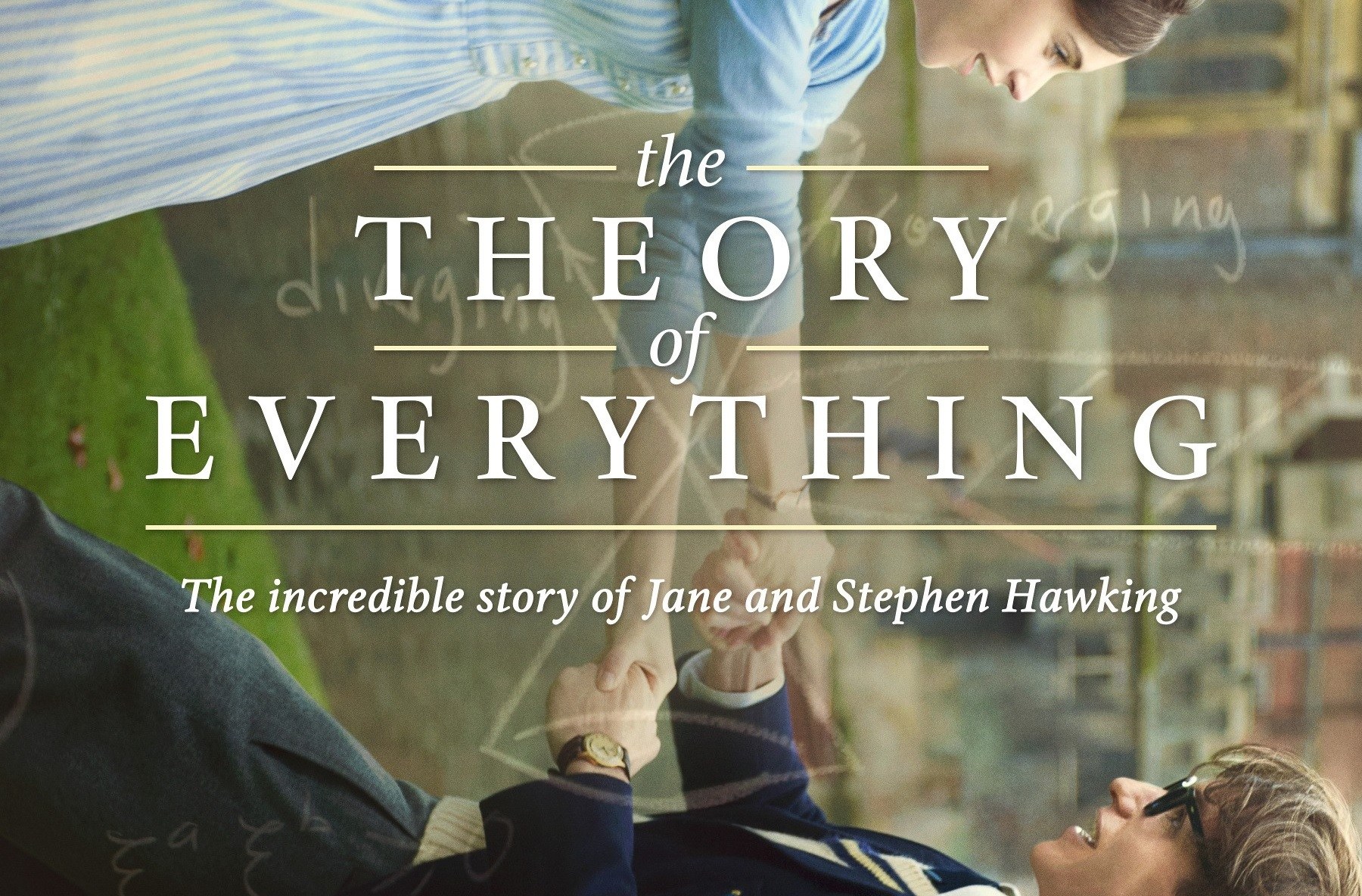
I recently saw the current film about Stephen Hawking, “The Theory of Everything,” enjoyed it very much, and decided I was overdue to read A Brief History of Time. For the first few chapters, the book was a master class in the emergence of current theories about the universe. Hawking handles the abstractions of astrophysics as deftly as most people handle a knife and fork. I was on edge keeping up with him, and he writes so clearly that I succeeded.

(wikimedia)
Up to a point. About a quarter of the way through the book, it looked like I was going to flunk the course. It was sentences like these that did me in:
“Because mathematics cannot really handle infinite numbers, this means that the general theory of relativity…predicts that there is a point in the universe where the theory itself breaks down. Such a point is an example of what mathematicians call a singularity. In fact, all our theories of science are formulated on the assumption that space-time is smooth and nearly flat, so they break down at the big bang singularity, where the curvature of space-time is infinite.” (Kindle location 687)
The theory of relativity wasn’t the only thing that broke down at that point. I’ve never understood what a singularity is nor can I thoroughly grasp how space or “space-time” can be curved. Over the years I’ve stared at those diagrams of what look like drain holes without being able to connect them fully to what I know of space or time. I do have a very elementary grasp of galaxies, the expansion of the universe, black holes, and portions of the theory of relativity, but when it comes to singularities, quanta, curved space, and why nothing can go faster than the speed of light, the little TV in my head loses the picture. So I drifted away from the book. I’m sure I’m not alone in all this. Science, always pushing the limits of knowledge, remains comprehensible to an educated audience as long they can visualize the new theories. But modern science has moved into the realms of the enormously large, the incredibly small, and the unbelievably old, and in the process has moved beyond many people’s capacity. Hawking himself observes that “in the nineteenth and twentieth centuries, science became too technical and mathematical for the philosophers, or anyone else except a few specialists” (2558).

Don’t ask me how, but space is curved—with spin. (wapsec.com)
One result that I find troubling has been that while some religious and spiritual organizations accept science as a source of information about the natural world, probably only a few of their members can understand what science is saying about the foundations of the universe. The educated generalist, whether theist or non-theist, who turns to science to learn about the building blocks of nature may quickly come face to face with concepts that she or he just can’t grasp. Fortunately, such complexities don’t interfere very much with people’s believing in a god or other ultimate entity. But over time this cosmology-spirituality gap is probably slowly closing. Scientific facts and theories that were unknown or controversial a few decades ago seem to be working their way into the religious mindset gradually. Evolution seems the obvious exception, but outside of America it is considered a sensible view of the past. And in my case, twenty years ago I would never have thought that the longevity of life over 3.8 billion years would mean much to me, but now it is central to my appreciation of life. From time to time, in articles about social trends or political events, I come across casual references to quantum mechanics or the uncertainty principle as phenomena at the root of how human affairs turn out. Who knows? Perhaps my grandson will grow up to feel that string theory is his key to making sense of the world. Significantly, Hawking’s book itself, intended for a general audience, represents his own effort to bring the frontiers of cosmology closer to home for “ordinary people” (his phrase). As for my failed first effort to read it, I went back to it, absorbed what I could about black holes and theories of the universe, and appreciated the breadth and agility of Hawking’s mind. It was well worth it. In the last couple of chapters, Hawking acknowledges how far the work of modern cosmologists remains from most people’s picture of the universe, but he is optimistic about closing the distance. The era of new and bewildering theories about nature, he writes, may be drawing to a close because a grand theory that unifies all the partial theories seems to be coming into sight; “we may now be near the end of the search for the ultimate laws of nature” (2319). When that stage is reached, theoretical cosmology can settle down and become sufficiently streamlined and teachable that laypeople will be better able to grasp it. “A complete, consistent, unified theory is only the first step: our goal is a complete understanding of the events around us, and of our own existence” (2504). The italics are in the book. Hawking recognizes that the value of science lies finally in the understanding that it brings to people and not just to scientists.
The Author
 Brock Haussamen: I grew up in New York City and now live in New Jersey, where I taught English for four decades at a community college, a profession I found varied and rewarding. I’m married, with family in the area. I retired in 2006 in part to fight poverty as best I could, at every level I could–locally, nationally, and in Africa. I’ve become a local volunteer and on-line advocate and along the way have learned fast about the economic, political, and legal issues that accompany poverty. I also found myself thinking more about the central questions that catch up with us sooner or later: What is my purpose? How will I face death? What do I believe in? I have always liked the descriptions from science about how living things work, about the history of the earth, about the nature of the cosmos. But I could not put those pictures together with my questions. Gradually I came to see that life’s history over 3.8 billion years stood inside and throughout my being and constituted my livingness at its core. In my blog at threepointeightbillionyears.com, I’ve been exploring the variety of ways in which our experience is anchored not just in our evolution from primates but in the much longer lifespan of life itself. See Brock Haussamen’s other posts.
[HP Pride] Philip Kanellopoulos and Deiwosism

HP Pride is a new monthly column where we interview members of the Humanistic Paganism community and other like-minded friends. One or more interviews will be published every month. If you are not a “Big Name Pagan”, or if you have never written online before, all the better! We want to hear from everyone! If you’d like to be interviewed, just click this link and follow the instructions.
Meet Philip Kanellopoulos
What do you call the religion you practice?
I practice Deiwosism — named after its pantheon of goddesses and gods known collectively as ‘Deiwos’ [DEY-wohs], which is a reconstructed Proto-Indo-European word and the world’s oldest known word for ‘god’. (www.deiwos.org)
If you call yourself “Pagan”, what about your religion is “Pagan”? Why do you choose to call yourself “Pagan”? If you don’t call yourself “Pagan”, why not?
For me, to be ‘Pagan’ means to believe that the universe is divine, alive, and populated with many gods — (that is, pantheistic, animistic, and polytheistic). Ample evidence exists that human beings naturally evolved to hold such “primitive” beliefs. They are part of our birthright and enduring strategy for survival, and so we discard them at our peril. Deiwosism represents an attempt to better reconcile Paganism with our modern, scientific view of the cosmos. Many thoughtful Pagans hold that such reconciliation is unnecessary, that no actual conflict exists. They quite reasonably view Pagan gods as physically unreal, metaphorical only, existing as poetic symbols comfortably confined to the psyche, and they maintain the sufficiency of such a view for our spiritual needs. In their expansive appreciation of the mystery of existence, they may well be correct. And yet, I believe that any properly functioning mythology should provide some better spiritual connection to contemporary models of physical reality. I believe that a more intimate integration of the physical and the spiritual is both possible and desirable. In the Deiwosist view, the Pagan gods are physically real. They are expressions not only of our minds but of the whole of creation as well. They are future facts who imprint themselves not only in our dreams but also in the very fabric of reality.
What other words (i.e., humanistic, naturalistic, atheistic, pantheistic, witch, druid, shaman, etc.) do you use to describe your religion and why?
I would further describe Deiwosism using the words naturalistic (relying on scientific explanations of reality), interfaith (celebrating all of the world’s religions), teleological (positing future “causes” of reality), panentheistic (that the divine transcends our universe), postbiological (that the fulfillment of our destiny may ultimately lie in our progeny), democratic (celebrating the sharing of power among everyone), pluralistic (celebrating all faiths, cultures, ages, ethnicities, sexes, genders, and identities), and progressive (in its concern for environmental sustainability and economic and social justice). I might also use the word Jungian (in that the various goddesses and gods of Deiwos resonate with Carl Jung’s archetypes of the collective unconscious).
What is your religion of origin? What religion were you raised with?
I was born and happily raised within an authoritarian/capitalist/atheist ideology, which, whatever its merits, is nevertheless a faith-based system of belief. It’s amusing to me that at the time we all thought of ourselves as irreligious, and yet we were as devout in our faith as any fundamentalists.
How did you transition to your current religion? Tell us a little about your faith journey.
In my mid-twenties, I fell seriously ill. The lack of emotional support from family during the crisis ultimately resulted in my suffering a stroke at the age of twenty-eight. The ordeal convinced me that the myths and ideologies by which I and those around me had been living were woefully inadequate. I intentionally set out in search of some alternative that would be both more natural and more nurturing. I felt that whatever I was to personally believe would need to be at least consistent with contemporary science. I began reading everything I could find about cosmology, anthropology, depth psychology, mythology, and comparative religions (both monotheistic and polytheistic). Relying on the life’s work of countless brilliant scholars, scientists, mystics and prophets, I labored to assemble a new mythology that would somehow attempt to honor both science and faith, both physics and metaphysics. After twenty years of careful searching, I finally found an answer that satisfied my own spiritual yearnings and standards.
What makes your religion a good fit for you?
Deiwosism fits with my love of speculative science, of Pagan mythologies, and of progressive and democratic values. It presents me with a vision of the world in which all living things are sacred — indeed, in which the universe and everything in it are alive and thus sacred. It lets me see the interconnections in a cosmos in which everything is conscious, and in which each of us is a small part and intimate expression of a greater whole.
How do you practice your religion?
I meditate for several minutes every evening, contemplating various challenges of life and praying for guidance from Deiwos. In addition, because the goddesses and gods of Deiwos speak through the prophets of all the world’s various faith traditions, I study their sacred texts looking for nuggets of wisdom, inspiration, comfort, and understanding.
Do you observe the Wheel of the Year? If so, how?
For yearly rituals, I’ve adopted the Gaian calendar, coordinated with the cycles of both the sun and the moon, in which the specific days of the solstices and equinoxes are celebrated. The Gaian year 0 [zero] occurred the same year as the first Earth Day (March 21, 1970), so the current year is 45 E.G. (Epoch of Gaia). In the evening of every solstice and equinox, I light a ceremonial candle — outside, weather permitting — and briefly pray for guidance from the particular patron goddess or god of that new season.
Do you believe in or work with “gods” or “deities” or “spirits” in any sense of those words? Why or why not? If so, how?
I do believe in the Pagan gods of Deiwos. That being said, my belief is not absolute and does not conform to “belief”/“disbelief” polarities. Mythologist Joseph Campbell described what he claimed is a common feature of primal societies, what he called “the belief that is not quite belief”, something perhaps unfamiliar to many of us in the West. I believe in the Pagan gods, and yet I willingly but conditionally suspend any disbelief, for the purposes of comfort, guidance, and wisdom. In this way, I feel a stronger connection to the wonders of existence than I otherwise might feel were I to regard the deities as exclusively metaphors. Nevertheless, the deities are a vehicle to insight rather than an insight in themselves. I believe the purpose of religion is not necessarily to provide spiritual proof, but rather to blur the lines between faith and despair.
Do you believe in or work with “magic” in any sense of the word? Why or why not? If so, how?
I personally don’t believe in magic. Deiwosism endeavors to be consistent with modern physics, which suggests — (when Einstein’s general relativity is reconciled with a many-histories interpretation of quantum mechanics) — that we live in a wholly deterministic world of parallel realities. Therefore, I don’t petition Deiwos for intervention but rather for guidance. My own prayers are about listening rather than talking.
How does your religion affect your daily life or your state of mind?
From moment to moment, I feel Deiwosism provides me with a way to interpret the events and circumstances of my own life in a greater context, helping me integrate them into a larger understanding beyond my own personal troubles and concerns. I’m more at peace with life than I was before. Because the goddesses and gods of Deiwos are ultimately the architects of reality, I can play my part joyfully with a certain detached participation and acceptance of the inevitabilities of life
Do you interact with theistic Pagans in religious community? Do you share ritual with theistic Pagans? What has been your experience in this regard?
I’ve lived with and among theistic Pagans over many years, including participation in various rituals. Because I’m a theistic Pagan myself, my experience of any disagreement has been with non-theistic Pagans. They’ve met Deiwosism with a degree of healthy skepticism. Still, I believe that any religious views that serve to enlighten, heal, comfort, and inspire can be legitimate. My primary purpose in sharing Deiwosism is to present it as just one option among many.
How do you engage other Pagans online?
The Pagans I’ve engaged in online forums have tended to be advocates of what I might describe as Gnostic Paganism — that is, a belief that the Pagan gods inhabit a spiritual realm separate from the material realm. This admittedly provides an explanation for the absence of evidence among the physical sciences for the everyday existence of the gods. Indeed, such matter/spirit dualism is actually a fairly elegant solution to the problem of maintaining theism in an age of reason, and yet I regard it as ultimately unsatisfying. The solution offered by dualism may succeed in sidestepping Paganism’s potential conflict with science, but I prefer attempting to meet the challenge more directly. Because of the surprising hostility within some Internet forums toward unconventional approaches to Paganism, I’ve begun to view my participation in those forums as needlessly disruptive and unproductive, and I’ve lately tended to avoid them. Given my desire for community, this ideological rejection has been a source of considerable disappointment to me.
Are you “out of the closet” about your Paganism? To what degree? Why?
I’m largely out of the closet about my Paganism, except among the few less tolerant members of my extended family.
What is the thing you love the most about Paganism?
What I love most about Paganism is the feeling of connection it gives me to things ancient and enduring.
What is one thing you would like to change about Paganism or the Pagan community?
I would ask of them the same thing I would ask of all of us, including myself — that we all challenge ourselves to be more open minded about beliefs and ways of being that may be different from our own.
Do you have a favorite quote regarding religion?
One from Joseph Campbell that might be particularly pertinent here is from page forty-three of ‘The Hero’s Journey’: “I don’t see any conflict between science and religion. Religion has to accept the science of the day and penetrate it to the mystery.”
Thank you for allowing me to share my spiritual views with you!
Philip Kanellopoulos
Deiwos: a Pagan Religion for the Future….
http://www.deiwos.org

“Turtles all the way up and turtles all the way down”: Introduction to March’s theme — Cosmos, by John Halstead
Last summer, my wife and I were taking a walk around our neighborhood. As we looked up at the stars, we began to speculate as to how many stars there are. I got out my phone and started Googling. It turns out, I was way off.
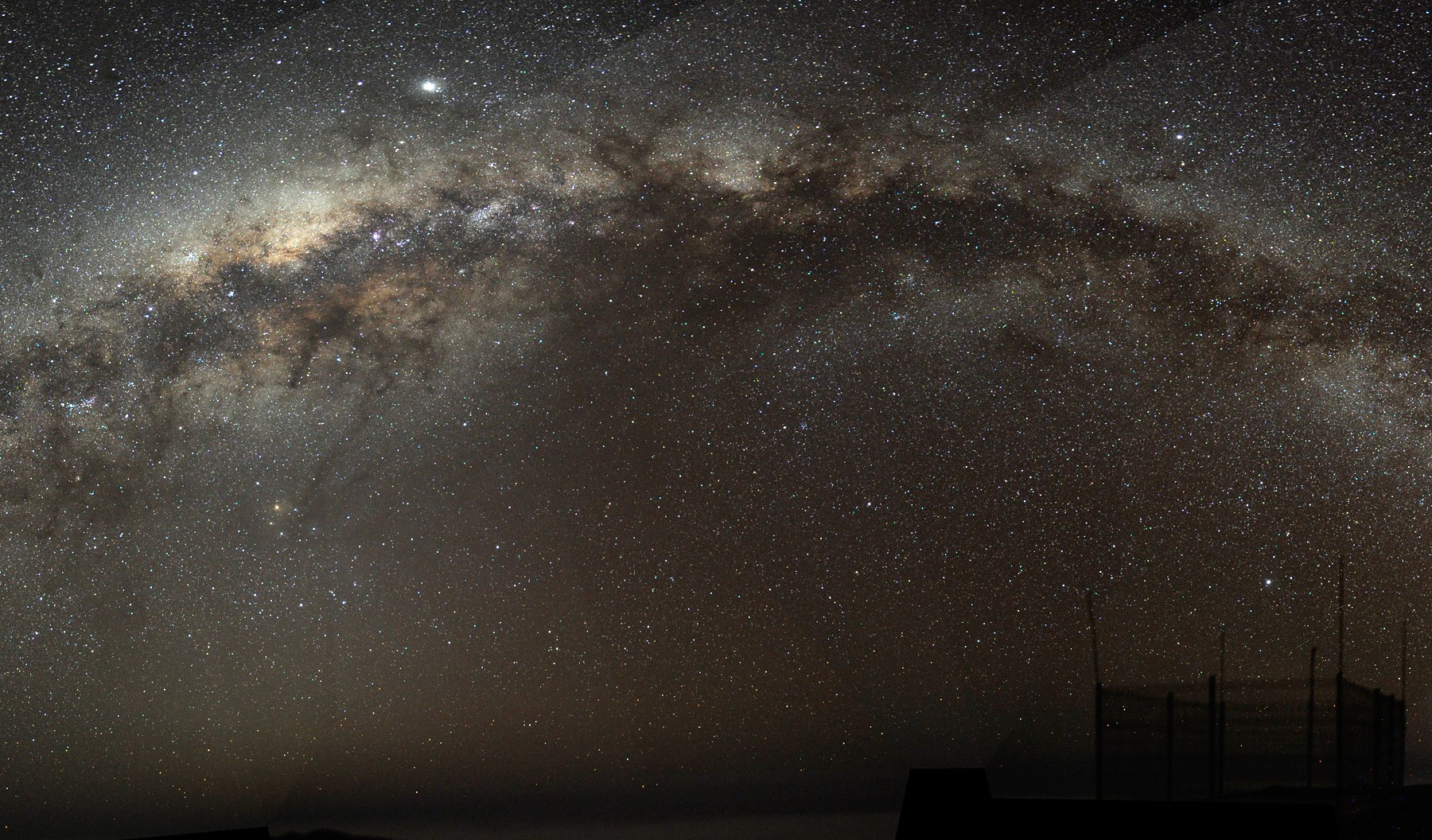
The number of stars that you can see on a clear, moonless night in a dark area, far away from city lights, is only about 2,000. We live in a suburb. close to Chicago, and the combination of city lights and humid Midwestern air drastically reduces the number of stars we can see. We have a wildly different view of the night sky when we visit relatives in Utah and go up in the mountains or out in the desert.

The Milky Way’s Galactic Center in the night sky above Paranal Observatory
All of the stars we can see are part of the Milky Way Galaxy, which our solar system is a tiny party of. The Milky Way has at least 100,000,000,000 (100 billion) stars, and maybe four times that much. Which means there are 50-200 million more stars in the Milky Way than we can even see on the clearest night! (The average number of planets around each star is estimated at 2.5.)
And that’s just our galaxy. Until the 1920s, it was believed that the Milky Way was the only galaxy. Now we know that there are 100 billion galaxies in the observable Universe. Which means there are approximately 10,000,000,000,000,000,000,000 (10 sextillion) stars. That is believed to be more stars than there are grains of sand on the entire earth!

Andromeda galaxy with the naked eye.
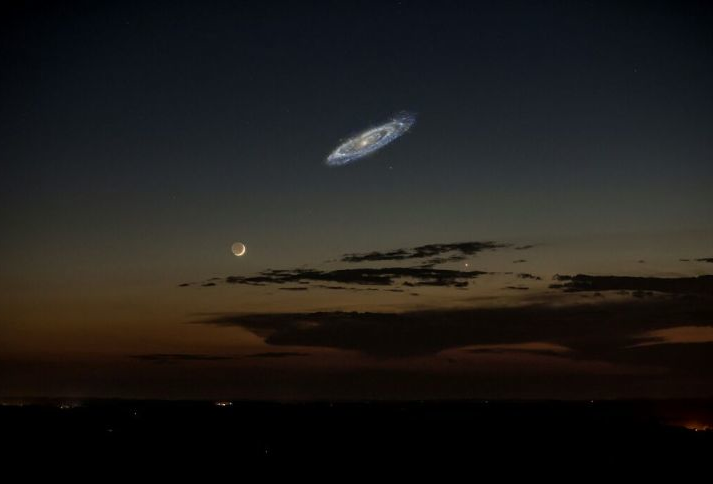
If the whole galaxy were bright enough, this is what you’d see at night (with the moon as a reference).
If we want to get a sense of the size of a galaxy, we can look at Andromeda, our closest galactic neighbor. It is 2.5 million light years away, which means we are just now seeing the light that left it 2.5 million years ago. It is the only galaxy you can see in the northern hemisphere with the naked eye. On the right is an image of what Andromeda looks like in our night sky. We can only see the nucleus of the galaxy, because the rest of it is not bright enough. But below is an image of what Andromeda would look like if we could see the whole thing. This really gives you a sense of its enormity, given that it is 2.5 million light years away! Earlier this year, NASA released an image of the Andromeda galaxy. At the bottom of this article is a video which zooms in on the sharpest image ever taken of our galactic next-door neighbor.

And this is just the macrocosmic scale. The universe is just as vast on the microcosmic scale: it goes “down” as far as it goes “up”. By way of illustration, the scale of human beings to the earth is approximately the same as the scale of human beings to the smallest things visible in a microscope. That is to say, the earth is on the scale of 10^7 meters (1 with 7 zeros behind it), while the smallest thing visible in a microscope exists on on the scale of 10^-7 meters (1 with a decimal point 7 zeros in front of it). Similarly, the scale of human beings to our sun (10^9) is approximately the same as the scale of human beings to a water molecule (10^-9). The Orion Nebula (of which we are a part) is on about the same scale (^17) in relation to us as the largest quarks are believe to be. (Note, this is entirely theoretical and there is some doubt as to whether it is even meaningful to talk about “size” at this level.) The Milky Way is on approximately the same scale (^21) in relation to us as an electron is. And the Local Group and the Virgo Supercluster (the system of galaxies that includes the Milky Way) are on roughly the same scale (^23) in relation to us as the smallest of elementary particles, neutrinos. It’s turtles all the way up and all the way down! Here’s a fun interactive application that allows you to experience these scales. And at the bottom of this article is another video which does the same thing.
If your mind was blown several paragraphs back, don’t worry. So was mine. Many words comes to mind. Awesome. Vast. Incredible. Overwhelming. But even these words seem too small to wrap around this thing we call the “Universe”. Even the words “Universe” or “Cosmos” may seem too small. I think it is even bigger than what are the biggest word for many people: “God” or “Goddess”.
We can have three different reactions to the realization of the scale of the Cosmos (macro- and micro-): (1) We can ignore it, keep our eyes on the ground, and shut our minds off from it. (2) We can try to shrink it in our minds and wrap our words around it, words like “God” or “Goddess”, so that we can regain a sense, however illusory, of control or purposefulness. (3) Or we can let it expand our minds, fully experience the joy and the terror it elicits, and just allow whatever words (or actions) happen to rise up from within our depths in response to it, without trying to limit it or control it. Personally, I do a lot of No. 1 and No. 2, but it is the last approach that is most consonant with Humanistic Paganism.
This month, our theme is the Cosmos. If you have an essay about astronomy or the stars, participle physics or quantum mechanics, or anything with huge numbers or very small ones, send your submissions to humanisticpaganism [at] gmail [dot] com.
The Author

John Halstead is a former Mormon, now eclectic Neo-Pagan with an interest in ritual as an art form, ecopsychology, theopoetics, Jungian theory, and the idea of death as an act of creation. In addition to being the Managing Editor here at HP, he is the author of the blogs, The Allergic Pagan at Patheos and Dreaming the Myth Onward at Pagan Square. He is also the administrator of the website Neo-Paganism.org.
We Are (Not) Special: Anthropocentrism and the Evolving Universe (Part 2), by John Halstead
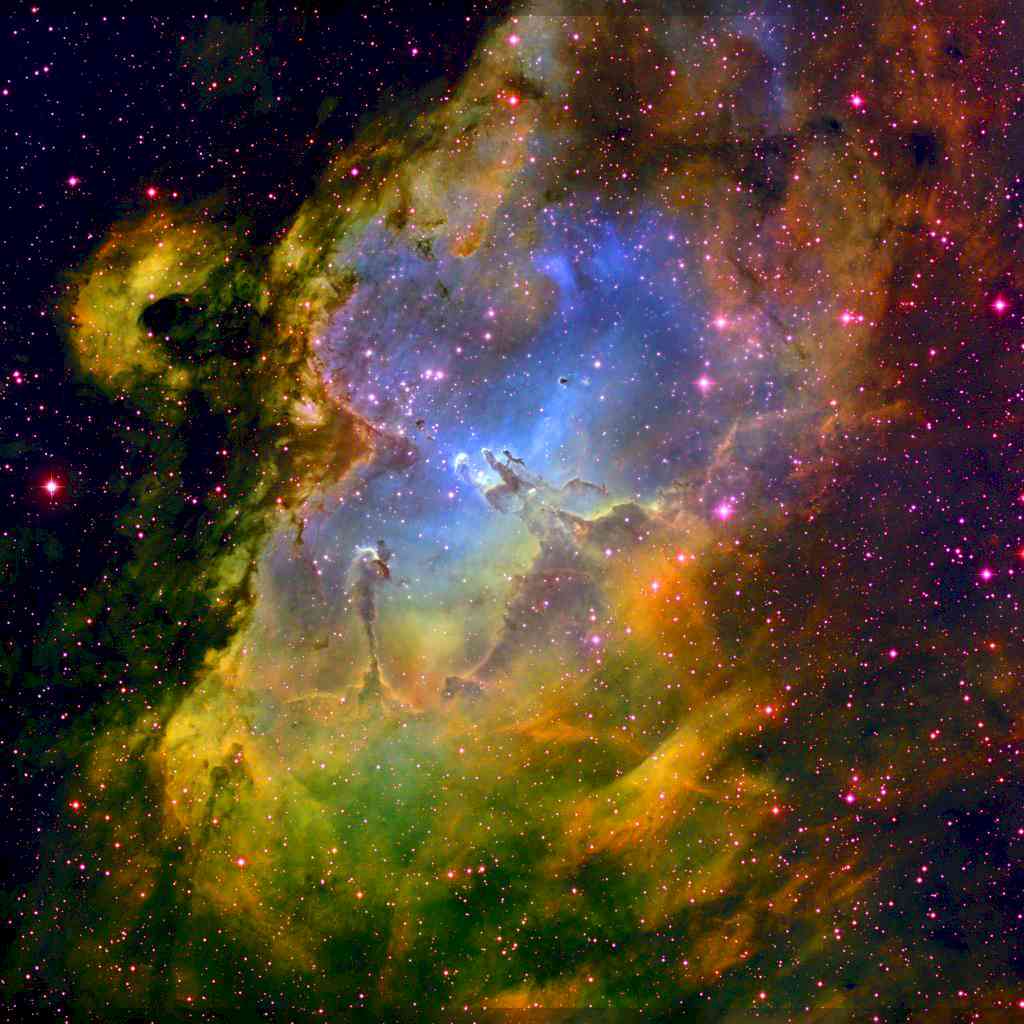
Cosmic Evolution
As mentioned in Part 1, if we were to go back in time and reset the course of evolution, it is highly unlikely that we would be here the second time around. On the other hand, according to some theorists, it is highly likely — perhaps inevitable — that some form of tool-using, self-conscious species would evolve. (For example, self-consciousness might be a form of convergent evolution.) While many biologists emphasize the directionlessness of evolutionary history, many physicists are now identifying a developmental trend in cosmic history, one moving toward localizations of increasing order and complexity which operate against the general entropic trend of the universe. If this is true on the cosmic scale, it is arguably true on a biological scale as well.
Philosopher Ken Wilber argues that, by portraying humankind as merely one strand in the web of life, deep ecology assumes a one-dimensional or “flatland” metaphysics. According to Wilber, a “deeper” ecology would perceive that the cosmos is hierarchically ordered in terms of complexity. Hierarchy does not imply dominion, though — it implies responsibility. This brings me to the third model of evolution, one which combines the insight that human beings are both special and not special. In this “Special/Not Special” model, the universe itself is evolving toward self-consciousness. One step in that evolution of the universe is the development of beings who are self-conscious. In other words, at some point in its evolution, the universe goes from being unconscious to having parts of itself — us — become aware of themselves as parts, as a stage in the process of the whole becoming aware of itself. In this sense, we are special. We as a species represent a point at which the universe has moved closer to self-consciousness. As a result, we have special responsibilities toward other species and the universe as a whole. Read More
We Are (Not) Special: Anthropocentrism and the Evolving Universe (Part 1), by John Halstead
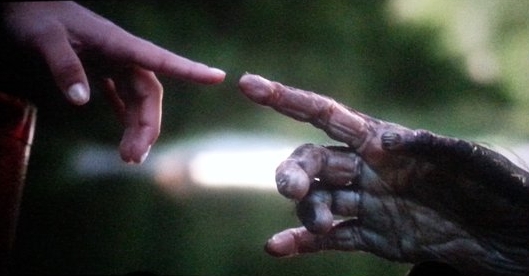
I had something like a spiritual experience watching a movie recently.
The movie Lucy is not what I would call a “good” movie. Starring Scarlett Johansson, Lucy is about a young woman who is kidnapped and has an bag of a new recreational drug implanted in her abdomen against her will. She is then forced to “mule” the drug across international borders. In the process, the bag is perforated and she absorbs a very large dose of the drug into her system. As a result, she begins to be able to access larger and larger percentages of her brain. She gains superhuman abilities, starting with extraordinary reflexes and perception and increasing until she can control matter and even the flow of time.
What made the movie stand out for me was a montage of images which Lucy experiences connecting her both to her remote ancestral past — in the form of her primate ancestor “Lucy” — and to the universe as whole — in the form of mind-blowing macrocosmic vistas. It was little Kubrick 2001-ish. As I walked out of the theater, I had this intense feeling of both our infinitesimal insignificance and our inestimable consequence as a species. I don’t know if this was the intent of the movie, but I was left with an intense feeling both of radical dissociation from the everyday concerns of my life and of deep responsibility to the universe as a whole.
Buy Godless Paganism (paperback)

Buy Godless Paganism (ebook)


Pagan Coming Out Day – May 2nd