Naturalistic Paganism

A Shinto Experience in New Zealand by Megan Manson

The Moon over Lake Te Anau at dusk.

In August, my family made a trip to New Zealand. My husband’s a Kiwi, so one of the main purposes of our trip was to catch up with members of his family. But of course we had plenty of opportunities to make the most of all the incredible experiences New Zealand has to offer.

New Zealand is a paradise for nature lovers and we were lucky enough to have plenty of chances to connect withthe country’s wild soul. We bathed in a natural hot spring that we dug ourselves at Hot Water Beach. We got up close and personal with friendly Kea (mountain parrots) and fur seals. We experienced the thrill of sailing under a waterfall at Milford Sound.

But among all these experiences, for me none were quite so profound as our visit to the Te Ana-au Glowworm Caves. From start to finish, it felt less like a mere tourist attraction and more like a spiritual pilgrimage – and in many ways, a Shinto pilgrimage.

The Journey

The Te Ana-au Caves are located on the west shore of Lake Te Anau, in the southwest of New Zealand’s South Island. At 12,000 years old, these limestone caves are considered young in geological terms, and were first discovered by Europeans in the 1940s following research into ancient Māori legends.

We set out on our pilgrimage at dusk. The tour company that organises the trip, Real Journeys, takes visitors to the caves by boat across Lake Te Anau. The cruise took about 30 minutes and during that time we were able to enjoy the haunting views across the lake. The Moon had risen and was almost full – it looked rather like a rugby ball, appropriately enough for New Zealand!

The Entrance
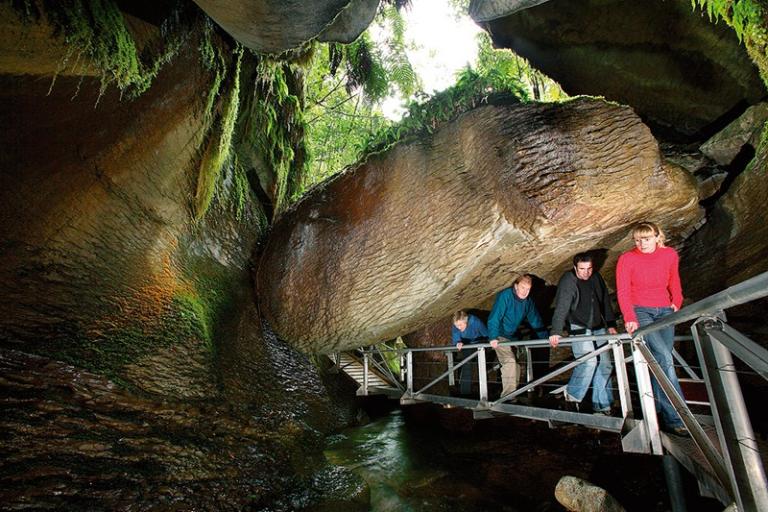
glowworm02

Near the Te Ana-au Cave entrance. Courtesy of Real Journeys

The entrance to the caves is in a beautiful wooded area. The mouth of the cave itself is very low and visitors have to duck down in order to enter. In essence, you have to bow before going into this place. It reminded me of bowing before atorii gate before entering a Shinto shrine, or the way in which traditional tea houses in Japan are deliberately designed with low entrances so visitors must bow slightly in order to enter, showing humility. It was as if Nature herself was telling us that this is a sacred place, and that humans must show respect in order to be admitted.
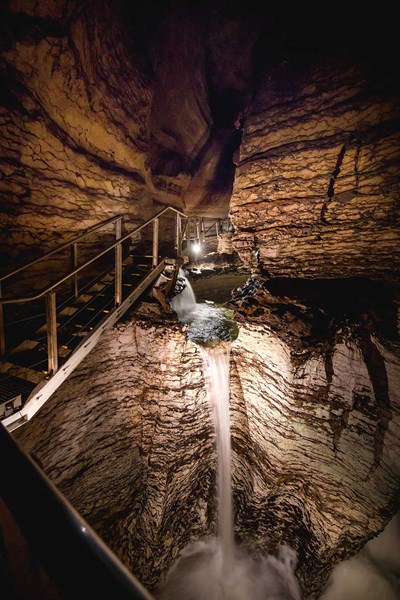
glowworm03

Waterfall in Te Ana-au cave. Courtesy of Real Journeys.

The Purification

The peculiar similarities to a Shinto shrine continued as we proceeded through the cave. We came to a spot where the cave water dripped down from the ceiling. According to our guide, the water is exceptionally pure and is said to bring health and youthfulness to those who drink it. I reached out and scooped some of the water in my hands to drink, all the while thinking how this echoed the purification ritual on entering a Shinto shrine; visitors first purify their hands and mouth before presenting themselves to the kami (deities). I felt as if we were preparing ourselves for a deeply spiritual encounter in these caves.

We then came to an awesome, roaring underground waterfall. In Shinto, waterfalls are considered the dwelling-place of kami. I felt that the presence of something deeply spiritual in this cave was growing stronger and stronger…
The Inner Sanctum

At last, we reached the heart of the caves and the destination of our pilgrimage – the chamber where thousands of glowworms live.

These glowworms are the larvae of a type of gnat called Arachnocampa (“spider-worm”). Like spiders, the glowworms feed by trapping prey in sticky silk threads. Their bright blue-green glow, which is produced chemically, lures creatures into their sticky traps.

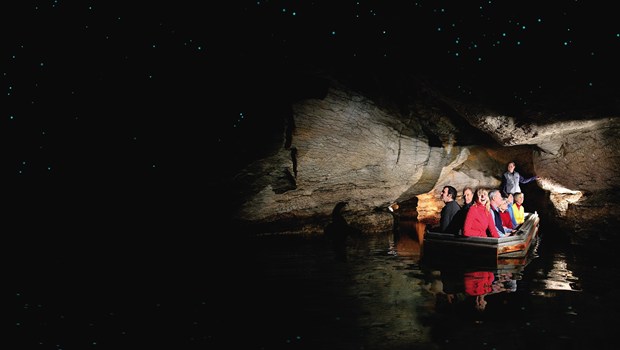
To enable visitors to get a close encounter with the glowworms, Real Journeys take you across an underground lake in a boat in complete darkness. They also tell everyone in the tour group to remain silent. All you can hear is the sounds of the water, and all you can see are the lights of the glowworms.glowworm04

Entrance to the glowworm chamber. Courtesy of Real Journeys.

Floating slowly and quietly through the black caves with only the lights of the glowworms to be seen was an experience that moved me deeply. It felt like flying through the cosmos, surrounded only by stars. Because I couldn’t see the outline of the rocks where the glowworms were and I couldn’t tell how close they were to the boat, this experience also had a dreamlike quality – at times, it felt like the glowworms were the ones that were moving rather than the boat, that they were drifting all around us. It was as if we had passed through the veil and entered the realm of spirits, of kami. I felt such a sense of awe and reverence that I uttered a Shinto norito under my breath in honour of this place.

I am not surprised that these caves are significant in Māori legends. The Māori concept of mana is somewhat similar to kami in that it refers to something that possesses a spiritual quality. I am certain that the Māori who first discovered these caves, like the thousands of visitors after them, felt the overwhelming power of the mana of this place.

It may seem strange that one of the most profoundly Shinto experiences I’ve had was in New Zealand. The whole trip, from the cave’s entrance to the meditative atmosphere of the glowworm chamber, felt like a pilgrimage to a particularly powerful Shinto shrine. To me, this visit to Te Ana-Au Glowworm Caves demonstrated how universal the concept behind Shinto – the sense of respect and awe we feel in the face of Nature’s wonders – really is, and that the kami themselves truly are to be found everywhere.

Original post here.

Megan Manson

kodomonihiMegan is an eclectic Pagan from the UK who also practices Shinto, the Japanese “Way Of The Gods.” She is actively involved in the field of Japan-UK relations, interfaith activities, and her local Pagan community. Her blog can be found here, and her facebook page here.

See Megan’s Posts


[Pagan in Place] “Year’s End: An Invitation to Daily Practice”, By Anna Walther

If you would be radical, the first step you take every morning must be a return to your own heart. You must not look at the evils of the world and recoil into passivity or aggression. You must seek the common root of things with your every breath.”   Read More

“Plants as Aliens”, by Brock Haussamen

Plants are so familiar to us that we don’t see them very well. We look at them and think about them according mostly to how we use them—for food and beauty. To shift our perspective, I’ll look at plants as if they were strangers from another planet, as plant-aliens. Making them weirder may make them more vivid.

Read More

A Call to the Humanistic Pagan Community: Please help Glen Gordon

My friend and fellow Humanistic Pagan contributor, Glen Gordon, has asked the HP community for help.

Glen is struggling with health issues and other personal issues that make it imperative for his emotional and psychological health that he relocate as soon as possible. Glen needs $600 for a deposit on a new apartment. Since he will be moving with little more than the clothes on his back, Glen also needs money to furnish the apartment, like a bed and kitchen supplies.

This is an opportunity for us to show the kind of community we are.  It is an opportunity for us to help take care of one of our own.  This year, HP did not do a funding drive.  I would ask that what money you might have contributed to HP go to Glen this year.

For those of you who know me, but not Glen, I can personally vouch for you. For those of you who know Glen, he needs no one to vouch for him. Glen has struggled with these problems for a long time without asking for our help, and what he has asked for is very modest in comparison to his needs.

If you are able, please help him.  Click this link to go to contribute.

The Wheel of the Year in Stone by Glenys Livingstone Ph.D.

My ancestors built great circles of stones that represented their perception of real time and space – cosmic calendars. They went to great lengths and detail to get it right. It was obviously very important to them to have the stones of a particular kind, in the right positions according to position of the Sun at different times of the year, and then to celebrate within it. [See Martin Brennan, The Stones of Time, 1994.]

Read More