 Naturalistic Paganism
The indifference of nature, by Rua Lupa

“Nature doesn’t care about our personal decisions, if we live one moment and die the next. And I like that.”
photo by B. T. Newberg (gazing up the gummy trunk of a tree)
Is Nature a loving mother? This week Rua Lupa comes forward with an environmental message of freedom and responsibility.
Pentamera Ardea 23 / 10 B.E. (Friday August 13th / 2010 C.E.)
Nature seems to be perceived as a loving mother who takes care of our every need. Who is waiting and watching to catch us when we fall. Well, I beg to differ. What makes Nature its most wonderful is its indifference. Nature doesn’t care about our personal decisions, if we live one moment and die the next. And I like that. Why? Because it means I don’t have someone constantly watching me and grading me on my every decision or thought. It means that I am free to do what I please within the boundaries of the Laws of Nature i.e gravity, within the Laws of the society that surrounds you (which can change and has changed through the hard works of dedicated people), and of course the moral compass that is all your own. It means that you are solely responsible for everything that you do, with no one to blame but yourself. You are who you make yourself to be, no one or thing can do that for you, that is the beauty of Nature’s indifference.
Being alone in Nature for an extended period of time is one of the best ways to learn this from Nature, as it really does put things in perspective. It makes you realize how vast the world and universe is and how truly utterly small and insignificant you actually are. You begin to feel all the life that surrounds you and know that you are a part of it, not separate or better than it like what civil society teaches, but a part. It makes me feel energized and strong to know that through eras of evolution I am somehow here and a part of this complex network of life. I know that when I sit with Nature, I am where I am supposed to be, involved and a part of the big picture.
In our civilized world we like to think that humanity owns and possesses everything, nothing is unknown to us, nothing is outside humanity’s reach, that the wild spaces are just things to conquer – which you hear all the time when it comes to climbing mountains. The fact is, you can never truly own anything. Possession just means control, and control is just something homo sapiens are utterly good at believing they have. When you really analyze everything you ‘own’, it is only because you and your society believes that you own it. What makes that mouse in the cupboard less of an owner of that house than you? It may not have bought the thing, but no homo sapiens consulted it about trading with it to have it move out of its residence for you to possess it. We bargain and trade for things between our species all the time. But we never consider bargaining or trading with other creatures, because we think we are superior to them, separate from the ecological system. “How can you bargain with other creatures?” You might ask. I am not really saying that you should bargain the way our society perceives bargaining. I am saying that you should consider the life forms that surround you and are connected to you. And I don’t strictly mean spiritual, I mean literal. Where do you get your food? How was your home made? Your clothes? It is all through Nature. There is no denying it, we rely on Nature for all our needs. The problem I am trying to emphasize is that we homo sapiens as a whole, tend to ignore that fact. So no, we shouldn’t ‘bargain’, but we should live in a mutualistic manner with the species we depend upon, and cooperate with the species we naturally compete with. We should relearn how to live with our immediate environment and not just take and take and take until nothing is left for the next generation. That is speciescide – for lack of a better word, and it is because we hold no responsibility for our individual consumption.
Nature also seems to be perceived as something that needs to be taken care of or ‘saved’, especially with this ‘Green Movement’ that was seeded in the late 60’s. Even if the entire earth were to be nuked, Nature would persist. So really, when we talk about ‘saving the planet’, we are just talking about our species. And as much as I like to think we are compassionate toward all living things, we are realizing that what affects one species affects every other species connected to it and eventually it connects to us; and that is the root of it. We care because it catches up to us eventually, at least that is how it is now due to the colossal size of our population. Overall, we should take a real look at ourselves and our society and see it for what it really is. Continual consumption and not giving back so that what we consumed returns. Our populations have become too immense to get away with it any more without receiving consequences. Yes, we should change the way we consume and I am very much behind the ‘green movement’ as an environmentalist/conservationist; we just need to realize that we are, in reality, in it for the species. Because Nature doesn’t give a damn.
The author

Rua Lupa
Rua Lupa is the creator of the naturalistic path called Ehoah. She also founded the Sault Community Drum Circle, The Gore Bay Drum Circle on Manitoulin Island, and has been a board member of Bike Share Algoma. She loves the outdoors and enjoys sharing experiences with others of the same passion. She is a strong advocate of wild spaces with native species instead of traditional gardens because of a growing problem with invasive species and lack of space and sustenance for our native wildlife. She strives to learn and retain as much as possible about the natural world and how one can live in balance with the immediate natural environment. She endeavors to one day live comfortably with all basic needs met within the natural environment.
Upcoming work
This Sunday
Rua Lupa, creator of the Ehoah naturalistic path, joins us tomorrow with a message of environmental freedom and responsibility entitled “The Indifference of Nature.”
Rua Lupa
The indifference of nature, by Rua Lupa
Appearing July 31st on Humanistic Paganism.
Recent Work
How Persephone killed the gods for me, by B. T. Newberg
So a polytheist, a Voodoo priest, and a Humanist walk into the woods…

View from the cabin where Drew, Urban, and I will be adventuring this weekend.
photo by B. T. Newberg
by B. T. Newberg
No, the title above isn’t the opening of a bad joke. It’s what Drew Jacob, Urban Haas, and I are going to do this weekend.
We’re setting out on a four-day excursion into the forest at my grandparents’ cabin in Ely, Minnesota. Set near the Boundary Waters Canoe Area, it’s a breath-taking region of marching woods and hidden lakes. It’s the same place I wrote about in a previous post, To build a fire: The spiritual art of socialization. The cabin is thirty minutes from the nearest tar road, has no electricity, and lies on a lake with only one other cabin on it.
But what I’m looking forward to even more than the grandeur of nature is spending time with people who blow my mind.
Drew Jacob, author of Rogue Priest and Walk Like a God, and gracious guest of our recent interview here on HP, is one of the boldest adventurers I’ve met.
And Urban Haas, Voodoo houngan and author of Chasing the Asson, is not to be taken lightly either. From what I’ve seen of him so far, he’s a thoughtful, compassionate, enthusiastic guy with nothing uninteresting about him. I can’t wait to get to know him better.
It’s going to be a confluence of minds, with Drew a Celtic Polytheist, Urban a Vodouan, and myself a Humanistic Pagan. We couldn’t be more different, perhaps, but we’re coming together around the one thing we all (not just the three of us, but everyone in the world) have in common: the glory of nature.
It’s going to be a full agenda: hiking, canoeing, fire-building, sword-fighting (Drew’s specialty), and good conversation. And then of course, there’s always that moment when the talking dies down, silence overtakes, and there is only the presence of the wilderness.
If the mosquitoes don’t eat us, or the bears carry us off into the woods, there will surely be a post on this trip in the future. Look for it in weeks to come.
Till then, enjoy the excellent post lined up for Sunday: an environmental message entitled The Indifference of Nature, by Rua Lupa.
How Persephone killed the gods for me, by B. T. Newberg
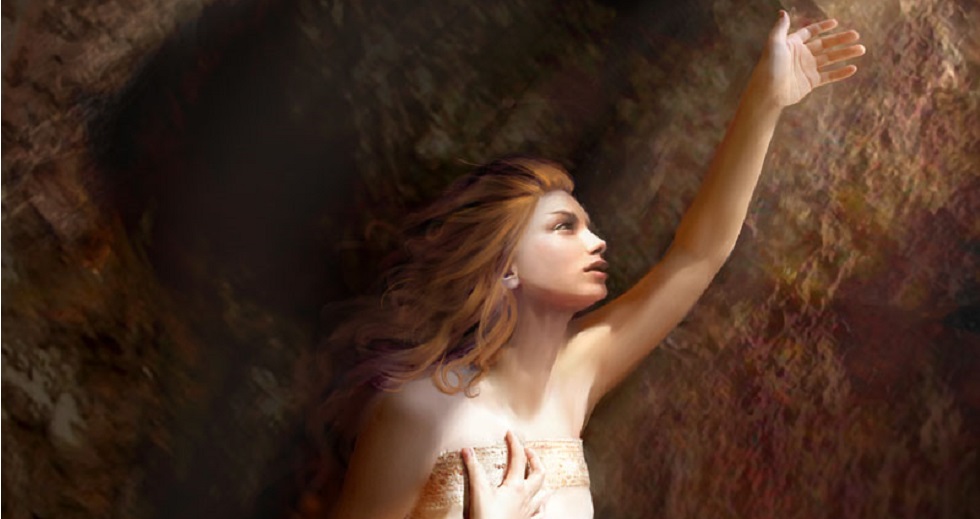
Persephone killed the gods for me.
That slender-ankled goddess, mistress of the underworld – she killed them. And, in that strange way that only gods can do, they came to life again.
Whatever I believed about deities before her, it all changed one summer solstice. This is the story of how Persephone turned me into a Humanistic Pagan.
The gods are dead
For me it was not Nietzsche but Persephone who proclaimed “God is dead.” It is appropriate, for she is a goddess of death after all, a being who dies and rises with the seasons.
According to myth, the young maiden Persephone was picking flowers in a meadow one day when suddenly the earth opened and out came Hades, god of death. He swept her into his chariot and plunged back down to the underworld. There she was to be his bride. Meanwhile, her mother, Demeter, goddess of grain and fertility, searched frantically for her missing daughter. So distraught was she that nothing on earth would grow, no plant nor animal would bear life. At last, Zeus, ruler of the gods, had to step in. The human race was withering, and without them the gods would receive no offerings. Without offerings, the gods too would wither. So a deal was brokered: Persephone would spend most of the year with her mother, but a third of the year she must return to the land of the dead. Thus began the seasons.[1]
So, Persephone knew about dying. If any had authority to declare the demise of the gods, it was her – this lady of life and death, this woman of both worlds.

“Let them die,” she said. And I realized I could no longer pretend.
image enhanced from original by Linda Joyce Franks
Let me back up a little. It was the summer of 2009, and I was standing over a small altar built beside the river. In my hand was a copy of Sargent’s Homeric Hymns, and around my neck was a special pendant. I had worn it for nine months, from the season of her last rising to the present moment of her immanent descent. It was to be an offering for Persephone. Just as she would go below, so I would bury it in the earth. What I didn’t realize was that I would bury the gods too.
For years I had been experimenting with polytheism. I had joined an organization of Pagans, gone through its rigorous training program, and emerged fully proficient in myth and ritual. Demeter and Persephone had been with me through it all. Through them I felt a kinship with the cycles of nature; through them the changing of the seasons came alive. The year felt enchanted, full of meaning. And that experience was very real. But the gods were not – I knew that, and could bear it no longer.
As I poured a libation of barley tea, read aloud the Hymn to Demeter, and called out to the Two Goddesses, Demeter and Persephone, a dull frustration was in the air. The words rang empty.
Then, as my fingers dug into the dirt and deposited the pendant into the ground, a rush came over me. Through my mind flashed a voice:
“Let them die.”
It was one of those moments, the ones you remember long after other memories have faded. I was left ruminating over what it meant, and where to go from there.
One thing was certain: I could no longer pretend, neither in public nor in the privacy of my own mind, that the gods were real.
For me, the gods were dead.

Like Persephone stolen down to the underworld, so too were the gods carried down, deep, and within – into the psyche.
image enhanced from original by Joseph Heintz the Elder
The gods live again
Yet that was not the end of the story. Persephone had still more mysteries to unveil.
How could it be that the goddess herself wanted me to disbelieve in gods? Didn’t they need human offerings, as told in the myth? Without us, wouldn’t they wither away?
I began to ask myself what it was that had persuaded me to “believe” in the gods in the first place. In truth, I had carried an agnostic attitude through it all – intellectually. But emotionally, I had developed a deep relationship with the gods. In some sense, the gods had been real to me.
When I sensed their presence, it was an intensification of emotion that tipped me off. Likewise, a successful ritual was a ritual that was moving, that felt powerful. These were the experiences that “proved” the gods, as it were.
Not all polytheists rely so exclusively on feeling. Others point to more objective phenomena, like strange coincidences or perceptual visions. I experienced some things like that too, but nothing that could not be explained by a naturalistic interpretation. Nor did I ever hear others tell of more convincing happenings. Some had inexplicable experiences, like one friend who saw phantom smoke wisps during ritual. But it is a long leap from seeing something to concluding that gods are real. Better to admit the unknown than to leap to an explanation, theistic or otherwise.[2] Ultimately, it is an act of faith. And my faith was based on emotion, it seemed.
Yet it was not for that matter insignificant.
Real or not, the gods did provoke powerful and beautiful experiences. I am a better person for having them. I feel more in tune with my world, and more alive as a person. This is no small thing in an era when alienation and apathy run rampant. To find connection to the world is to find meaning.
So maybe, in a sense, the gods are real after all.
They may not be literal, independently-existing entities. They may not be causal agents with the power to influence events, save through the actions of my own two hands. They may not send messages, save for what pops to mind through the power of imagination. Yet in some meaningful sense, they are real.
As presences in the imagination, they are real. As cultural and psychological forms, they are real. As sources of meaning and beauty, they are real.
The gods live again.
Thank you, Persephone
Persephone killed the gods for me. And she brought them back to life.
She showed me that gods don’t have to be real in order to be real.
You can develop wonderful relationships with them. They can enhance quality of life, and motivate responsible action. Through their power, your world can grow vibrant.
In that fateful way that makes sense only in myth, the gods had to die in order to bring life back to the world. Inside me, it had been the barren season. Like Demeter searching for her daughter, I was searching for my truth. So long as I had not found it, no living thing could grow. But by letting the gods die, life returned. They were reborn as beings of the mind.
Ultimately, I had to be honest with myself. I simply didn’t believe literally in the gods. Yet that was no reason to foreswear them. On the contrary, it was reason to embrace them all the more.
Since that fateful summer ritual, where I buried the pendant and the gods too, my world has come alive again. No longer do I feel that dull frustration in ritual, that sense of empty words. Now I speak with full knowledge and confidence in what I’m saying. Now I see gods in the human, and the human in the gods.
I became a Humanistic Pagan.
And that’s why I say to you, Persephone, beautiful goddess in my head:
Thank you.

Life returned to the world as I began to speak my truth.
image enhanced from original by Frederic Leighton
Upcoming work
This Sunday
Tomorrow’s piece shares the story of my journey toward Humanistic Paganism.
Read “How Persephone killed the gods for me” tomorrow here on Humanistic Paganism.

B. T. Newberg
Recent Work
Being human when surrounded by Greek gods, by M. J. Lee
Buy Godless Paganism (paperback)

Buy Godless Paganism (ebook)


Pagan Coming Out Day – May 2nd
 Naturalistic Paganism