Naturalistic Paganism
The HPedia: Naturalism
Your help is needed! Please critique this entry from the HPedia: An encyclopedia of key concepts in Naturalistic Paganism. Please leave your constructive criticism in the comments below.
Naturalism is a worldview with numerous technical definitions, each with their own virtues and difficulties. One of the oldest definitions comes from Littré’s 1875 Dictionnaire de la langue française, which defined naturalism as:
“the system of those who find all primary causes in nature” (Furst and Skrine, 1971).
Variations on this definition continues to enjoy popularity today. Concentrating on causes, it allows analysis to focus on how people explain events, which makes it more or less portable across historical eras. Like most all definitions of naturalism, it does not escape the question of differing concepts of nature in different eras, much less the question of the so-called supernatural, which remains problematic in Pagan contexts today.
Other popular definitions obtain, such as these from Wikipedia:
- Methodological naturalism, naturalism that holds that science is to be done without reference to supernatural causes; also refers to a methodological assumption in the philosophy of religion that observable events are fully explainable by natural causes without reference to the supernatural
- Metaphysical naturalism, a form of naturalism that holds that the cosmos consists only of objects studied by the natural sciences, and does not include any immaterial or intentional realities
These two are clarified by William E. Kaufman, starting with methodological naturalism:
Naturalism may be defined as “the disposition to believe that any phenomenon can be explained by appeal to general laws confirmable either by observation or by inference from observation” (CRN 21). This does not mean that everything that happens in the universe is at present explainable. Rather, naturalism represents a methodological recommendation concerning the theory of knowledge. What it suggests is that the only instruments of knowledge we possess are reason and critically analyzed experience. Claims to knowledge based on a special faculty, such as mystical intuition, must therefore be recognized as assertions of faith which cannot be verified and can only be evaluated in terms of their consequences for human conduct. The reliance on reason and critically analyzed experience is thus the method of naturalism, its logic of inquiry.
Kaufman goes on to speak of metaphysical naturalism:
Naturalism as a theory of reality, however, can be problematic because of the ambiguity of the term “nature.” For most naturalists, nevertheless, it is safe to say that “nature” signifies the totality of reality — its substance, functioning and principles of operation, since what distinguishes naturalism from other metaphysical standpoints is its claim that there is nothing beyond nature.
HP adopts only methodological naturalism as an essential tenet; metaphysical naturalism is left up to the individual to accept or reject. This is simply and purely a statement of what HP is, not a dogmatic proclamation of what is right or wrong for all people in the universe to believe. Those who practice HP do not invoke supernatural causes; others are free to do as they see fit. Invoking supernatural causes is neither condoned nor condemned; it just isn’t HP.
Metaphysical naturalism (also called philosophical or onotological naturalism) is left up to the individual to accept or reject. Some may find it questionable to believe in the existence of the supernatural while denying it any causal influence, but that is for individuals to judge for themselves (those interested may see Barbara Forrest’s treatment of the methodological-philosophical naturalism debate). The only naturalism required for a path to be considered HP is methodological naturalism.
In HP, naturalism refers to methodological naturalism, unless otherwise specified.
Note that the definitions above rely on definitions of nature and science, which are not uncontested.
See also “Nature”, “Supernatural”, and “Science.”
Check out other entries in our HPedia.
Naturalistic Druidry: A Retrospective, by WhiteHorse

Can we learn from past mistakes, in order to build a better future?
Yesterday’s article, entitled “What Do Druid Naturalists Do?”, explored the activities of the recently-defunct Druidic Order of Naturlists (DON). This follow-up article draws insight from DON’s twilight, in order to build a better community for the future.
Sadly, since I wrote the original article about 3 years ago, the Druidic Order of Naturalists is no longer active. However I would like to share some ‘lessons’ that I learnt from our ‘experiment’ with a naturalistic pagan group in the United Kingdom.
I still believe naturalistic paganism can be as coherent and viable as any form of ‘religious’ or theistic paganism. However to be an effective movement the naturalistic pagan must focus on the positive. The group has to be more than a platform for criticizing religious beliefs, pagan or otherwise. It is easy for the naturalist to say what she doesn’t believe in without knowing what they are ‘for’ and what contribution they can make to wider paganism/society. Also while some naturalists have a deep personal disillusionment with religion, you should not let this become the main motivation driving the group. Read More
What do Druid Naturalists do? by White Horse

What exactly is it that a Druid Naturalist does?
The following is an article excavated from the Druidic Order of Naturalists, which is unfortunately now defunct (though its website is still accessible). While the Order may no longer operate, its legacy remains instructive for naturalists of all stripes.
This is a non-exhaustive and definitely non-compulsory list of things that some (but not all) members of the Order might be involved at any one time and which the Order can encourage and facilitate:
Naturalistic Ritual
- Celebrating Nature and our fundamental connection and response to it, notably the seasonal festivals and cycles of nature familiar to most pagans. We wish to design and take part in rituals and celebrations that don’t require a belief in the supernatural but are yet evocative, profound and inspiring.
- Celebrating the entirely made up festival of Yode (See below)
- In the long term contributing to the development of alternative rituals for rites of passage from birth to death and developing celebrants to take part in these. Promoting humanistic and non-religious celebrants and rites of passage generally. Read More
The HPedia: Pagan
Your help is needed! Please critique this entry from the HPedia: An encyclopedia of key concepts in Naturalistic Paganism. Please leave your constructive criticism in the comments below.
There are generally four different uses of “Pagan” floating about, in order from most restricted to most broad:
- Someone belonging to a range of contemporary religions/spiritual paths inspired by pre-Christian Indo-European or Mediterranean traditions, though not necessarily attempting to recreate them exactly as they were. This meaning can be more precisely denoted by “Contemporary Pagan” or “Neopagan”, but Pagan rolls off the tongue better and serves as a nice shorthand.
- Someone belonging to such a contemporary religion or a historical person belonging to said pre-Christian Indo-European/Mediterranean traditions from those times, e.g. Roman polytheists of Classical times, Norse, Greeks, Egyptians, Indians, etc. This usage is somewhat anachronistic as the ancient peoples did not call themselves Pagan but were called that derogatorily by Christians in the late Roman era. Nevertheless, the term has been reclaimed by moderns and now serves to emphasize the link between those moderns and their spiritual ancestors.
- Someone belonging to a contemporary religion or path which shares certain things in common with Neopagans, such as an earth-centered nature-based path or an interest in the Occult. E.g. Gaians might be covered under this meaning.
- Anyone belonging to a non-Abrahamic religion.
HP used to use “Pagan” to refer primarily to the first two, and sometimes a little more inclusively to include the third, with the fourth being considered too broad to be of much use. However, in 2013 popular opinion found this usage unnecessarily restrictive, so “Pagan” has now opened up to include the fourth meaning.
Halstead has analyzed Contemporary Paganism in terms of three partially-overlapping centers of interest, resulting in some tension and conflict in the community:
- The Three Centers of Paganism (adapted from Halstead)
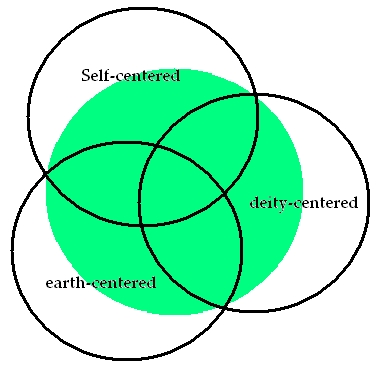
Recently, controversy has raged over the definition of “Pagan”, mainly as a matter of identity in the community. Essential characteristics, as well as who/what to include or exclude have been central issues. There have been notable debates over the appropriateness of Atheist Pagans and “Christo-Pagans” under the Pagan umbrella.
Check out other entries in our HPedia.
Truth and compassion: Which takes priority?

When push comes to shove, which do you value more – truth or compassion?
– by B. T. Newberg
In a recent guest post at The Friendly Atheist, Marcus Mann posed a question:
“I have to ask to what degree correctness crowds out other values important to me, particularly that part of me that strives to be kind… atheists need to be wary of valuing correctness over the much more important values of kindness, sobriety, and pluralism.”
In that spirit, I want to ask: Which is more essential to you, truth or compassion?
By truth I mean factual accuracy, fidelity to reality, or tracking what’s objectively “out there.” I realize there are other kinds of truth, such as poetic truth, but today let’s stick to factuality. By compassion I mean non-suffering, non-harm, or the promotion of well-being for others and yourself.
Most of the time these two enjoy happy agreement, but occasionally they may conflict. In those cases, which takes priority?
Precedents in Paganism
The priority of truth in Paganism has precedent. For example, the myth of matriarchal prehistory, though important to many and no doubt painful to give up, has largely been discarded. So have many of the more fantastical notions about our past, thanks in no small part to the work of Reconstructionists. Many polytheists today value accuracy of historical fact over fanciful invention, no matter how warm and fuzzy it may make one feel. They draw a line (rightly, in my opinion) at the reality of the gods beyond which they will fight for their views vociferously.
The priority of compassion also enjoys precedent. The principle of non-harm, encapsulated in the popular counsel “Harm none, do as you will”, puts the wellbeing of others on center stage, alongside the freedom to pursue one’s path regardless of what others may think. Buddhism is also well-known for making compassion, alongside wisdom, one of its highest values. Read More
Buy Godless Paganism (paperback)

Buy Godless Paganism (ebook)


Pagan Coming Out Day – May 2nd