Naturalistic Paganism
The Spiritual Naturalist Society now has a podcast!
The Spiritual Naturalist Society now has a podcast: “Spiritual Naturalism Today!” They have just released their first podcast where they talk about what Spiritual Naturalism is. Click on the image below to go there now.
“Why ‘Naturalistic Pagan’?” by NaturalPantheist
NaturalPantheist’s blog has recently moved to www.naturalpantheist.com. Remember to update your bookmarks and subscriptions! This essay was originally published naturalpantheist.com.
As you know, there has recently been a kerfuffle in the blogging sphere between Naturalistic/ Humanistic Pagans and Hard Polytheist Pagans. Now I follow many bloggers both Naturalistic Pagan and Polytheist Pagan, and a Heathen blogger has recently written a blog addressed to John Halstead (and any other Naturalistic Pagans) asking why we identify as Pagans, rather than just atheists/ humanists ect. This is a very valid question and so I’d like to respond with my own story and thoughts …
Why am I a Naturalistic Pagan?
Let’s start off with why I don’t call myself an atheist. I was most definitely an atheist for a while after I left fundamentalist Christianity. In the immediate aftermath of the death of a friend and the searching it led me to engage in, I was first a liberal Christian and then very soon became atheist, thanks to watching many Youtube videos and reading books by prominent atheists. But that wasn’t the end of my religious journey. I was hungry for more.
When I found the World Pantheist Movement, I became a Pantheist – one who sees the universe as divine and the earth as sacred. This was religion without the supernatural. I still consider myself a Pantheist. I see the Earth as Mother Nature, something to be honoured, revered and, yes, worshipped. I even pray to the Earth. It is our duty as children of the Earth to honour and look after her. This to me is the essence of Paganism. Read More
Reserve Your Copy of “Godless Paganism” and Support the Wild Hunt!

We’ve reached our funding goal in just 16 hours! Thank you to everyone who contributed. But we’re not done …
But you can still order your copy of “Godless Paganism” and take advantage of the other perks. All profits over and above our funding goal will go to The Wild Hunt’s fall funding campaign!
To reserve your copy of “Godless Paganism”, go to the campaign page and click one of the perks:
- All contributions of $20 or more will get a copy of “Godless Pagans: Voices of Non-Theistic Pagans” hot off the press (hard copy plus ebook/pdf).
- All contributions of $45 or more will their name or the name of the organization of their choice listed on the acknowledgments page of the book AND a copy of “Godless Pagans: Voices of Non-Theistic Pagans” hot off the press(hard copy plus ebook/pdf). There’s still 8 more of this perk left!
- All contributions of $100 or more will get a graphical ad (165×165) at HumanisticPaganism.com linking to the website or blog of their choice AND their name or the name of the organization of their choice listed on the acknowledgments page of the book AND a copy of “Godless Pagans: Voices of Non-Theistic Pagans” hot off the press (hard copy plus ebook/pdf). There’s still 3 more of this perk left!
Shipping outside the U.S. can be arranged by contacting humanisticpaganism@gmail.com directly.
And don’t forget to:
- Send your articles and essays about non-theistic Paganism to humanisticpaganism@gmail.com for consideration for inclusion in the book. It can be something you have shared before or something new. Poetry, photography, and other art is also welcome.
- Share this on Facebook and other social media.
Help Us Publish “Godless Paganism: Voices of Non-Theistic Pagans”

We are gathering writings of atheist and other non-theistic Pagans for publication of the first ever anthology of writings by and about non-theistic Pagans.
“But ‘atheist Pagan’ is a contradiction in terms!” Maybe you have heard this or something like it before. Maybe you are an atheist Pagan and you’ve kept it a secret because you thought you were the only one. The truth is that atheist Pagans exist! Together with other non-theistic Pagans, like humanists, naturalists, animists, pantheists, and Gaians, atheist Pagans are part of a growing and vibrant community within the larger Pagan umbrella.
Non-theistic Pagans are Pagans who do not believe in the literal existence of personal gods. But beyond that definition, “non-theistic Pagan” may refer to a variety of theological orientations. For some, gods play no role in their spiritually at all. For others, gods are seen as mere metaphors or as numinous archetypes. Some are pantheists or animists. Most non-theistic Pagans share a love of Pagan ritual and myth and experience a deep sense of awe or reverence in nature.
What We Need
- What we need: $687 ($624 publishing costs + $63 platform and transaction fees) CLICK HERE TO CONTRIBUTE.
- Essays and articles on the meaning and practice of non-theistic Paganism. Poetry, photography and other art is also welcome. Send to humanisticpaganism@gmail.com
What You Get
- All contributions of $20 or more will get a copy of “Godless Pagans: Voices of Non-Theistic Pagans” hot off the press (hard copy plus ebook/pdf).
- All contributions of $45 or more will their name or the name of the organization of their choice listed on the acknowledgments page of the book AND a copy of “Godless Pagans: Voices of Non-Theistic Pagans” hot off the press(hard copy plus ebook/pdf).
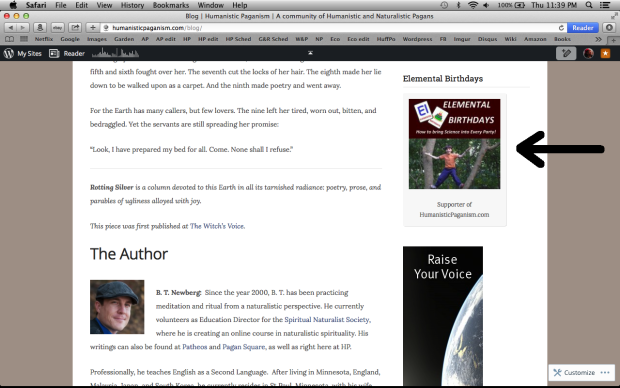
- All contributions of $100 or more will get a graphical ad (165×165) at HumanisticPaganism.com linking to the website or blog of their choice AND their name or the name of the organization of their choice listed on the acknowledgments page of the book AND a copy of “Godless Pagans: Voices of Non-Theistic Pagans” hot off the press (hard copy plus ebook/pdf).
Shipping outside the U.S. can be arranged by contacting humanisticpaganism@gmail.com directly.
(If we do not reach our goal, your contribution will go toward a more limited publishing run and you will still get your perks.)
Other Ways You Can Help
- CLICK HERE TO CONTRIBUTE.
- Send your articles and essays about non-theistic Paganism to humanisticpaganism@gmail.com for consideration for inclusion in the book. It can be something you have shared before or something new. Poetry, photography, and other art is also welcome.
- Share this on Facebook and other social media.
[Rotting Silver] “Simile of the Open Queen” by B. T. Newberg

This Earth may be compared to a queen who declared her body’s love open to all.
She sent her animals to call those who had been invited to her bed, but none would come.
Again, she sent her servants, saying, “Tell those who have been invited: Look, I have prepared my bed with green leaves, I have lined my eyes with dew, sweetened my breath with daffodils, and decorated my dark skin with sprouting things.”
Then nine came to call upon the Earth. Of the nine, one neglected her while another took her roughly. A third took her weight and measure, and a fourth sang of her from afar. The fifth and sixth fought over her. The seventh cut the locks of her hair. The eighth made her lie down to be walked upon as a carpet. And the ninth made poetry and went away.
For the Earth has many callers, but few lovers. The nine left her tired, worn out, bitten, and bedraggled. Yet the servants are still spreading her promise:
“Look, I have prepared my bed for all. Come. None shall I refuse.”
Rotting Silver is a column devoted to this Earth in all its tarnished radiance: poetry, prose, and parables of ugliness alloyed with joy.
This piece was first published at The Witch’s Voice.
The Author

B. T. Newberg: Since the year 2000, B. T. has been practicing meditation and ritual from a naturalistic perspective. He currently volunteers as Education Director for the Spiritual Naturalist Society, where he is creating an online course in naturalistic spirituality. His writings can also be found at Patheos and Pagan Square, as well as right here at HP.
Professionally, he teaches English as a Second Language. After living in Minnesota, England, Malaysia, Japan, and South Korea, he currently resides in St Paul, Minnesota, with his wife and cat.
After founding HumanisticPaganism.com in 2011 and serving as managing editor till 2013, he now serves as advising editor, and feels blessed to be a part of this community.
Buy Godless Paganism (paperback)

Buy Godless Paganism (ebook)


Pagan Coming Out Day – May 2nd