Naturalistic Paganism
My Path to Paganism, by Tyler Clow

My Path Begins
Like many before me and many others since, I was baptized into Christianity as an infant. I could barely support my own head, let alone understand the concept of God or the tenets of the Bible, yet I had already undergone a formal initiation rite and been declared an official member of the Catholic Church. Beyond that, however, religion was not a major part of my upbringing, as my parents had separated before my second birthday and my primary residence was with my non-denominationally monotheistic father.
Of course, my mother was only loosely Catholic herself, and even though I spent at least every other weekend and half of all holidays and vacations with her I can still count on one hand how many times we went to a Sunday church service. In fact, the first time I remember Christian doctrine even being mentioned was when I was school age and she told me – as well as my younger sister, whom she did not have baptized – the Abrahamic creation story with Adam and Eve’s disobedience and subsequent expulsion from the Garden of Eden.
At roughly the same time, I had been exposed to many Pagan influences as well. My four step-siblings were being raised Pagan by their mother, a number of close friends of the family were Pagans, and my step-father worked for several art galleries and seasonal haunted houses in Salem, Massachusetts – the “Witch City” – so a good portion of my peers, adult role models, and acquaintances from an early age were Pagans of a variety of traditions.
Late Winter Theme: The Unexpected
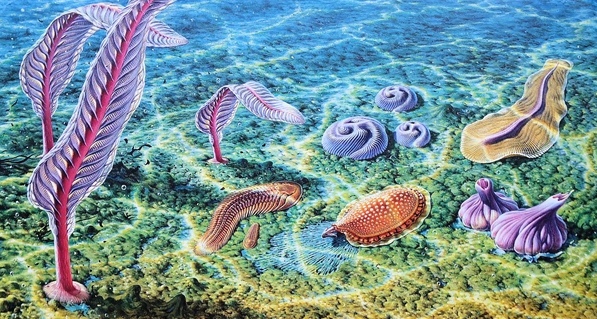
Continuing our Deep Time map, late winter looks to the time from the first cell to the evolution of animals. For me, animals are a huge leap from bacteria – something unexpected, and time and again in my life, I’ve learned about things that I previously had no idea were real. As with all themes, this just an optional muse.
Late Winter (February 2 – March 20)
Cosmic event: First life on Earth to first animals
Theme: Unexpected discoveries
Questions: Life is an incredible thing – to imagine that molecules could self organize to give us reproduction, DNA heredity, and movement! Similarly, are there things in your life or in our world that have appeared in surprising ways – things that you didn’t imagine could exist?
[The Dionysian Naturalist] “Dancing with Dionysus: Ecstasy and Religion in the Age of the Anthropocene, Part 4” by Wayne Martin Mellinger, Ph.D.

Continued from Part 3 …
DIONYSIAN NATURALISM AND THE QUEST FOR ECSTASY
Unitarian-Universalists and Religious Naturalists are both groups of people concerned with infusing reason and science into modern religious life and practice. In social worlds often replete with supernaturalism and superstition, this itself is a noble goal. And while in so many ways I am with them in that pursuit and definitely want a religious cosmology ground in scientific evidence, I follow Friedrich Nietzsche in seeing modernity as expressing the triumph of the Apollonian. Instrumental rationality and cold calculation have almost killed the soul of the world—the Pagan notion of anima mundi—and we desperately need a Dionysian revival.
Dionysian Naturalism, while ground in a scientific worldview and in the practices of critical thinking and skeptical inquiry, maintains a healthy place for the passions and the emotions. Moreover, our human impulses and instincts are seen as related to our sacredness. “Dionysian”, for me, invokes the Earth-centered Pagan traditions of the ancient world and their corporeal form of communion. Dionysian Naturalism reclaims the Sacred Journey at the heart of Western Nature Religions. And it celebrates these forms of ecstasy as ways to re-sacralize the natural world. Thus, I want to bring together Pagan and Naturalist traditions.
In ancient Greece ekstasis meant “standing outside oneself” and referred to the flight of the soul from the body. While I originally associated the “Dionysian” with wild states of frenzy, profane experiences of “partying” and drunken orgies, I now know that the “Dionysian” essentially involves being transported to a spiritual realm, in which even calm and meditative, but no less profound, states of consciousness may be experienced. While reclaiming ecstatic religion and the potential of sacramental entheogen use, Dionysian Naturalism also explores other alternative non-entheogenic spiritual practices which may equally serve to re-sacralize nature and create transcendent experiences.
Personally I have learned that, because of my prior abusive experiences with cocaine and methamphetamine, I must be vigilant about sobriety, for my mind will tell me that all recreational drug use is equivalent to entheogenic sacramental use (“Go ahead and get high! “The Will to Party” is a sacred instinct!”), and when that happens I tend to loose everything in my life. Being someone with bi-polar disorder with a history self-medicating with high-powered stimulants leading to repeated bouts of homeless, I must continue to discover new ways to “dance with Dionysus” This has opened up my spiritual journey in greatly enriching ways and has lead to deep study of meditation, yoga and tantric sexuality. Elsewhere, I detail “The Amethyst Path” of recovery I follow in which I seek Dionysian spirituality while maintaining sobriety.
ENCHANTING NATURALISM
I describe much of contemporary naturalism as “disenchanted”, that is, as a deterministic, mechanistic and reductionistic scientific worldview in which everything can be explained through natural laws and mechanisms, with no mystery left behind. Disenchanted naturalism observes the natural world through a detached objective perspective in which any notion of wonder has been removed. The consequence of this way of thinking has been near ecological collapse. By conceiving of nature as mere “inert matter” with the central purpose of serving human needs we set up a situation ripe for human abuse and exploitation of the biosphere.
To “save our planet” we must re-sacralize nature, for no people who truly revere our natural world would allow it to become destroyed. Thus, “enchanting” naturalism is essential to the survival of our planet. To change from a disenchanted naturalism to an enchanted naturalism one need only acknowledge that one is in the presence of the sacred. We must open ourselves to the mysteries of the Universe with ways of knowing that integrate imagination, aesthetic sensibility and religious intuition. As stated, the Pagan notion of anima mundi—the soul of the world—is being revived. Through acts of enchantment our alienation from the natural world can be removed and we can again feel the magic of a spring morning, a shooting star on a warm summer night and the majesty of a snow-capped mountain. Without doubt, Dionysian Naturalism is an enchanted naturalism!
A paradigm shift is occurring in which the Universe is now imagined, not as a clocklike mechanism in which wholes are reducible to their parts, but as a sacred living system with emergent properties. This new worldview brings together the wisdom of religion and science to change our relationship to the cosmos. By re-enchanting nature and reviving anima mundi, we re-affirm that we are an intimate part of the web of life and kin to other species. The resulting sense of belonging to this planet is required if we are create a new global ethic in which all objects are valued and respected and choose to live responsibly. Our ancient Pagan roots are still alive and we must graft our modern spirits onto them to protect our sacred living planet.
About the Author
 Wayne Martin Mellinger, Ph.D. is a Santa Barbara-based social justice activist, writer, and educator who uses spiritual practices to create a better world. Specifically, Wayne is very active in helping our neighbors of the streets transition into permanent housing and environmental issues. He has taught at the Santa Barbara, Santa Cruz, and Berkeley campus of the University of California, Ventura College, the Fielding Graduate University and Antioch University Santa Barbara.
[The Dionysian Naturalist] “Dancing with Dionysus: Ecstasy and Religion in the Age of the Anthropocene, Part 3” by Wayne Martin Mellinger, Ph.D.

Continued from Part 2 …
SACRED JOURNEYS AND THE WESTERN MYSTERY TRADITIONS
Through years of deep study of the Western Mystery Traditions I have identified some “base elements” in the “Sacred Journey”, in which earlier paleolithic shamanic practices become “re-articulated” and re-adapted through subsequent traditions, including the Paganisms of the classical age (Greek, Roman, Celtic, Teutonic, Norse), Hermeticism, Alchemy, Medieval Witchcraft, as well as other so-called “esoteric traditions”. These base elements are also found within the western Christian mystical traditions (Hildegard von Bingen, Saint Francis, Mister Eckhart). Broad parallels in the underlying structure of this formulation might be seen in such diverse traditions as Carl Jung’s Archetypical Psychology, Joseph Campbell’s Hero’s Journey ( or “monomyth”), Ralph Metzner’s Green Psychology and Michael Harner’s Core Shamanism, although important substantive differences exist which I won’t discuss here due to space constraints. I believe these sacred practices are at the heart of Nature Religions as they serve to make the natural world a sacred place and strengthen our spiritual connections to our planet
Base Elements in the Sacred Journey
1. Individuals begin with an experience of psychological crisis verging on insanity. Included here might be intense feelings of isolation, fragmentation, nihilism, alienation and despair. In this state of misery ego blocks intuition, attempts at healing, wellness and wholeness are thwarted, and traditional ways of seeing prevent the new perspectives needed move forward or change. In this initial state people often feel separated from the natural world and thirst for a unifying wholeness.
2. Individuals partake a “Sacred Journey” in which they “travel” beyond the realms of their culture’s pre-established and accepted ways of knowing through an ecstatic state in which they reclaim a forgotten gnosis. This is a journey of death and re-birth, for the old Self shall die and a new Self will emerge. While physical pilgrimages to real places have long been essential forms of Sacred Journeys, other types of “travel” have equally long lineages. While many traditions in the Western Mystery Tradition see this journey as a literal voyage to another realm, for Religious Naturalists the notion of a journey is more symbolic and denotes more inner transformation than actual travel to another place.
3. All Sacred Journeys involve a change of consciousness. The techniques used to achieve such transformations are many, and might include the real-world trials and tribulations of a life lived, overcoming physical limitations through disciplined training, sensory deprivation, “shadow work” (in which psychological “demons” are confronted), entheogenic sacraments, mystical experiences, contemplative practices or other trance-inducing methods. Some of these transformational processes may be virtually unmotivated and spontaneous, while others involve intensely motivated effort, arduous study and greatly focused attention. Rejecting mind / body dualisms, I envision all these vision quests as involving the full human.
4. These processes of non-ordinary states of consciousness dissolve the subjective mind, deflate the ego and re-connect the human with nature. The outcome of these Sacred Journeys is a new way of viewing the world, other life forms and ourselves. Individuals enter a state of egoless becoming, personal integration and transcendence. A universal vision in which individuals experience themselves as part of ongoing humanity embedded in the very processes of creation may also result.
5. Having found their Holy Grail—a new way of seeing the world, a new and transcendent sense of identity, and new ways to bring healing to their community, individuals return to re-integrate into mundane social life with numerous gifts and forms of wisdom. The recovery of the numinous leads to a state of wholeness and health.
Humans have an innate need to alter states of consciousness. This need has evolved in our species over hundreds of thousand of years and serves evolutionary purposes. These purposes include the generation of new ideas and perspectives, psychological integration, health and wholeness, re-connection with nature and other living beings, and numerous other religious functions. These practices have been institutionalized and enculturated in diverse shamanic and other spiritual practices throughout history.
My focus has been on locating these practices in the traditions of my Northern and Western European ancestors, although clear parallels exist among other traditions, including those of indigenous people of the American, African and Asian continents. This focus on the spiritual traditions of my European ancestors avoids many of the ethical problems involved the cultural mis-appropriation of non-European practices, in which, for example, “white shamans” enormously profit from stealing Native American spiritual practices.
In the language of the soul, we might state that the individual, prior to the Sacred Journey, has lost contact with the sacred. To re-establish our connection to the soul, direct experiences of the sacred are necessary. The Sacred Journey is a form of soul retrieval. Everything, both animate and inanimate, is imbued with spirit. We need to re-populate the woods, rivers and mountains with numina, for our dis-ease is linked to our dissociation from the natural world. I hold that all of the Universe (by which I also mean “Nature”) is sacred. For me, this “sense of the sacred” is invoked by (1) the incredible mystery at the center of our understanding of the cosmos; (2) our absolute dependence on the natural world as a source for all life and for our very sustenance, survival, revelation and fulfillment; and (3) awareness of our humble human fragility in the face of nature’s awesome power.
Humans seem to naturally distinguish between that which is sacred and that which is profane, and to say that nature is sacred is to insist that it must be treated with respect and reverence and never violated. It is of utmost important. It is holy and ultimate. This conception of the natural world as sacred is intended to change our relationship to the planet and even if it is built upon a somewhat mythic metaphor, this radical leap of imagination can be a purposeful act which promotes ecological consciousness.
While elements of these Sacred Journeys are at the heart of most Nature Religions in the Western Mystery Traditions (such as Wicca, reclaimed Paganism, Druidry, etc), thusfar, Religious Naturalists have not embraced these “base elements” of the Sacred Journey. Enter Dionysian Naturalism.
To be continued …
About the Author
Wayne Martin Mellinger, Ph.D. is a Santa Barbara-based social justice activist, writer, and educator who uses spiritual practices to create a better world. Specifically, Wayne is very active in helping our neighbors of the streets transition into permanent housing and environmental issues. He has taught at the Santa Barbara, Santa Cruz, and Berkeley campus of the University of California, Ventura College, the Fielding Graduate University and Antioch University Santa Barbara.
[The Dionysian Naturalist] “Dancing with Dionysus: Ecstasy and Religion in the Age of the Anthropocene, Part 2” by Wayne Martin Mellinger, Ph.D.
Continued from Part 1 …
UNITARIAN UNIVERSALISM AND THE GROWTH OF RELIGIOUS NATURALISM
It is within the context of Unitarian-Universalism (UU) that I discover Religious Naturalism (RN). Many of the core theologians of RN are based in this denomination, including Donald Crosby, Jerome Stone, Robert Corrington and Michael Hogue. While not all UUs are Religious Naturalists, the faith does provide the growing movement somewhat of an institutional base. Religious Naturalists generally hold that:
1. The natural world is all that exists;
2. Science is a good way to know about that world, although not the only way;
3. There are religious aspects of this world.
Religious Naturalism fits with the overall UU concern for creating a more rational approach to religion ground in the reality of this world and supported by recent scientific discoveries. In the early part of the twentieth century both Unitarians and Universalists were already reading the Bible metaphorically and affirming the humanity of Jesus. Unitarians were particularly prominent as signers and backers of the original Humanist Manifesto (1933) which stated, among other things, that science and reason have important roles to play in the pursuit of religious belief and practice.
Unitarian Universalism (they merged in 1961) is a radically inclusive faith in which “all people of good will are welcome”. They tend to emphasize “deeds not creeds” and have what I would call a very thin unifying theology. My particular congregation in Santa Barbara has Buddhists, Christians, Jews, Pagans and a large non-theist /panentheist Humanist / Naturalist contingent. UUs proudly proclaim themselves a “liberal religion”, and have been instrumental in civil rights, marriage equality and environmental movements.
With the addition of a Seventh Principle in 1986 affirming and promoting “respect for the interdependent web of all existence” and of a Sixth Source in 1995 affirming the “spiritual teachings of Earth-centered traditions, which celebrate the sacred circle of life and instruct us to live in harmony with the rhythms of nature”, Unitarian Universalists increasingly opened themselves up to all Nature Religions, including Wiccans, Pagans, Druids and Religious Naturalists. The Bay Area feminist Wiccan and UU Starhawk played a central role in the adoption of this Sixth Source and is a frequent instructor at the UU Starr-King seminary associated with the University of California at Berkeley—one of the two exclusive UU theological training centers.
As implied above, Religious Naturalism is, in my opinion, a subset of the Nature Religions, in that it centrally regards the natural world as inherently sacred. Yet, ground in a scientific worldview, RN asserts that there is no ontologically separate realm which gives meaning to this world. Moreover, it claims that there are religious aspects of this world which can be understood within a naturalistic framework. We might say that Religious Naturalism is a Nature Religion without the supernatural “woo-woo”.
Naturalists do not suppose that all truths are scientific truths, what is sometimes called “scientism”. Rather, naturalists argue only that science offers the best way to understand the nature of reality. Naturalists believe that answers based in science are generally more reliable and universally acceptable than those derived from other ways. While many Naturalists are non-theists there are also those who are theist, pantheist and panentheists.
Our physical world consists of a space-time continuum composed of the basic elements as described by contemporary physics. The natural world is all that exists and there is no evidence of a special realm “out there” filled with angels, animal spirits nor deities. The “epic of evolution” is the story told by scientists and others about the various processes that have lead us from the “Big Bang” to our present moment—from hydrogen to humans, one might say. Included within that story are the processes of natural selection which have populated our world with various flora, fauna and other life forms. While firmly ground in a scientific cosmology, Religious Naturalism can be seen as a revival of ancient creation-based spirituality through its focus on cosmic evolution.
Naturalist spirituality posits an underlying unity and interconnectedness of all phenomena. It leads to mystery and wonder about why we are here or exist at all. It leads to a sense that Spirit and sacredness is at work in the cosmos. Increasingly, the scientific community refers to the Earth as if it is a sacred living organism—“the Gaia hypothesis”. It seems important to note that referring to this world by the name of a goddess acts to reclaim the sacred feminine, which had long been banished from western civilization.
To be continued …
About the Author
Wayne Martin Mellinger, Ph.D. is a Santa Barbara-based social justice activist, writer, and educator who uses spiritual practices to create a better world. Specifically, Wayne is very active in helping our neighbors of the streets transition into permanent housing and environmental issues. He has taught at the Santa Barbara, Santa Cruz, and Berkeley campus of the University of California, Ventura College, the Fielding Graduate University and Antioch University Santa Barbara.
Buy Godless Paganism (paperback)

Buy Godless Paganism (ebook)


Pagan Coming Out Day – May 2nd