Naturalistic Paganism

The Void, Wicca, & Becoming Atheopagan, by Pat Mosley

The Void

“Each part of my body seemed to be going off on its own. […] and I was seized with the fear that I was falling apart. At the same time I experienced an intoxicating sensation of flying. […] I soared where my hallucinations — the clouds, the lowering sky, herds of beasts, falling leaves […] billowing streamers of steam and rivers of molten metal — were swirling along,” (Gustav Schenk, The Book of Poisons (1956), pgs. 36-37, documenting his experience with henbane seeds).

Like many youth, I spent my teens and early twenties pursuing spiritual truth and escape from reality through entheogens. Terence McKenna famously recommended five grams and total darkness. I recreated these circumstances to the best of my ability, encountering a wild phantasmagoria of astral imagery, entities, and far off places. Radical visions accompany this unfettered liberty. As each generation is initiated into this subculture, we rebel against social custom, law, and upbringing, bitingly calling attention to societal hypocrisies and the failures of both culture and ourselves.

Potent upheaval spills from our shadows.

As my mind emptied through mental landscapes of trauma and conditioning, the kaleidoscope eventually ran out, leaving me with nothing but the deafening and maddening awareness of Nothingness.

I termed this the Void. The Fall from high-flying Pleiadian lightships and astral travel marked my soul with bitterness and angry confusion. The timelessness promised by drugs was abruptly broken into periods of adulting, work, responsibility. Still, the imagery is mesmerizing. Some attach to devils and devas alike. Unlike many of my psychonaut companions, I survived the folly of youth.

The Void pressed on–in the memories of their dark pupils, and in terrifying dreams of what it is like to die. Growing up, returning to the material world I’d abandoned for heaven encouraged critical re-analysis of all I’d seen and encountered. The longer I spent sober, the more material reality came into focus, and the more it all felt like a dream.

Those who return–we find ways to make it through. We come back from the mountaintop with a new appreciation for art, life, love, religion. We re-integrate and orient ourselves as parents, activists, massage therapists, or Buddhists. Those who fail to return stay imprinted in our minds or their own–eternal youth, ruling the astral planes promised by dancing visions, imagination, and drugs. They are Ganymede, Antinous, dead rock stars and murdered children, images of hippies and protesters.

Escape

Amanita muscaria so clearly showed me how easy it is to become trapped in the astral. I was abducted into another world, a dungeon ruled by powerful and magical mushrooms much larger than myself. I could stay here forever–and that terrified me. With such great force and all the strength I could muster, my legs climbed backwards up the wall and I vomited straight down onto the floor, collapsing back to this world, relieved.

Wicca, while commonly perceived as a haven for the astral dalliances I’ve outgrown, welcomes me as a post-Void home. In Paganism, I’ve found space to engage with my irrational mind–its traumas and anxieties who likewise evade rational explanation. The Pagan gods offer Queer reflections to this heterocisnormative culture I am immersed in. And while others may pray to them, for me they are an archetype to restore to the mind, a hirstory of our presence here, and a reminder of my own Power.

My coven connects me to the youth of other generations–some still navigating their own mushroom dungeons, while others similarly engage in this experimental psychology of post-theistic Paganism.

Hindsight

I remember years ago that an academic researcher interviewed me for a study on Paganism in Appalachia. I disappointed her. In my juvenile state of weed-induced visionary vomit, she saw Paganism as little more than youth counterculture.

At first, my ego was wounded by the truth of her assessment. In my foolhardy play, had I been unfaithful to the pagan ancients who allegedly inspired me? In entering Wicca, I’ve found the patterns of my astral explorations repeating back through the modern age–in my high priest and in the magicians who likewise inspired him. Entheogenic researchers like McKenna of course assert that our relationships with hallucinogens extend back much further, to the ancients, even to the evolution of the species.

But for me, being a stoned ape has grown to be simply a starting point, not an end goal or spiritual focus. For all his talk of machine elves, even McKenna eventually broke through to the Void. Though apparently cut from the final form of his brother’s book, Brotherhood of the Screaming Abyss, this passage sums up his experience:

“Terence’s pivotal existential crisis came abruptly. Sometime in ’88 or ’89. Everything that happened after that event was fallout. I don’t know exactly when it happened and I don’t know exactly what happened. I am piecing it together from what Kat has told me and she has volunteered few details and I am reluctant to probe. It happened when they were living for a time on the Big Island and it was a mushroom trip they shared that was absolutely terrifying for Terence. It was terrifying because, for some reason, the mushroom turned on him. The gentle, wise, humorous mushroom spirit that he had come to know and trust as an ally and teacher ripped back the facade to reveal an abyss of utter existential despair. Terence kept saying, so Kat told me, that it was, ‘a lack of all meaning, a lack of all meaning.’ And this induced panic in Terence and probably, I speculate, a feeling that he was going mad. He couldn’t deal with it. Kat’s efforts to reassure him were fruitless. After that experience, he never again took mushrooms and he took other psychedelics such as DMT and Ayahuasca only on rare occasions and with great reluctance.” (source: here)

The Void uncovered beneath the astral, the crisis of our existential reality, the poetry of life upon the Nothingness–these things call me forward, not as a believer or devotee of any gods or God, but as an appreciator of metaphor, a human, a heretic, even a Witch.

Today

Why not stop at plain atheism? Many do. And perhaps I will join them one day. Why atheopaganism? Because, from my perception, our world is full of rituals, full of god-characters, and full of bullshit we wholly believe in. Some are poetically beautiful, others are harmful.

Since 9/11, traveling by airplane has increasingly involved the ceremonial security theater of checkpoints, shoe and full-body scans. Is this so different than any protection spell in any Wiccan grimoire? Both are laughably reductive performances engaged in for the sake of our mental well-being.

We form loyalties to brands whose products we only buy to acquire social capital or to appease the trauma of being told we’re ugly or fat without them–ever catch yourself humming commercial jingles? Is this less questionable than chanting in communities united in maintenance of a commons?

We believe in mythic terrorists–Muslims and transgender women, while ignoring the atrocities of the church and state represented by those who peddle in those myths. Are these myths more believable because they lack the label of gods–lack social standing?

Wicca, for me, offers a framework for seeing through to the Power of myth, manipulating that Power to subvert patriarchal social dynamics, or at least, learning enough self-discipline to reject myth that is undesired. It is a necessary post-Void step, for me, in a world that believes in so much–more than just gods, more than rejected by atheism alone–regardless of how or what I believe.

More assertively, claiming the mantle of Witch, refusing fear of Satan or any god–these aspects of Paganism evoke the superstitious fears of those religious despots traumatizing the world I live in. They level our playing field, and call into question the absurdity of their belief systems.

Wicca grounds me in ritual practices that incite personal empowerment, provide community, and grant me a greater sense of control over the irrational forces–anxieties and traumas–that complicate this life. And unlike many of my ritual companions, I embrace an atheopaganism that discerns deeper than the astral entities and dreamscapes that entice us in siren song.

The Void is not something I wish to escape or cover. It is the reality of nature I seek most to celebrate. Wicca, for me, is a guiding force to maintain that vision of existential reality in this material world of glittering politics and terror.

Sous les pavés, la plage!

Author: Pat Mosley

Pat is a jack-of-all-trades variously unknown as an author, aromatherapist, janitor, small business owner, and all-around student of the world’s religions, presently living in Winston-Salem, North Carolina.   This post is also available here.


The Sabbath of Water, by Mark Green

In my Wheel of the Year, the cross-quarter which lands around the beginning of February is Riverain: the Feast of Water.

That’s because where I live, in Northern California with its Mediterranean climate, that time of year is the heaviest with rainfall. The mountains grow emerald green with winter grass, the creeks gush, filled to their banks, and the wetland areas fill into lakes.

However, we’ve been in a drought for the past five years. Last year, we had a few good storms before the New Year, and then the sky shut off like a tap. Riverain rolled around and the hills were still a sickly yellow, the reservoirs were empty, the creek beds dry. Every year I would pour a libation of saved stormwater and call to the sky for rain, but in those years, it didn’t come.

At last, this year, with the powerful El Niño current driving tropical moisture across the Pacific, we seem to be seeing a normal—at least—year of rainfall. And so this year’s festival is a particularly happy one.

For many years, it was my tradition on the weekend closest to Feb. 2 to go for a nice, wet hike in the rain. I love the cozy feeling of huddling in my rain gear, breath pluming before me, squishing up the muddy trail as the lovely patter of water sounds on my hood. But in recent years there hasn’t been an opportunity; I’m hopeful that next weekend, it will be wet so I can reinvigorate the tradition.

Other traditions for Riverain can include a ritual bath, or even just sitting indoors and gazing out at the rain, perhaps with a warming drink in hand. Though the darkest days have now noticeably passed, these are still the coldest days of our Northern hemisphere’s year, and there is much to be said for celebrating the tiny fire of life kept safe from the magnificent, howling elements.

Depending on where you are, of course, this Sabbath may make no sense to you at all. As always, I encourage you to create your own, based in the cycles of the natural world where you are located.

Because of the long drought, I have been thinking quite a bit about what to do when the world is not being cooperative with the usual observances and expectations of a Sabbath. A couple of years ago, for example, the high temperature on Yule in my area was in the 70s Fahrenheit. It was shorts-and-tee-shirt weather, not huddling-indoors weather. And though I made my Yule observances, they felt awfully strange. Sitting outside in silence and darkness when the temperatures were still in the fifties just didn’t communicate the same sense of encountering-the-harsh-elements-of-winter that my silent Yule vigil usually does.

The tension there, I feel, is between maintaining traditions—something of great value in instilling rituals with power and continuity—and facing up to what is actually happening in the world in that particular year. I don’t have easy answers for how to bridge that gap, but I suspect it lies in changing the traditions just a little, to better suit the times.

For example, last year I could still have gone for a hike, but rather than having the hike be about the experience of being engulfed in water, it could have been in search of water. A hike to the ocean (I leave near the coast), for example, or to a lake, or even a hike through the mountains to a spring that I knew still to be producing. After all, the reality of that year was the desire for water; a quest for water made more sense than waiting around for a storm that never came. I could have made an offering at the spring, the lake, the ocean, with wishes for a return of the rains.

I’m also considering adding a new tradition this year: The Rain Baby. Rooted in some of the old Brighid holiday traditions, this involves soaking reeds in rain water and then weaving them into a small humanoid figure and allowing to dry. The Rain Baby signifies the newborn-babe point in the life cycle represented by the Wheel of the Year, and is literally steeped in the life-giving water that is (usually) so abundant at this time of year. The Rain Baby may be tucked up in a little bed on the Focus (altar), and will come out to play a bigger role at Summer’s End (beginning of August), when it is adorned with grain beards to become John Barleycorn, who is presides over the feast at Harvestide (autumnal equinox) and then is burned in the Hallows fire. And so the cycle goes again.

Adding new traditions like this lends richness, fun and meaning to an Atheopagan practice which is still—and probably always will be—evolving.

May your deep-winter holiday, however you name and celebrate it, be rich, joyous and meaningful. Stay warm!


An Atheopagan Life: Practices and musings of an Earth-honoring atheist by Mark Green

An Atheopagan Life is a monthly column about living an atheist, nature-honoring life.

Mark Green is a writer, thinker, poet, musician and costuming geek who works in the public interest sector, primarily in environmental policy and ecological conservation. He lives in Sonoma County on California’s North Coast with his wife Nemea and Miri, the Cat of Foulness. For more information on Atheopaganism, visit Atheopaganism.wordpress.com, or the Facebook group at facebook.com/groups/godlessheathens.21.

See An Atheopagan Life posts.

Jay Forrest interviews B. T. Newberg on Naturalistic Paganism

Hi everybody. I was just given an opportunity to raise awareness of our community on the podcast Spiritual Wisdom with Jay Forrest. Jay is a published author, experienced podcaster, ex-pastor, and certified Humanist minister and meditation instructor – in short, an eminently interesting guy. I highly recommend you check out his podcast.

Also, FYI the next session of the course mentioned in the episode – which to my knowledge is the only online course designed specifically for naturalists, including Naturalistic Pagans – begins this March on the 6th.

Please share, like, and tweet this podcast episode widely. The more we publicly raise awareness of our community, the more we all reap the benefits. Thank you!

Image Credit: Banner Header for Spiritual Wisdom with Jay Forrest

The Author

B. T. Newberg

B. T. Newberg:  Since the year 2000, B. T. has been practicing meditation and ritual from a naturalistic perspective. He currently volunteers as Education Director for the Spiritual Naturalist Society, where he created and now teaches an online course in naturalistic spirituality (including Naturalistic Paganism!). His writings can also be found at Patheos and Pagan Square, as well as right here at HP.

Professionally, he teaches English as a Second Language, and hopes to begin a PhD program in the psychology of religion soon.  After living in Minnesota, England, Malaysia, Japan, and South Korea, he currently resides in Minneapolis, Minnesota, with his wife and cat.

After founding HumanisticPaganism.com in 2011 and serving as managing editor till 2013, he now serves as advising editor, and feels blessed to be a part of this community.


My Path to Paganism, by Tyler Clow

My Path Begins

Like many before me and many others since, I was baptized into Christianity as an infant. I could barely support my own head, let alone understand the concept of God or the tenets of the Bible, yet I had already undergone a formal initiation rite and been declared an official member of the Catholic Church. Beyond that, however, religion was not a major part of my upbringing, as my parents had separated before my second birthday and my primary residence was with my non-denominationally monotheistic father.

Of course, my mother was only loosely Catholic herself, and even though I spent at least every other weekend and half of all holidays and vacations with her I can still count on one hand how many times we went to a Sunday church service. In fact, the first time I remember Christian doctrine even being mentioned was when I was school age and she told me – as well as my younger sister, whom she did not have baptized – the Abrahamic creation story with Adam and Eve’s disobedience and subsequent expulsion from the Garden of Eden.

At roughly the same time, I had been exposed to many Pagan influences as well. My four step-siblings were being raised Pagan by their mother, a number of close friends of the family were Pagans, and my step-father worked for several art galleries and seasonal haunted houses in Salem, Massachusetts – the “Witch City” – so a good portion of my peers, adult role models, and acquaintances from an early age were Pagans of a variety of traditions.

Read More

Late Winter Theme: The Unexpected

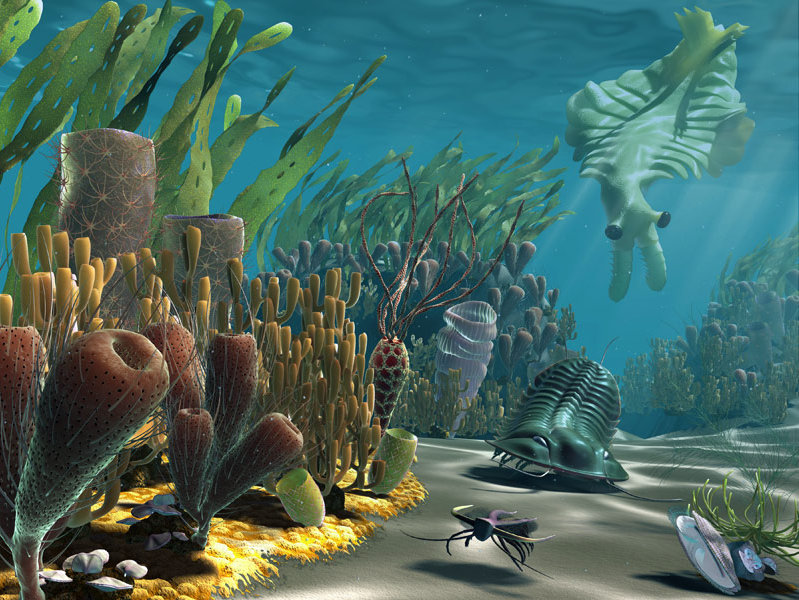
Continuing our Deep Time map, late winter looks to the time from the first cell to the evolution of animals.  For me, animals are a huge leap from bacteria – something unexpected, and time and again in my life, I’ve learned about things that I previously had no idea were real.  As with all themes, this just an optional muse.


Late Winter (February 2 – March 20)
Cosmic event: First life on Earth to first animals
Theme: Unexpected discoveries

Questions: Life is an incredible thing – to imagine that molecules could self organize to give us reproduction, DNA heredity, and movement! Similarly, are there things in your life or in our world that have appeared in surprising ways – things that you didn’t imagine could exist?