 Naturalistic Paganism
The Sabbath of Water, by Mark Green
In my Wheel of the Year, the cross-quarter which lands around the beginning of February is Riverain: the Feast of Water.
That’s because where I live, in Northern California with its Mediterranean climate, that time of year is the heaviest with rainfall. The mountains grow emerald green with winter grass, the creeks gush, filled to their banks, and the wetland areas fill into lakes.
However, we’ve been in a drought for the past five years. Last year, we had a few good storms before the New Year, and then the sky shut off like a tap. Riverain rolled around and the hills were still a sickly yellow, the reservoirs were empty, the creek beds dry. Every year I would pour a libation of saved stormwater and call to the sky for rain, but in those years, it didn’t come.
At last, this year, with the powerful El Niño current driving tropical moisture across the Pacific, we seem to be seeing a normal—at least—year of rainfall. And so this year’s festival is a particularly happy one.
For many years, it was my tradition on the weekend closest to Feb. 2 to go for a nice, wet hike in the rain. I love the cozy feeling of huddling in my rain gear, breath pluming before me, squishing up the muddy trail as the lovely patter of water sounds on my hood. But in recent years there hasn’t been an opportunity; I’m hopeful that next weekend, it will be wet so I can reinvigorate the tradition.
Other traditions for Riverain can include a ritual bath, or even just sitting indoors and gazing out at the rain, perhaps with a warming drink in hand. Though the darkest days have now noticeably passed, these are still the coldest days of our Northern hemisphere’s year, and there is much to be said for celebrating the tiny fire of life kept safe from the magnificent, howling elements.
Depending on where you are, of course, this Sabbath may make no sense to you at all. As always, I encourage you to create your own, based in the cycles of the natural world where you are located.
Because of the long drought, I have been thinking quite a bit about what to do when the world is not being cooperative with the usual observances and expectations of a Sabbath. A couple of years ago, for example, the high temperature on Yule in my area was in the 70s Fahrenheit. It was shorts-and-tee-shirt weather, not huddling-indoors weather. And though I made my Yule observances, they felt awfully strange. Sitting outside in silence and darkness when the temperatures were still in the fifties just didn’t communicate the same sense of encountering-the-harsh-elements-of-winter that my silent Yule vigil usually does.
The tension there, I feel, is between maintaining traditions—something of great value in instilling rituals with power and continuity—and facing up to what is actually happening in the world in that particular year. I don’t have easy answers for how to bridge that gap, but I suspect it lies in changing the traditions just a little, to better suit the times.
For example, last year I could still have gone for a hike, but rather than having the hike be about the experience of being engulfed in water, it could have been in search of water. A hike to the ocean (I leave near the coast), for example, or to a lake, or even a hike through the mountains to a spring that I knew still to be producing. After all, the reality of that year was the desire for water; a quest for water made more sense than waiting around for a storm that never came. I could have made an offering at the spring, the lake, the ocean, with wishes for a return of the rains.
I’m also considering adding a new tradition this year: The Rain Baby. Rooted in some of the old Brighid holiday traditions, this involves soaking reeds in rain water and then weaving them into a small humanoid figure and allowing to dry. The Rain Baby signifies the newborn-babe point in the life cycle represented by the Wheel of the Year, and is literally steeped in the life-giving water that is (usually) so abundant at this time of year. The Rain Baby may be tucked up in a little bed on the Focus (altar), and will come out to play a bigger role at Summer’s End (beginning of August), when it is adorned with grain beards to become John Barleycorn, who is presides over the feast at Harvestide (autumnal equinox) and then is burned in the Hallows fire. And so the cycle goes again.
Adding new traditions like this lends richness, fun and meaning to an Atheopagan practice which is still—and probably always will be—evolving.
May your deep-winter holiday, however you name and celebrate it, be rich, joyous and meaningful. Stay warm!
An Atheopagan Life: Practices and musings of an Earth-honoring atheist by Mark Green
An Atheopagan Life is a monthly column about living an atheist, nature-honoring life.

Mark Green is a writer, thinker, poet, musician and costuming geek who works in the public interest sector, primarily in environmental policy and ecological conservation. He lives in Sonoma County on California’s North Coast with his wife Nemea and Miri, the Cat of Foulness. For more information on Atheopaganism, visit Atheopaganism.wordpress.com, or the Facebook group at facebook.com/groups/godlessheathens.21.
Jay Forrest interviews B. T. Newberg on Naturalistic Paganism

Hi everybody. I was just given an opportunity to raise awareness of our community on the podcast Spiritual Wisdom with Jay Forrest. Jay is a published author, experienced podcaster, ex-pastor, and certified Humanist minister and meditation instructor – in short, an eminently interesting guy. I highly recommend you check out his podcast.
Also, FYI the next session of the course mentioned in the episode – which to my knowledge is the only online course designed specifically for naturalists, including Naturalistic Pagans – begins this March on the 6th.
Please share, like, and tweet this podcast episode widely. The more we publicly raise awareness of our community, the more we all reap the benefits. Thank you!
Image Credit: Banner Header for Spiritual Wisdom with Jay Forrest
The Author

B. T. Newberg: Since the year 2000, B. T. has been practicing meditation and ritual from a naturalistic perspective. He currently volunteers as Education Director for the Spiritual Naturalist Society, where he created and now teaches an online course in naturalistic spirituality (including Naturalistic Paganism!). His writings can also be found at Patheos and Pagan Square, as well as right here at HP.
Professionally, he teaches English as a Second Language, and hopes to begin a PhD program in the psychology of religion soon. After living in Minnesota, England, Malaysia, Japan, and South Korea, he currently resides in Minneapolis, Minnesota, with his wife and cat.
After founding HumanisticPaganism.com in 2011 and serving as managing editor till 2013, he now serves as advising editor, and feels blessed to be a part of this community.
My Path to Paganism, by Tyler Clow

My Path Begins
Like many before me and many others since, I was baptized into Christianity as an infant. I could barely support my own head, let alone understand the concept of God or the tenets of the Bible, yet I had already undergone a formal initiation rite and been declared an official member of the Catholic Church. Beyond that, however, religion was not a major part of my upbringing, as my parents had separated before my second birthday and my primary residence was with my non-denominationally monotheistic father.
Of course, my mother was only loosely Catholic herself, and even though I spent at least every other weekend and half of all holidays and vacations with her I can still count on one hand how many times we went to a Sunday church service. In fact, the first time I remember Christian doctrine even being mentioned was when I was school age and she told me – as well as my younger sister, whom she did not have baptized – the Abrahamic creation story with Adam and Eve’s disobedience and subsequent expulsion from the Garden of Eden.
At roughly the same time, I had been exposed to many Pagan influences as well. My four step-siblings were being raised Pagan by their mother, a number of close friends of the family were Pagans, and my step-father worked for several art galleries and seasonal haunted houses in Salem, Massachusetts – the “Witch City” – so a good portion of my peers, adult role models, and acquaintances from an early age were Pagans of a variety of traditions.
Late Winter Theme: The Unexpected
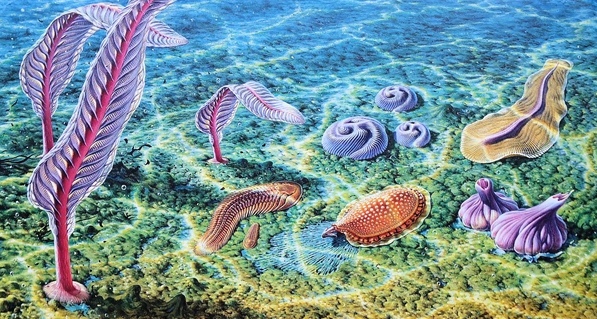
Continuing our Deep Time map, late winter looks to the time from the first cell to the evolution of animals. For me, animals are a huge leap from bacteria – something unexpected, and time and again in my life, I’ve learned about things that I previously had no idea were real. As with all themes, this just an optional muse.
Late Winter (February 2 – March 20)
Cosmic event: First life on Earth to first animals
Theme: Unexpected discoveries
Questions: Life is an incredible thing – to imagine that molecules could self organize to give us reproduction, DNA heredity, and movement! Similarly, are there things in your life or in our world that have appeared in surprising ways – things that you didn’t imagine could exist?
[The Dionysian Naturalist] “Dancing with Dionysus: Ecstasy and Religion in the Age of the Anthropocene, Part 4” by Wayne Martin Mellinger, Ph.D.

Continued from Part 3 …
DIONYSIAN NATURALISM AND THE QUEST FOR ECSTASY
Unitarian-Universalists and Religious Naturalists are both groups of people concerned with infusing reason and science into modern religious life and practice. In social worlds often replete with supernaturalism and superstition, this itself is a noble goal. And while in so many ways I am with them in that pursuit and definitely want a religious cosmology ground in scientific evidence, I follow Friedrich Nietzsche in seeing modernity as expressing the triumph of the Apollonian. Instrumental rationality and cold calculation have almost killed the soul of the world—the Pagan notion of anima mundi—and we desperately need a Dionysian revival.
Dionysian Naturalism, while ground in a scientific worldview and in the practices of critical thinking and skeptical inquiry, maintains a healthy place for the passions and the emotions. Moreover, our human impulses and instincts are seen as related to our sacredness. “Dionysian”, for me, invokes the Earth-centered Pagan traditions of the ancient world and their corporeal form of communion. Dionysian Naturalism reclaims the Sacred Journey at the heart of Western Nature Religions. And it celebrates these forms of ecstasy as ways to re-sacralize the natural world. Thus, I want to bring together Pagan and Naturalist traditions.
In ancient Greece ekstasis meant “standing outside oneself” and referred to the flight of the soul from the body. While I originally associated the “Dionysian” with wild states of frenzy, profane experiences of “partying” and drunken orgies, I now know that the “Dionysian” essentially involves being transported to a spiritual realm, in which even calm and meditative, but no less profound, states of consciousness may be experienced. While reclaiming ecstatic religion and the potential of sacramental entheogen use, Dionysian Naturalism also explores other alternative non-entheogenic spiritual practices which may equally serve to re-sacralize nature and create transcendent experiences.
Personally I have learned that, because of my prior abusive experiences with cocaine and methamphetamine, I must be vigilant about sobriety, for my mind will tell me that all recreational drug use is equivalent to entheogenic sacramental use (“Go ahead and get high! “The Will to Party” is a sacred instinct!”), and when that happens I tend to loose everything in my life. Being someone with bi-polar disorder with a history self-medicating with high-powered stimulants leading to repeated bouts of homeless, I must continue to discover new ways to “dance with Dionysus” This has opened up my spiritual journey in greatly enriching ways and has lead to deep study of meditation, yoga and tantric sexuality. Elsewhere, I detail “The Amethyst Path” of recovery I follow in which I seek Dionysian spirituality while maintaining sobriety.
ENCHANTING NATURALISM
I describe much of contemporary naturalism as “disenchanted”, that is, as a deterministic, mechanistic and reductionistic scientific worldview in which everything can be explained through natural laws and mechanisms, with no mystery left behind. Disenchanted naturalism observes the natural world through a detached objective perspective in which any notion of wonder has been removed. The consequence of this way of thinking has been near ecological collapse. By conceiving of nature as mere “inert matter” with the central purpose of serving human needs we set up a situation ripe for human abuse and exploitation of the biosphere.
To “save our planet” we must re-sacralize nature, for no people who truly revere our natural world would allow it to become destroyed. Thus, “enchanting” naturalism is essential to the survival of our planet. To change from a disenchanted naturalism to an enchanted naturalism one need only acknowledge that one is in the presence of the sacred. We must open ourselves to the mysteries of the Universe with ways of knowing that integrate imagination, aesthetic sensibility and religious intuition. As stated, the Pagan notion of anima mundi—the soul of the world—is being revived. Through acts of enchantment our alienation from the natural world can be removed and we can again feel the magic of a spring morning, a shooting star on a warm summer night and the majesty of a snow-capped mountain. Without doubt, Dionysian Naturalism is an enchanted naturalism!
A paradigm shift is occurring in which the Universe is now imagined, not as a clocklike mechanism in which wholes are reducible to their parts, but as a sacred living system with emergent properties. This new worldview brings together the wisdom of religion and science to change our relationship to the cosmos. By re-enchanting nature and reviving anima mundi, we re-affirm that we are an intimate part of the web of life and kin to other species. The resulting sense of belonging to this planet is required if we are create a new global ethic in which all objects are valued and respected and choose to live responsibly. Our ancient Pagan roots are still alive and we must graft our modern spirits onto them to protect our sacred living planet.
About the Author
 Wayne Martin Mellinger, Ph.D. is a Santa Barbara-based social justice activist, writer, and educator who uses spiritual practices to create a better world. Specifically, Wayne is very active in helping our neighbors of the streets transition into permanent housing and environmental issues. He has taught at the Santa Barbara, Santa Cruz, and Berkeley campus of the University of California, Ventura College, the Fielding Graduate University and Antioch University Santa Barbara.
Buy Godless Paganism (paperback)

Buy Godless Paganism (ebook)


Pagan Coming Out Day – May 2nd
 Naturalistic Paganism