Naturalistic Paganism
Interrupted Visions: Your chance to join with the Foundation Beyond Belief to help victims of the flooding

Yes, I know we are in the middle of our 3 part series on visions, but we well know that weather systems don’t care what we humans are doing. This week, extreme rainfall caused historic flooding in Louisiana, with people killed and the property damage mounting by the day. We have a chance to help, both indirectly (because climate change makes rare events like this more likely, so helping slow climate change helps future victims), and directly. The Foundation Beyond Belief has set up an easy way for us Atheists to make a difference in the lives of those hurt by the flooding – regardless of who they are or what they believe. Here’s the link. While we’ll each return to our daily lives in mere minutes, it’ll be a lot longer than that for those affected by the flooding can return to anything like a regular daily life.
Visions Part 2: Visions and Delusions, by Megan Manson

Depiction of ghostly apparitions by Utagawa Kuniyoshi. Public domain, Wikimedia Commons.
For many years I suffered from POTS (Postural Orthostatic Tachycardia Syndrome), a condition that causes the heart to race on standing up. This in turn results in dizziness, shortness of breath, chest pain, and fainting – most common for me was “pre-syncope” (near-faints). Fortunately I am pretty much recovered now and I haven’t experienced any serious symptoms for a very long time. But when my POTS was full-blown, it did give me an interesting perspective on certain spiritual experiences.
Pre-syncope, where you’re on the knife-edge of consciousness, causes the mind to do very strange things. During pre-syncope episodes, I have seen things or heard things that aren’t really there (often other people), seen flashing lights and colours, Read More
Visions, Part 1: Integrating Critical Lenses into Spirituality as a Naturalistic Pagan Goal, by Emile Wayne

Let’s face it. I am a very young pagan, both in terms of my own age (27) and the number of years I have self-consciously identified as such (one, very eventful, year).
Needless to say, I’ve spent this last year soaking up any and all things pagan. I’ve gone to Pagan Pride, participated in and let rituals throughout the Wheel of the Year with my ADF Grove, read dozens of articles and books, set up altars, made offerings, meditated, carved and burned my own set of runes, collected knick-knacks and paraphernalia, and let my normally skeptical mind entertain some truly unfamiliar ideas.
But as a full year rounds and I return to the season wherein I began, I find that my path forward looks very different than I expected it to. Read More
“The Forgotten History of Atheist Paganism” by John Halstead

Diagoras: History’s First Confirmed Atheist
(This essay first appeared in Godless Paganism: Voices of Non-Theistic Pagans.)
Atheist Pagans?
A frequent complaint brought by some polytheistic Pagans against non-theistic Pagans is that they have misappropriated the name “Pagan.” Ancient paganism, they argue, was synonymous with polytheism, and thus contemporary Paganism should be polytheistic as well. Humanistic and Naturalistic Pagans tend to be more forward-looking than backward-looking. Unlike forms of Paganism which seek to reconstruct the religions of ancient pagans from surviving sources, Humanistic and Naturalistic Pagans have largely abandoned attempts to legitimize their beliefs by appeals to the past. For them, the value of a religious practice lies in its usefulness to people in the present.
Having said that, Polytheists and Pagan Reconstructionist do not have an exclusive claim to the pagan past. While belief may have been the norm (as it is today) among ancient pagans, there were atheist pagans in antiquity. Most of the examples we have come from ancient Greece and Rome, due to the abundance of records we have from that time and place. (More material survives in Greek than in all other ancient languages put together.) Nevertheless, there were atheists among the heathen peoples of northern Europe, as well as among ancient Indian philosophers and Buddhist thinkers. It is likely that, wherever and whenever there have existed people who believed in gods, there have also existed people who did not. Some contemporary non-theistic Pagans look back to and find inspiration from these ancient predecessors.
Oxymoron or Redundancy?
The argument that modern Paganism should be polytheistic because ancient pagans were polytheistic mischaracterizes how the word “pagan” has been used in history. The term “pagan” was invented by Christians to stigmatize non-Christians. It was applied first to polytheistic people in the Roman Empire, but it has also been and continues to be applied to animistic indigenous peoples, to polytheistic Hindus, monotheistic Muslims…and to atheists. Like other words which have been reclaimed by an oppressed group, like “queer” or even “geek,” the word “pagan” might also be reclaimed by any group it has been used against.
Some Pagans today feel that “atheist Pagan” is a contradiction in terms. But as it has been applied by Christians historically, “atheist pagan” was not an oxymoron, but a redundancy—to be “pagan” and to be “atheist” both meant being someone who disbelieved in the Christian god. Early Christians were as likely to call their polytheist neighbors “atheist” as they were to call them “pagan.”
Atheist Pagans in Ancient Greece
The argument that atheist Pagans are misappropriating the name “pagan” also overlooks the fact that there were atheists and other non-theists in antiquity. In Battling the Gods: Atheism in the Ancient World (2015), Tim Whitmarsh traces the history of atheism from Classical Greece to the early Roman Empire, beginning with the pre-Socratics, who looked for the origins of the universe, not in supernatural theogonies about the birth of gods, but in physical matter.
In the 5th century BCE, Xenophanes of Colophon argued that the gods were projections of human qualities, anticipating 20th century cognitive theorists who would explain the origins of religion in terms of the human desire to render a mysterious nature familiar. While Xenophanes and other Pre-Socratics spoke of “God” (in the singular), their one “God” was more or less synonymous with nature or the rational order of the universe.
Other naturalistic philosophers followed. Anaxagoras may have been the first to be put on trial for impiety because of his atheism. Hippo of Samos argued that the soul was nothing more than the corporeal brain. Similarly, Democritus believed that the mind was made of atoms and disbursed after death. And Thucydides was the first to write a history without reference to supernatural agents, which Whitmarsh describes as “the earliest surviving atheist narrative of human history.”
“Atheist” As Epithet
Any or all of these individuals may have been referred to as atheoi, yet they probably did not refer to themselves in this way. The first references we have to atheoi are actually not to those who disbelieved in the gods, but to those who had been abandoned by the gods, i.e., the “godforsaken,” and to those who lived without the civilizing order of the gods. As Whitmarsh explains, only later did the term become “a social category constructed by self-styled protectors of religious orthodoxy as a receptacle for those whose beliefs they do not share.” It included those who disbelieved in the gods, as well as those whose conception of deity was radically different from the orthodox view.
Take, for example, the Epicureans, who were commonly called atheoi. While they claimed a belief in the gods, and rejected the atheist label, they nevertheless denied that the gods created the universe or that they intervened in the world. They also believed that worshipping the gods did not influence them. The gods of the Epicureans were practically irrelevant to humanity, except for their occasional appearance in dreams.
Other pagan philosophers, while not self-styled atheists, adopted allegorical interpretations of myths, seeing the gods as metaphors for natural phenomena or human attributes. Theagenes of Rhegium, for example, associated Apollo and Hephaestus with fire, Poseidon with water, Hera with air, Athena with the intellect, Ares with folly, Aphrodite with desire, and so on. Prodicus of Ceos said that ancient people had deified all things beneficial to humankind, so that bread became Demeter, wine Dionysus, water Poseidon, fire Hephaestos, and so on. Later, the Stoics, like Zeno, Cleanthes, and Chrysippus, also associated different gods with different elements and qualities.
Reclaiming “Atheist”
As with many other epithets, though, what began as an insult was eventually reappropriated. Diagoras of Melos may have the honor of being the first self-professed atheist, to be followed by others like Theodorus of Cyrene. But it was Clitomachus, the 2nd century BCE skeptic, who was responsible for the idea of atheism as a coherent movement with its own philosophical history. Clitomachus likely wrote a book called, On Atheism, which is now lost to us, but he was a prolific writer, so other of his writings survive. He collected atheistic arguments, identified atheism as a distinct philosophical school, and categorized its varieties. He also compiled a compendium of philosophical atheists, which included Protagoras, Prodicus, Diagoras, Critias, Theodorus, Euhemerus, Epicurus, and others—thus giving atheism its own intellectual history. According to Whitmarsh, his “inventive doxography of atheistic argumentation created, for possibly the first time in human history, an intellectually coherent and substantial set of arguments against the existence of the divine.”
But Were They “Pagan”?
But were these individuals “pagan”? As has already been discussed above, the question is anachronistic, since the term “pagan” was invented by Christians centuries after atheism emerged in Greece. Perhaps, then, we might ask whether these individuals were religious. Certainly some of them were. Some of them spoke of “God” or “gods,” albeit in radically different ways from the traditional understanding of anthropomorphic divine beings.
In addition, many of the individuals identified as atheists continued to engage in public worship of the gods. The early Stoic, Persaeus of Citium, for example, insisted that the gods of the city should be worshipped in the traditional ways, even while denying their literal existence. Similarly, the second century AD Roman skeptic, Sextus Empiricus, stated that honoring gods by performing ritual sacrifices did not require believing that they exist, and he argued that skeptics could and should take part in public religious activities. The Epicureans also continued the practice of prayer, but with the understanding that it benefited, not the gods, but the humans performing the prayers.
Paganism as Practice, Not Belief
While this position appears contradictory from the perspective of 2000 years of subsequent Christianity, we must remember that religion had a very different meaning in antiquity. The religion of the ancients was not so much a matter of personal belief as public performance. Due largely to the influence of Protestant Christianity, the notion of personal communion with the gods is central to the modern conception of religion. But this was not the case for people in the ancient world, for whom religion was primarily a communal activity, one concerned with maintaining a beneficial relationship between the community and its gods. Viewed from this perspective then, it is the cultivation of personal relationships with gods by contemporary polytheistic Pagans which is anachronistic.
In addition, ancient religion was less concerned with belief, than with practice. In the parlance of students of religious studies, it was “orthopraxic,” rather than “orthodoxic.” For this reason, atheism per se was never criminalized in ancient Greece, in contrast to “impiety.” To be sure, charges of impiety were brought against atheists, but impiety referred not to the absence of belief in the gods, but to the failure to perform sacrifices—because it was the failure of outward performance, not the absence of belief, that was thought to have a deleterious effect on the wellbeing of the community.
The concern with orthodoxy may have first arisen with the Orphic mystery cults, which were uniquely concerned with the salvation of individuals. Later, Christianity was to follow this pattern, eventually transforming our understanding of the meaning of religion.
Atheist Neo-Pagans
When Paganism was revived in the 20th century, contemporary Neo-Pagans followed the pattern of their ancient pagan predecessors in emphasizing practice over belief. While polytheism was a significant element in many of the spiritualities that were emerging under the tent of Paganism at that time, in many cases these polytheisms were of a new kind—the many gods of the polytheist pantheons were understood as aspects of a single Great Goddess, or of a Goddess and her male counterpart, or else as archetypes of the collective unconscious. In fact, literal belief in gods may have been more the exception than the rule among 20th century Pagans for several decades.
Thus we see that atheistic and non-theistic Paganism has a long history dating back to Classical Greece and Rome. If we had better sources for other pagan peoples, we would likely find atheists among them as well. Literal belief in the gods was never a prerequisite for participation in ancient pagan religions, nor is it necessary for Neo-Pagans today.
Bibliography
Bremmer, J. “Atheism in Antiquity,” in Martin, M., ed. The Cambridge Companion to Atheism. Cambridge University Press (2006)
Brisson, Luc. How Philosophers Saved Myths: Allegorical Interpretation and Classical Mythology (2004)
Drachmann, A. B. Atheism in Pagan Antiquity (1922)
Anne Bates Hersman, Studies in Greek Allegorical Interpretation (1906)
Whitmarsh, Tim. Battling the Gods: Atheism in the Ancient World (2015)
About the Author: John Halstead
 John Halstead is Editor-At-Large and a contributor at HumanisticPaganism.com. He blogs about Paganism generally at AllergicPagan.com (which is hosted by Patheos) and about Jungian Neo-Paganism at “Dreaming the Myth Onward” (which is hosted by Witches & Pagans). He is also an occasional contributor to GodsandRadicals.org and The Huffington Postand the administrator of the site Neo-Paganism.com. John was the principal facilitator of “A Pagan Community Statement on the Environment,” which can be found at ecopagan.com. He is a Shaper of the fledgling Earthseed community, which is described at GodisChange.org. John is also the editor of the anthology, Godless Paganism: Voices of Non-Theistic Pagans.
To speak with John, contact him on Facebook.
Late Summer Theme: Cooperation
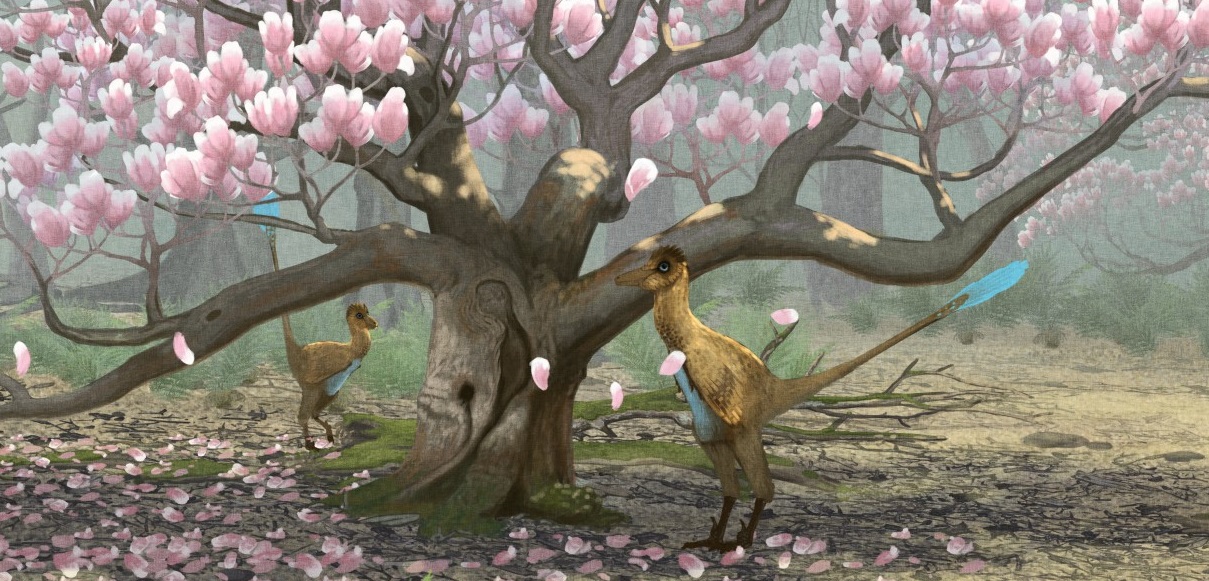
In Deep Time, late summer can span the time from the mid to the late Mesozoic – a time during which many new forms of cooperation evolved, adding the many cooperative ways of life already discovered. Already established forms of cooperation included our mitochondria and the chloroplasts in plants (both being domesticated bacteria) as well as the very fruitful fungi-plant cooperatives. New forms include the symbiosis between flowers and insects, between fruit and fruit eaters (seed dispersers) and more. Can we call on our knowledge of the success and mutual benefit of these cooperations to spur us to find and join with those many people around us who want to help? Today, and for millions of years, cooperation often means that everyone wins. As with all themes, this just an optional muse.
late Summer (August 1 – September 22)
Cosmic event: Cooperation up to an including the late Mesozoic (~150 to 66 million years ago)
Theme: Cooperation
Questions: Who can help us? Who can we help? How can our spirituality spur us to reach out to them?
Buy Godless Paganism (paperback)

Buy Godless Paganism (ebook)


Pagan Coming Out Day – May 2nd