 Naturalistic Paganism
Backup Power
Watts, Volts, Power, Energy – What?
To function in our world, especially as things switch to electricity over gasoline, we need to understand basic electrical concepts. If you already are very familiar with what a kwh is compared to a kw, then skip to the next heading.
Electricity is the flow of electrons (such as in a wire), while there are tons of good youtube videos on basic electrical terms (such as here & here), a quick review is that electrons flow (current, or amperage, “amps”, “I”) due to the amount of voltage (the amount of “push” or “force”, volts, “V”), and in doing so, generate power (rate of energy given off, watts, W=I times V). The key is that power is a *rate* of energy being given off, so to find the total energy used, you have to multiply power (watts, or kilowatts = watts * 1000) times the time (usually in hours), so kilowatts (kw) times hours (h) = kilowatt hours (kwh). You are charged by the electric company for how many kwh you use, usually at around 20 cents a kwh. As a Naturalistic Pagan, I find understanding our real universe, and the laws that it obeys, to be fun!
New Technology is a Game Changer

For most of my life, the only way to have back up home power was to get a gasoline generator. But that’s history now. What changed? The cost of high energy, lithium based batteries, that’s what changed – and that changed a lot! The cost of a kwh of battery has dropped much more than I thought possible. That amazing drop has been over 99% (see graph at left). What, a 99% drop in price? Really? How is that even possible? We’ve seen that before in human history as technologies improve, such as with aluminum, or computers, or data storage, or many other examples. It’s certainly possible, and history shows that it happens again and again. Look at what that means! Can you imagine if you could buy, say, a car that cost $40,000 in 1990 for just $350 in 2026? Wow!! But that’s reality when it comes to lithium batteries! That’s of course also why all of a sudden you see battery tools (such as by Ryobi or Makita) everywhere.
Or just turn the same data around to look at it another way. A typical electric car battery pack adds around $10,000 to the cost of the car today. Back in 1990, that very same battery pack would have cost over: one. million. dollars!! That’s why “all of a sudden” EVs are taking over. Technology that was only available for the super rich is now available for us all! This of course is why EVs now are cost-competitive with dirty gasoline cars, and why even new EVs will be cheaper than gasoline cars within a few years (used EVs are already usually cheaper than comparable gasoline cars). But EVs are sorta off topic here, being covered in detail for Naturalistic Pagans in this post .
Batteries to the Rescue! 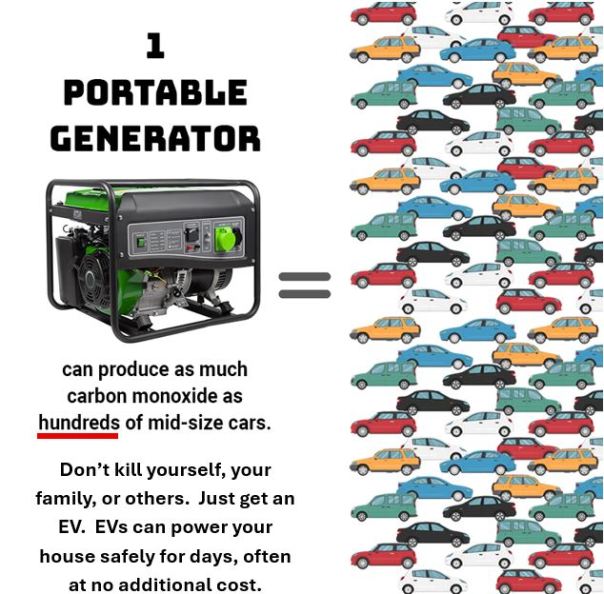
But what about all those gasoline generator companies running advertisements to sell gasoline generators? Don’t be fooled – now that battery prices have dropped by over 99%, there are a lot of advantages to battery backup over gas generators. So silly for someone to spend $8,000 on a stinky, loud, high maintenance, inconvenient, bulky, toxic home generator when instead they can just get a battery backup. Most people don’t realize that a gasoline generator makes as much toxic carbon monoxide as literally 300 cars. Wow. They have to be not just outside the house, but also far from windows, doors, inlet vents or such to be safe. Literally thousands of people are poisoned every year in the US by gasoline generators (and of course even if you keep yourself safe, you are still dumping all that into the air your neighbors breathe). Plenty of people have been killed by their gasoline generator even when it was outside, because they had a window open nearby or such – or have killed the neighbors who weren’t even using the gasoline generator, depending on which way the wind was blowing. Plus they aren’t reliable. My friend even had a generator, and threw his back out trying to get it to run – then was still in the dark, and now injured.
 For battery solutions, there are battery backups by eco-flow at home depot, Jackery, and many more that are cheaper than a gasoline generator, better for your health & our planet, while being more reliable and easy. A 5 kwh backup will generally last around 6 hours (and costs around $3K), while most power outages last a 2-3 hours. You can get that whether you live in house, apartment, condo, etc. And you can take it camping, tailgating, etc. A friend uses one for her CPAP, enabling her to go camping. The key with a stand alone battery backup (if you don’t have an EV) is to sharply limit electricity use to low power items you need. For instance, the fridge is around 0.2 kw. As such, a 5 kwh battery backup will run just the fridge for ~ just over a day (25 hours), while if you add another 500 watts of power use (big screen TV, computer game graphics, etc.), then that drops to just 7 hours of backup.
If you live in a house, then an even better option is to get an EV (see previous post on EVs, here). Tons of affordable used EVs are available now that will save you thousands on gasoline and have many more advantages, such as backup power in a power outage. An EV typically has a 65 kwh or bigger battery (compare that to the 5 kwh back up above – wow!), which will last days, and when it gets low, you can just drive out to a charger and come back with a full charge – if a power outage lasts days, which they usually don’t. How to set up the power depends on the car – some already have that ability (called V2L for “Vehicle to Load”), others have to add it. Here’s a super easy way to add it to many cars – just a plug in for instant power.
If You Can Couple it with Solar, you win!
Solar power (see previous post here) can make your battery backup practically infinite in many places & seasons. This has two big advantages.
The first advantage is that you have a source of power during a power outage. For most solar panel systems, you have to have a battery backup to be able to get *any* power from the panels when the grid power is off. But with battery backup, you can draw from the batteries in a power outage as well as get power from the panels. Batteries provide power at night, and then daytime sun recharges them, often giving you power while the outage lasts. A battery backup is easy to add to a solar setup because the setup already has to have an inverter (to convert the DC electricity from the panels into AC electricity for the home), so there is already an inverter there to convert the DC from the battery into AC for the home. Of course, the battery backup is an added cost (around $2 to $8K or more), which doesn’t get you money back. What it does give back to you is power in an outage, which is worth a lot in itself – compare that, for instance, to a home generator. People routinely pay $8K to $12K for the generator, which is much worse – it’s very loud, requires maintenance like spark plug changes, oil, gas winterizing, etc. However, also remember that if you already have an EV, you can likely power your house from that (see the EV post, and check on your car for this). If so, then you might want to save the cost of the battery backup and rely on the EV instead (or buy a small battery and inverter).
Another benefit of a battery backup is that it can help you benefit from tiered pricing (see Solar Post). You can fill your battery during cheap hours and then use it (or sell it back to the grid!) during expensive peak hours, saving more money.
Another comparison of gasoline generators and battery backups is here.
It won’t be long until no one will use gasoline generators anymore, and we’ll be trying to convince younger adults that those dangerous and expensive things really did exist, back in the stone age (gasoline age?).
Busting Myths
The fossil fuel industry has spent literally billions of dollars peddling lies to slow the rapid growth of green energy solution. Addressing them is not the topic of this already long post, but many are addressed here at this website. If many people want it, I can write a post busting all those myths. However, if you hear some scary thing about EVs, battery backups, or solar panels (like the lie that solar panels give off toxic heavy metals – they don’t). Like the myths about EVs, don’t fall for lines like solar panels cause cancer due to electric something mumbo quantum waves MAGA jumbo or something.
Your always powered Home awaits! Feel free to share this with others – every electrified house helps the resident, helps our planet, helps future generations, and helps everyone’s health today.
Starstuff, Contemplating by Jon Cleland Host
We are assemblages of ancient atoms forged in stars – atoms organized by history to the point of consciousness, now able to contemplate this sacred Universe of which we are a tiny, but wondrous, part.

Dr. Jon Cleland Host is a scientist who earned his PhD in materials science at Northwestern University & has conducted research at Hemlock Semiconductor and Dow Corning since 1997. He holds eight patents and has authored over three dozen internal scientific papers and eleven papers for peer-reviewed scientific journals, including the journal Nature. He has taught classes on biology, math, chemistry, physics and general science at Delta College and Saginaw Valley State University. Jon grew up near Pontiac, and has been building a reality-based spirituality for over 30 years, first as a Catholic and now as a Unitarian Universalist, including collaborating with Michael Dowd and Connie Barlow to spread the awe and wonder of the Great Story of our Universe (see www.thegreatstory.org, and the blog at evolutionarytimes.org). Jon and his wife have four sons, whom they embrace within a Universe-centered, Pagan, family spirituality. He currently moderates the yahoo group Naturalistic Paganism.




 Naturalistic Paganism