 Naturalistic Paganism
Well, they are, for many new EVs. *Used* EVs are often quite affordable – often cheaper than a similar gasoline car. That whole “bUt eV dePreCiaTioN is bAD” line the anti – EV people use is actually a positive point – means that *used* EVs get affordable quickly. Sure, EV’s depreciate fast, just like any other new technology – computers, phones, etc. – but we don’t buy cars as investments, we buy cars for providing transportation, and EVs are great for that – just like how we don’t use the fast depreciation of phones as a reason to not have a cell phone.
Plus, federal incentives give you $4,000 off the price of a used EV ($7,500 off a new EV), making them even easier to afford!
But Trump has now set a deadline for those incentives – they end in September, just a couple months away. So to get them, you have to get that EV quick! It’s easy – see below.
So Many Advantages!
We have an EV and it works great (Heather’s car). We got a used (2020) Chevy Bolt in late 2023 for ~16K. I just ran the Kelly Blue Book value and the same car can be purchased today for less than $10K! The range is over 200 miles in most conditions (the official rating is 230 miles), and her daily commute is ~50 miles round trip. We aren’t the only ones overjoyed with our EV experience either – the data shows that for those who have an EV, only an incredibly low ** 1% ** want to go back to a gas car!
Better Performance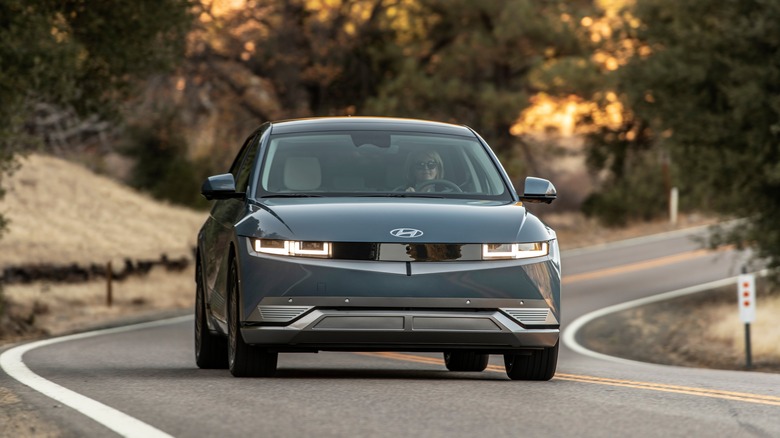
The performance is a big benefit. EVs have better acceleration, handling, and instantly respond to you. To go on the trip to see the eclipse, we were going to go through Canada and since we don’t know how common their chargers are, the family went in my gasoline car. Heather started off driving and said “something is wrong with the car – it’s so sluggish and loud!” I had to remind her that gas cars just simply suck compared to EVs like she’s now used to. Then when we went on the tight curve onramp to I-75, she was going a little fast and had to brake. “sorry, the handling is terrible, I’m used to my EV which can take curves like this a lot faster.”. Driving the EV later, we tried to merge onto the highway and a car wouldn’t let us in. She turns to me and says “this guy doesn’t know I have an EV.” Bam! She pushes down on the pedal and we rocket ahead of the other car, merging in easily far ahead of him!
 FYI – When I use the term “BEV”, that’s “Battery Electric Vehicle”. By “EV” I generally mean an BEV, but can also include hybrids. When I do, I mean those hybrids that you can plug in to charge (Plug-in Hybrid Electric Vehicle = PHEV). Gas cars are Internal Combustion Engine cars, or “ICE” cars.
Plus, the EV is nearly silent! No more yelling to talk to the passenger – it’s so peaceful, you can forget that you are driving. I like to go back in the woods, and it’s nice to be able silently glide along, instead of disturbing every animal within a mile as happens with a gas car.
 Fuel Costs $1.24 a Gallon (equivalent). Forever! No need to go to Dirty Gas Stations.
Another big benefit is the cost of fuel. Our electric bill went up a little (like +30%). I calculated it out, and it works out to about $1.24 a “gallon”. So we don’t care what happens with gas prices. We pay $1.24 for fuel all the time, regardless of gas prices. She sees the big gas price spikes on holiday weekends or at random times with amusement. I realized that I have more range anxiety with my gas car. She wakes up to a full “tank” every morning (more on that below), while I have to go to a dirty, smelly, gas station at some point no matter what.
If you want to skip reading about even more advantages, just scroll down to “How Do I Get One?”.
Maintenance? What’s that?
EVs need less maintenance – no oil changes, radiator fluid fill ups, spark plugs, etc. Of course, some maintenance is needed, like adding windshield washer fluid – but most of the maintenance you are used to is gone. That’s why it’s cheaper to own an EV (even if the license plate costs a little more) than a gas car. Plus, Heather was a little concerned previously with all the catalytic converter thefts – but no worries now, her car doesn’t have a catalytic converter.
 Just fine in the Cold!
Wait, what? I heard people say that EVs are destroyed if it gets a little chilly outside. Nope. It’s a bit mixed, but overall, EVs are good in the cold, with a little planning (and ICE cars certainly have some problems with the cold anyway).
While it is true that BEV (and hybrid) lose a little range (usually ~15%) in very cold weather, that’s both easy to plan around and usually not relevant – in addition to the many advantages of BEVs in cold weather. Most EVs get between 200 and 400 miles of range, so that drops to around 160 to 320 miles, with the average American commute being 29 miles. Long trips are much more common in the summer, not winter. The instant heat in the winter has been nice – no more waiting for the “car to warm up”.
The clearest data point here is perhaps the fact that the country with the highest EV adoption, where already today most cars on the road are BEVs and 90% of new car sales are EVs, is *Norway*, which is much colder than the United States. If cold weather were any significant issue at all, Norway wouldn’t be the world leader in BEV use. Overall, EVs are better than ICE (Internal Combustion Engine) cars in cold weather. ICE cars often won’t start in cold weather (BEVs start ~as easily as when warm), ICE cars take so long to warm up that people buy remote starters to waste gas to heat the car up – while BEVs give nearly instant heat. BEVs are also safer – every year some people die from backing up into a snowbank or are stranded and running the car to keep warm, then being killed by the exhaust – rarely relevant, but real – while a stranded BEV, by contrast can go for many days because it’s not using fuel to run the engine, instead only to keep the driver warm.
Better than a House Generator – Power when the Grid goes Down! 
Though it varies from car to car, most EVs can provide you with power if the power goes out. What, really? Yep! A lot of them have that dedicated ability – often called “Vehicle to Load” – V2L (especially many of the GM cars). Most don’t have that – but can still often be used as a portable power source. Many have a 110v outlet inside the car, which one can run an extension cord to important stuff in the house (fridge, lights, wi-fi, TV, computers, furnace, water pump, etc.). Even if they don’t have that, then many (like my Bolt) still work by easily hooking up an inverter (such as this one at right, $159 at Home Depot) to the little 12 volt battery, which is charged by the big battery. Check at online forums for discussion about how to DIY it if the car doesn’t already have a dedicated ability for this. I did a quick calculation on mine – and it’ll run the essential stuff for around 3 days! If a power outage goes longer than 3 days (almost never happens), then I’ll just drive the car out to get a charge and bring back another 3 days worth of power! Compare that to a house generator that some people get for $8 or $10 thousand dollars and only use the loud, toxic, gas guzzling generator once or twice a year.
 Plus, you can’t take a house generator camping! You already drove to the campsite, now you can simply plug stuff into your car for power! (As mentioned above, check online forums and such to make sure your car can do this). Lights, morning coffee, you name it! I have a friend who has sleep apnea and needs a CPAP at night. With the EV, camping is possible again! Works great for tailgating too!
 Better for your (& your Family’s) Health
We may not all be fully aware of it (because we grew up with ICE cars), but the exhaust damages your lungs. If you run a gas car in the garage, it can kill you – either slowly or quickly (literally hundreds of people die every year from car exhaust, and dozens of thousands end up in the hospital for it). Driving a gas car worsens or causes chronic health problems like asthma and lung cancer. It’s safer for you, your family, and your whole town to have an EV than a toxic gas car. I was surprised to find out this year that the yearly deaths caused by the overall health burden of gas car exhaust is literally higher than the number of people killed in car crashes every year! That’s right, if we switched to EVs, we’d save more lives than if we magically prevented all car accidents! Cities with a lot of EVs can already see the health benefit right now!
And there are lots of other benefits – like how cool is regenerative braking? Adding fuel while you are driving! Wow!
How Do I Get One?
It’s easier than ever to get an EV today. We now have a lot of used EVs hitting the market! Any EV purchased this year (2025) may be eligible for the incentive* ($4,000 off from a used car, $7,500 off a new car). First, decide if a BEV or a PHEV works best for your situation (next), then look at sites like these (and here’s a good overview of car buying websites). Looking around these, I see tons of EVs for under $10K (be sure to change the zip code to your location).
A BEV has the lowest cost to buy, less maintenance, and other advantages – but can use only electricity as a fuel. The most common deciding factor between a BEV and a PHEV is whether or not you own a house or have reliable level 2 charging (which makes it easy to own a BEV). Next look at the range that you need – usually over 150-200 miles of range is enough, and most BEVs have around 200-300 miles range). If those look OK, a BEV may be your best choice.
If you don’t own a home or are sure of reliable charging, a PHEV may be your best option. With PHEV, you can charge (most cost effective), or can also use gasoline if needed. Be sure to avoid any hybrid that can’t plug in (a non-PHEV hybrid) – they’re not much better than a gas car.
Plus, remember that the reduced wear and tear of an electric motor means that a high mileage EV is probably a lot “younger” than the equivalent gas car we are used to. Don’t believe me? Check out all these EVs that reached literally hundreds of thousands of miles on the odometer without changing the battery or motor!
* $4,000 off a used car and $7,500 off a new car! But Trump has set the incentives to expire after 2025, so act quick! The incentives also have income limits, so rich households aren’t eligible. Be sure to check on the details to see if your purchase is eligible – here’s the website.
Looking around, there are lots of articles that list some of the best used EV, affordable options. Here’s an example!
A quick review of the 3 types of charging:
- Level 1 – A regular 110 volt wall outlet. Using a regular outlet means that it’s easy to find a place to charge, but it’s very slow – only about 4 miles of range an hour of charging. While sometimes useful (like when visiting relatives), you generally will need better than that at home when owning an EV.
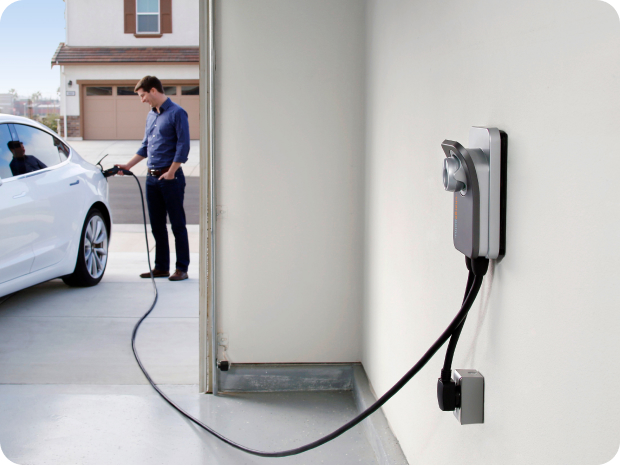
- Level 2 – A regular 240 volt outlet, like those used in your house for the electric dryer and the electric stove. Just plug a portable charger into a 240 v outlet or use a dedicated level 2 wall charger, and you get around 20 miles of range per hour of charging. This works great for most needs at home, especially overnight charging. (My EV can’t even do level 3 charging, level 2 is plenty).
- Level 3 – DC fast charging, which often gives as much as 60 miles of range in just 15 minutes. Almost never set up at home, these are the chargers around the country that make long distance trips easy.
Busting Myths
The fossil fuel industry has spent literally billions of dollars peddling lies to stop EV ownership. Addressing them is not the topic of this already long post, but many are addressed here at this website. If many people want it, I can write a post busting all those myths. However, if you hear some scary thing about EVs (like the lie that they catch fire often – they don’t. EVs catch fire much less than gas cars, or that batteries often fail – they don’t, they usually last longer than a gas cars whole lifespan), or others not addressed on the link above, just let me know. Probably the funniest one I’ve heard is the claim that EVs give the driver hair loss or whatever due to electric something mumbo quantum waves MAGA jumbo or something.
Your adventure awaits! Feel free to share this with others – every EV on the road both helps our planet, helps future generations, and helps everyone’s health today.
Oh hey, I noticed that a car site just published an article just like this one. It has most of the advantages of EVs listed above, and also has a handy checklist of things to look at – after all, buying a car is a big decision and it’s up to each of us to look closely.
Starstuff, Contemplating by Jon Cleland Host
We are assemblages of ancient atoms forged in stars – atoms organized by history to the point of consciousness, now able to contemplate this sacred Universe of which we are a tiny, but wondrous, part.

Dr. Jon Cleland Host is a scientist who earned his PhD in materials science at Northwestern University & has conducted research at Hemlock Semiconductor and Dow Corning since 1997. He holds eight patents and has authored over three dozen internal scientific papers and eleven papers for peer-reviewed scientific journals, including the journal Nature. He has taught classes on biology, math, chemistry, physics and general science at Delta College and Saginaw Valley State University. Jon grew up near Pontiac, and has been building a reality-based spirituality for over 30 years, first as a Catholic and now as a Unitarian Universalist, including collaborating with Michael Dowd and Connie Barlow to spread the awe and wonder of the Great Story of our Universe (see www.thegreatstory.org, and the blog at evolutionarytimes.org). Jon and his wife have four sons, whom they embrace within a Universe-centered, Pagan, family spirituality. He currently moderates the yahoo group Naturalistic Paganism.






Pingback: With the Solar Power Incentives set to expire in December, *Now* is the time to get powered up. Here’s why. (Plus, Solar can give backup power for storm outages!) Green: Part 2 | Naturalistic Paganism