 Naturalistic Paganism
For most of the country, solar more than pays for itself with the electricity produced. Add Biden’s federal incentive of 30% of the cost, and that’s even better financially. If you have a house with a good South facing roof, you can add solar, and we all win – especially our Earth!
But Trump has now set a deadline for the solar incentives – they end in December, just a few months away – plus, the process of getting solar takes months. So to get the solar incentive, you have to get those solar panels quick! It’s super easy (just go to Energysage.com)- see below.
So Many Advantages!
 You can’t afford to pass this up. It literally pays you $$$ to get Solar Power.
Of course this varies with location and other factors (see below under “Can this work for me?”), but for nearly all of us who can install it (we have a house), the payoff is very positive, giving us a higher value in electricity than we pay for getting solar power. This is not just “30 years from now you’ll have saved the cost of the installation”. No, because that ignores the reality of the interest rate. Solar is much better than that, giving enough back to equal more than you’d get with a safe investment (which gives ~4-6%)- usually around 8 or 9% return on investment, or more! Want details? Here they are (skip to next section if you already are all set with the big financial payback of solar).
OK here comes a lot of math for the rest of this section. Imagine that I said that for $100, I’d pay you $10 every year for the next 10 years (10 X $10 = $100). Neutral, right? No. That’s a bad deal. Because you could invest that $100, and in 10 years, it will grow to $179! (Using a quite reasonable interest rate of 6%). What if I said that for $100, I’d pay you $11 a year for 10 years? Is that worth it? We need a calculation called “Net Present Value” (NPV) to determine that. The NPV is how much a given payback plan is worth, right now, taking into account the interest rate (which is very important whenever we talk about real money). An NPV calculation (I won’t explain how it works here, it’s easy to look it up if you don’t remember from Econ 101) for the above $11 scenario (at a typical 6% interest rate) gives an NPV of $81 (go ahead and check my math!). It’s not a good deal at all to pay $100 to get $11 every year, because $81 is less than $100. You’d be paying $100 and getting $81 back. That’s how an NPV calculation helps clarify what’s a good deal and what isn’t. Another way to measure the increased passive income from solar is the Return on Investment (ROI). Basically, it’s the interest rate that you are paid for an investment. ROIs over about 4 to 5 are needed if it’s to be better than what you’d get in the stock market. For my installation, it’s looking like an ROI of nearly 10% – very good passive income! I wish I could reliably get that in the stock market! However, if I was doing this without the 30% federal incentive, the ROI drops to around 6%. Still worth it, but what a difference!
Also, Excel has an “NPV” function ( =NPV(“rate”, “value1”, “value2″………) ), which makes it easy to quickly run many different scenarios. Plus of course the solar companies run them for you also so you don’t have to.
So how does solar stack up in NPV calculations? It’ll vary a little depending on your regional sunlight (see below) and how many panels you get, from which company, etc., but in nearly all cases, solar costs a lot less than the value of the electricity you’ll get. For instance, I ran the numbers on a system that gives 5.4 KW, from a typical company that had given me a quote (Palmetto – which would install solar for $9,000), using Detroit sunlight levels, and got an NPV of $12,880. That’s the value I’d get, after paying $9,000 for the solar! I’d literally be getting paid $3,880 for getting solar. It can be fun to see how much value you’ll get – which will usually be more than my case, because most places in the US get more sunlight over the year than I do here in Detroit Michigan (see below).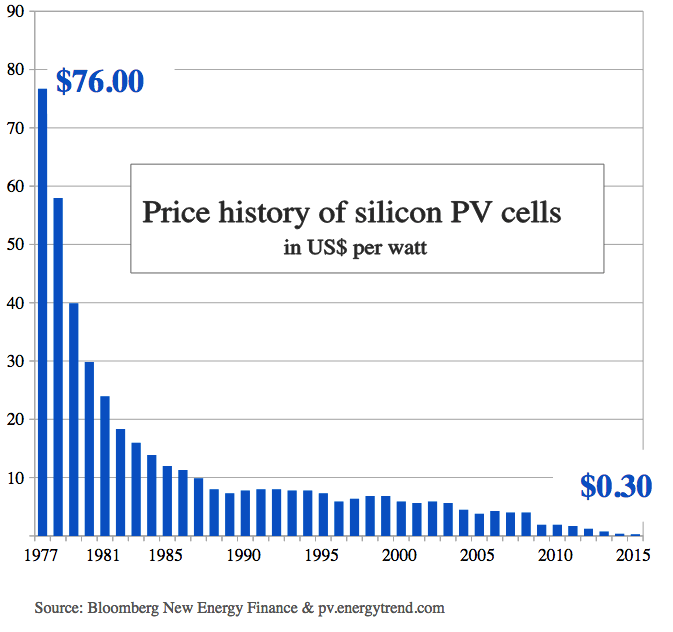
Oh, but you are going to move in a few years? The data show that solar panels significantly increase the selling price of houses – by around 3 to 5%, depending on the details. Today, the median house price in the United States is ~$413K. 4% of that is $16K! That’s probably already more than the cost of the solar installation, plus all the passive income you get prior to selling your house!
Why is solar such a good financial deal now? Well, of course part of that is the 30% federal incentive – but part of it is also the fact that solar panel production has gotten so much cheaper. Here’s data (at right). You can see that the price of a solar panel 5o years ago was literally 250 *times* as expensive as now – that’s 25,000 percent more expensive! Can you think of anything that has dropped in price that much in our lifetimes?
If you want to skip reading about even more advantages, just scroll down to “How Do I Get Solar?”.
You Get a Solar Powered Fridge! 
What? A solar powered fridge? Well, everything in your house will be at least partially solar powered now, making it all kinda magical! You can remember that when watching a movie on your your solar TV, etc. If you have an EV, your transportation is completely green! Awesome! This can be a powerful part of your rituals, too! Anything with any electric power now has the power of the Sun from your own panels!
Maintenance? What’s that?
Solar panels generally don’t need maintenance. Once installed, the produce power without any input aside from sunlight. There’s not a lot of other things in our lives that need so little maintenance.
Solar Gives Electricity During Peak (Expensive) hours of the day
Most electric companies now charge much more for electricity Electricity costs more during peak hours (such as noon to 7 pm), and is cheaper at night (for instance, a peak price of 22 cents/kwh and a night price of 13 cents is typical). Solar produces electricity during the peak time (when people run their air conditioners), making “high value” electricity. This saves you from having to buy when the electricity is expensive. Plus, in most places you can sell your excess electricity back to the grid – and if you do so during the peak hours, they pay you more for it! Here, the sell back prices are of course less than the buy prices, but the peak hour price is still quite good (16 cents), and more than the night time cheap price.
Better than a House Generator – Power when the Grid goes Down!
A battery backup can be included in your solar power system. This has two big advantages.
The first advantage is that you have power during a power outage. For most solar panel systems, you have to have a battery backup to be able to get *any* power from the panels when the grid power is off. But with battery backup, you can draw from the batteries in a power outage as well as get power from the panels. Batteries provide power at night, and then daytime sun recharges them, often giving you power while the outage lasts. A battery backup is easy to add to a solar setup because the setup already has to have an inverter (to convert the DC electricity from the panels into AC electricity for the home), so there is already an inverter there to convert the DC from the battery into AC for the home. Of course, the battery backup is an added cost (around $2 to $8K or more), which doesn’t get you money back. What it does give back to you is power in an outage, which is worth a lot in itself – compare that, for instance, to a home generator. People routinely pay $8K to $12K for the generator, which is much worse – it’s very loud, requires maintenance like spark plug changes, oil, gas winterizing, etc. However, also remember that if you already have an EV, you can likely power your house from that (see the EV post, and check on your car for this). If so, then you might want to save the cost of the battery backup and rely on the EV instead (or buy a small battery and inverter).
Another benefit of a battery backup is that it can help you benefit from tiered pricing (see above). You can fill your battery during cheap hours and then use it (or sell it back to the grid!) during expensive peak hours, saving more money.
 Better for everyone’s Health
Though it has little effect on your home air, the overall effect of fossil fuel power plants have caused the deaths of literally millions of people worldwide, and cause the deaths of dozens of thousands of Americans in the United States every year. Your solar panels help reduce that toll, saving lives even if you don’t directly see them. For me, I’m glad to help save lives, whether I personally get credit or not.
How Do I get Solar Power?
It’s ridiculously easy. In the past, you had to figure out much of it yourself. Today, there are companies that do the vetting of contractors (of course check yourself as well to be safe), line them up for you, and then the contractors do all the work. I went with the site EngergySage.com. You simply go to the site EngergySage.com (or a similar site), click on home solar, answer a few questions, and then EnergySage lines up quotes from contractors for you. Energysage has a helpful person to answer questions about options – then you simply pick the quote you like (or have the contractors write up new ones with your changes), and then they get all the permits, have all the inspections done, and so on. You simply watch them put in your solar, and then get the benefits above. Most of them offer financing too. Of course check it carefully – I found that the company I used (Strawberry solar) offered rates of 6.5 % and 7%, and both of those were financially good options. Then you’ll have much of the payment already covered by reduced electric bills, making your payments small, until they are paid off, and then it’s pure profit. The loans also help build your credit rating.
Some Considerations

Sometimes people think that solar is only for those who live in Arizona. The data show that this simply isn’t true! As mentioned earlier, the NPV calculations showed that it’s a big money saver for me in Michigan, even. Looking at the map to the right of the amount of solar energy each location gets, you can see that most places (aside from Seattle and Western Pennsylvania) get more sunlight than Michigan, and hence the financial gain is even better for most other houses compared to mine. My calculation was with the federal incentives, of course. Without them, most places are still good, if not as good. One surpise was that even areas like Michigan still get a lot of sun – about 80% as much as, say, Houston Texas, or the same as San Diego California. Comparing the insolation (how much sunlight each location gets) to the map here of the US population shows that well over 90% of the population lives in an area where there is enough sunlight to make solar worth it.
Your Current Roof
Solar panels usually have to be removed to re-shingle a roof, so only put panels on a new or nearly new roof. It’s a good idea to check on the age and status of your roof before installing solar panels. For me, my roof was at the end of it’s life (past it a bit, in fact!), so I needed a new roof anyway. If your roof is quite new, you may be OK, but be sure to check. If the roof is old, replacing it before the panels go up is a good idea. Plus, you’ll need to have at least some portion of roof which faces roughly South, and isn’t overly shaded by trees. A tree blocking one panel can shut down the whole array, depending on the way they are wired.
Busting Myths
The fossil fuel industry has spent literally billions of dollars peddling lies to slow the rapid growth of solar power. Addressing them is not the topic of this already long post, but many are addressed here at this website. If many people want it, I can write a post busting all those myths. However, if you hear some scary thing about solar panels (like the lie that they give off toxic heavy metals – they don’t). Like the myths about EVs, don’t fall for lines like solar panels cause cancer due to electric something mumbo quantum waves MAGA jumbo or something.
Your Solar Home awaits! With the whole process, including installation and inspections, often taking 2 to 4 months, you need to start now to make sure you can get all of the federal incentives! Feel free to share this with others – every panel on rooftops both help our planet, help future generations, and help everyone’s health today.
Starstuff, Contemplating by Jon Cleland Host
We are assemblages of ancient atoms forged in stars – atoms organized by history to the point of consciousness, now able to contemplate this sacred Universe of which we are a tiny, but wondrous, part.

Dr. Jon Cleland Host is a scientist who earned his PhD in materials science at Northwestern University & has conducted research at Hemlock Semiconductor and Dow Corning since 1997. He holds eight patents and has authored over three dozen internal scientific papers and eleven papers for peer-reviewed scientific journals, including the journal Nature. He has taught classes on biology, math, chemistry, physics and general science at Delta College and Saginaw Valley State University. Jon grew up near Pontiac, and has been building a reality-based spirituality for over 30 years, first as a Catholic and now as a Unitarian Universalist, including collaborating with Michael Dowd and Connie Barlow to spread the awe and wonder of the Great Story of our Universe (see www.thegreatstory.org, and the blog at evolutionarytimes.org). Jon and his wife have four sons, whom they embrace within a Universe-centered, Pagan, family spirituality. He currently moderates the yahoo group Naturalistic Paganism.




 Naturalistic Paganism