 Naturalistic Paganism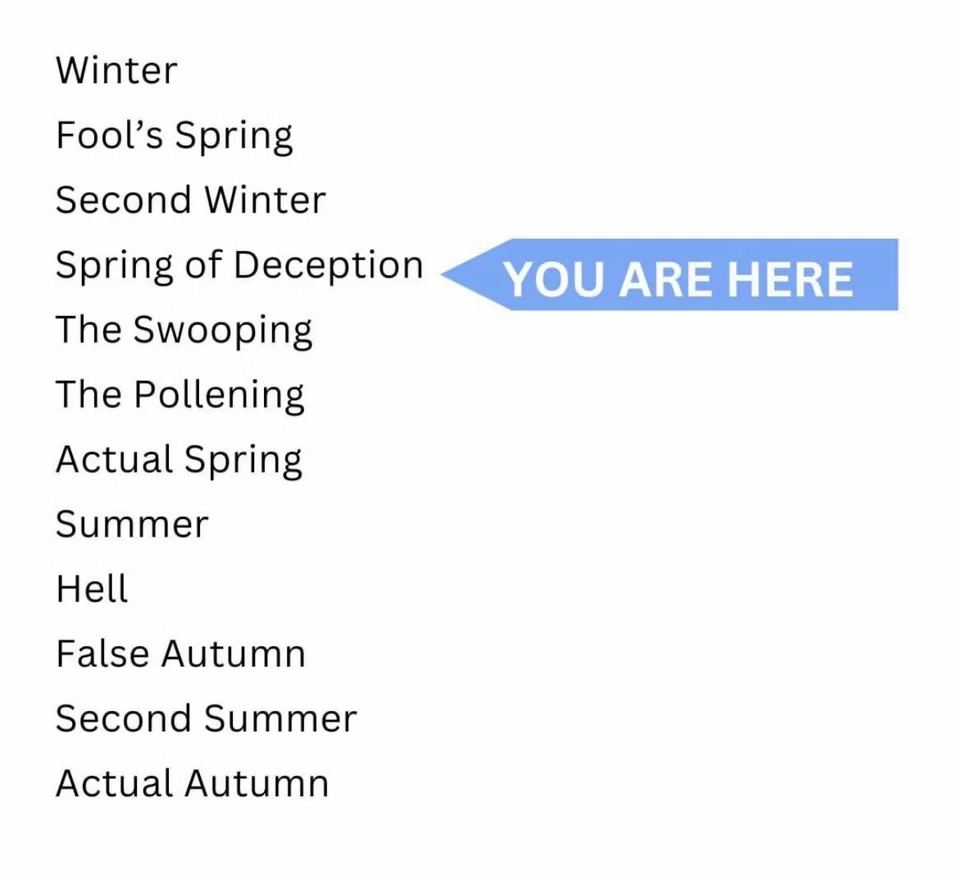
In this series, “No-Nonsense Paganism”, I have been striving to strip Paganism down, take away its ancient or faux-ancient terminology, its mythological and legendary pretensions, its foreign (to wherever you are) folk practices, its superstitious and pseudo-scientific justifications, and its esoteric ritual structures, and get down to the phenomenological core of pagan experience: our interaction with the earth and the other-than-human beings who we share it with. You can check out previous posts in this series here.
Unseasonably Warm
It’s late February. In spite of that, the temperature here in Northwest Indiana got up into the high 60s today. I left my winter coat at home. On purpose. I even rolled down the window. The birds seem to think it’s spring too.
I live in the Midwest of the U.S. This is the time of year I have come to associate with interminably gloomy skies, being chilled to the bone, and depression. It’s also the time of the year that I regularly complain about Pagans in the U.S. celebrating Imbolc as the beginning of spring, regardless of what ewes did in the British Isles in Celtic times.
It’s tempting to attribute the unseasonably warm weather to climate change. But it would be wrong. No single weather phenomenon can be attributed to climate change, because weather and climate aren’t the same thing. For the same reason that cold winters aren’t proof that climate change isn’t real, warm winters aren’t proof that it is.
Regardless of the undeniable impact of climate weirding on the weather of recent years, the fact is that unseasonable weather is not a new phenomenon. We had occasionally unseasonable weather before the CO2 concentration in the atmosphere exceeded 350 ppm (around 1988). My father’s generation had unseasonable weather from time to time. And so did his father. The Celts no doubt had occasionally unseasonable weather too. There’s always been unseasonable weather from time to time. The reason is that seasons are, well, unpredictable.
That’s not what I was taught in elementary school. I remember learning that there were four seasons, that they were exactly three months long, and they corresponded precisely to the months of the calendar. And for most of my life, I have continued to more or less believe this. Even after I starting calling myself a Pagan. The Pagan Wheel of the Year reinforces the belief in the predictability and equilaterality (equal length) of the seasons. This despite everything my senses told me.
Twelve Seasons?
As I said, I live in the Midwest. I’m very close to Chicago, so I’m pretty much right in the middle of the Midwest. But I’ve also lived in Appalachia, the Intermountain West, and on the East Coast. Wherever I’ve lived, people always said that it was nice that we had four seasons there. We always had leaves turning colors in the fall, snow and cloudy days in the winter, rain and pollen in the spring, and hot sunny summers. But there were also a lot of differences. For instance, fall–or what I think of as “fall”, really autumn foliage–is usually pretty short here. And winter seems to stretch on forever.
But recently I’ve realized that winter doesn’t actually stretch on in the way that I thought it did. In fact, it’s not even continuous. It ebbs and flows. I finally realized this when I came across a meme on the internet which described, not four Midwestern seasons, but twelve (or sometimes 11):
- Winter
- Fool’s Spring
- Second Winter
- Spring of Deception
- Third Winter
- Mud Season (sometimes replaced with
“Pollening”) - Actual Spring
- Summer
- Hell’s Front Porch
- False Fall
- Second Summer
- Actual Fall
I’ve seen variations of this humorous meme (one of them in the picture above) used to describe the weather in as diverse locations as Texas, Canada, and Melbourne. It actually describes pretty well what I see year after year where I live. Certainly better than what I learned in elementary school. And also better than what the Pagan Wheel of the Year describes. Right now, where I live, we’re in the Spring of Deception, I think. Or maybe even Fool’s Spring. (What does that make me?) As hard as it is to believe, standing outside without my coat and listening to the riot of birds, we probably still have one or two significant stretches of winter weather ahead of us.
Of course, the equinoxes and solstices still happen on their regularly scheduled days and times. The revolution of the earth around the sun and the axial tilt of the globe are predictable. And this remains important, because the lengthening and shortening of the days and nights has a profound impact on both the wild world and the domesticated world, on both the part of us that remains wild and the part that is domesticated (hence Daylight Savings).
But these things we call seasons are less predictable. They certainly don’t fit the three month pattern I was taught in school. And the don’t fit the English Cross-Quarter Days (Candlemas–Feb 2nd, May Day–May 1st, Lammas–Aug 1st, All Hallows–Nov 1st) which the Pagan Wheel of the Year was based on. They don’t even fit various attempts to save the Cross-Quarter Days by relabeling them “thermistices” and “equitherms” or moving them closer to the actual mid-points between the solstices and equinoxes (roughly Feb 3rd, May 5th, Aug 7th, Nov 7th).
Breaking the Wheel
The seasons just aren’t what we think they are. If you’re paying attention, and you can let go of preconceptions, it’s obvious. There’s not four of them. And they’re all different lengths. And they each have their unique quality. It’s not just about temperature. There’s precipitation, humidity, wind, storms, cloudiness, the smell of the air. It’s still more or less predictable. But it’s a lot more complex. It’s not even a wheel. It is circular-ish, but it’s not a circle. It weaves and bobs, ebbs and flows.
And it’s a lot more local. I live at the southernmost tip of Lake Michigan and our weather is strongly influenced “lake effect”. There is a significant and more or less predictable difference in the severity of weather just a few miles to the east of us because of this. But you could get even more local. I have a Pagan friend who suggested she might measure the changing of seasons by the sound of falling acorns on her roof. That’s very specific to her place. But it’s far more accurate than the Pagan Wheel of the Year.
What does all of this mean for me? Well, at the start of every year, I try to map out a year of seasonal observances. Some of them are tied to the sun, and not the seasons, and those remain predictable. Others are human-made, like the changing of the clocks. But the seasonal observances have continually frustrated me. And now I think I can say why. We don’t have one winter. We have three or so. We don’t have one spring. We have a couple of false starts and mud season (which I’ve seen called “the Muddening”). There’s summer, but then there’s also “Hell’s Front Porch” summer. And so on.
In short, I haven’t been paying close enough attention. Not really. I was still trying to make the world around me fit my idea of what it should be, rather than letting it be and just being present to it. My favorite definition of paganism (small “p”) is “a quiet devoted relationship to nearby life” (Martin Buber). That’s what I’m aiming for in my practice. And that’s what I’ve been trying to describe in this series. So I’m breaking my Wheel. Metaphorically speaking. Tossing it out. Starting new. With a blank piece of paper. And with open eyes, ears attuned, skin bared, and a nose for the smell of the season.
JOHN HALSTEAD

John Halstead is a native of the southern Laurentian bioregion and lives in Northwest Indiana, near Chicago. He is one of the founders of 350 Indiana-Calumet, which worked to organize resistance to the fossil fuel industry in the Region. John was the principal facilitator of “A Pagan Community Statement on the Environment”. He strives to live up to the challenge posed by the statement through his writing and activism. John has written for numerous online platforms, including Patheos, Huffington Post, PrayWithYourFeet.org, Gods & Radicals, now A Beautiful Resistance. He is Editor-at-Large of HumanisticPaganism.com. John also edited the anthology, Godless Paganism: Voices of Non-Theistic Pagans. He is also a Shaper of the Earthseed community which can be found at GodisChange.org.



 Naturalistic Paganism
Interesting observations, John. Though, as you note, the equinoxes and solstices are universals–and mark Earth’s annual journey around the sun. The cross-quarter days are as well–not in what they mean to local places, but being half-way marks between solstices and equinoxes. They serve as a skeleton for local, place-based ritual formation (whether that’s celebrating the falling acorns or jumping through the mud in mud season).
I’m glad to read you’re tracking local nature as well (and love Buber’s definition of paganism, which is new to me). We just developed a local(ish) ecological calendar (for southern New England) that tracks the leafing, fruiting, and flowering of 20 native tree and shrub species, plus precipitation and day length. It’s been useful in making the annual journey more local–as will the nature journal we’re developing that will bring that into a more interactive format. You can check it out here: https://cyclesofgaia.com/
Go with Gaia,
Erik