 Naturalistic Paganism
Though we don’t have quite as much time as that teenager from when Reagan was president (story here), we do have enough time to plan for the momentous total solar eclipse coming in April! A total solar eclipse is an unbelievably powerful experience of our Universe. If you’ve felt one, I don’t have to explain – and if you haven’t, then words can’t do it anyway.
I went decades with no total solar eclipses in the United States – a string broken by the 2017 eclipse, and now, a total solar eclipse on April 8, 2024, follows right on it’s heels! As an awesome display of the power of our solar system, a total solar eclipse is both an incomparable experience as well as a great opportunity for powerful rituals. I’ll post more about the ritual planning as the eclipse approaches, but for now, it’s still early enough for you to get it on your calendar, and make plans to be in the path of totality, before all the campgrounds/hotels book up – as they are already quickly doing.
The eclipse path is 60 miles wide. You need to be inside that band during the eclipse to see totality – towards the middle gives a longer eclipse. However, one good lesson from the 2017 eclipse is that you don’t have to actually get a campground or hotel in the path, as long as you can drive into the path before the eclipse (leave lots of extra time, the traffic will be heavy in most places). Work in some flexibility for the weather – while the farther South, the better (see map toward the bottom of this post), things can change the day before the eclipse. In 2017, the day before the eclipse, our chosen campsite location suddenly got a cloudy forecast, and we abandoned it for a hotel 40 miles off the path in an area with a sunny forecast. It was easy to get up and drive an hour to a sunny location in time for the eclipse. This page is a great resource – you can type in your target city on the right, and it will give the exact times of the start of the partial eclipse, the time and length of totality, and the time to the end of the partial eclipse.
As we prepare for this astounding event, imagine what eclipses have meant to our Ancestors over the millennia.
Looking back, our Ancestors’ responses to eclipses reflect the evolution of our minds. Animals as simple as crickets “notice” a total eclipse – commencing their chirping as if it were nig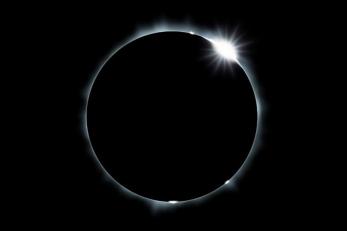 ht. But do they notice this as any different from a normal evening? I don’t know. Do animals like shrews and lemurs realize it’s something different? I would think that monkeys probably think that something is different from a normal nightfall – it’s much faster, and often at the “wrong” time of day – but do they barely notice, or do they freak out? I found some research – it sounds like their response is closer to “barely noticing” (this was for baboons, but I think that’s close enough), so Ancestors before primates probably saw this as an out of place “nightfall”. OK, what about chimps? Do they have the thinking minds that might react in a stronger way? It sounds like they do! This study (reported in the American Journal of Primatology) reports many of them looking up at the eclipse, and a child appearing to take special interest in it. It seems likely that our Ancestors 8 million years ago probably behaved similarly. Behaviors during eclipses don’t tend to fossilize well, so with no living creatures similar to Homo habilis, H. afrarenis, and others, we’ll have to jump ahead millions of years to human records. We know that many differe
 nt cultures have noticed and written about eclipses for thousands of years – usually in fear. One example is the sad fate of two Chinese astronomers who failed to predict an eclipse in 2,134 BCE, and were beheaded as a result. The importance of eclipses to
humans is also shown by the fact that one role of the Antikythera device (a gear based computer built over 2,000 years ago! Yes, it’s real.) was to predict eclipses. In the dozens of thousands of years that humans like us have lived, how many were amazed, inspired, scared, astounded, etc, by the thousands of total solar eclipses they experienced? How many of them worked these into the their spiritualities in important ways? How many rituals did they inspire? What was it like for the first person to realize they could be predicted? In doing so, did that person banish much of the fear of a supernatural cause, as science has done in case after case? I wish there were a way to know- to see at least some of them! There they hide, behind a nearly unbreachable wall of years, with only a few tiny glimpses being possible. How many eclipse rituals were held in stone circles? How many rituals included sacred items, words, or stories of eclipses? Scientific discovery seems to be the most likely way we might find a few hints of these – just as scientific work gave us the realization of the use of the Nebra Sky Disk. These (along with many other achievements) remind us that our Ancestors were not at all stupid – with minds like ours and a greater focus on the sky as part of their lives, their insights were often far beyond what you or I could accomplish with the limited tools they had.
This is the powerful book of stories we connect with when we too see the blinding Sun blackened in the sky. Like the Sun itself, the details of those many stories are hidden from view – yet I still feel their power, penetrating that wall of years, to my inner being. To connect with all of those people – with countless humans both living and dead – is one gift that the coming eclipse can give us. Don’t miss it! If you are important in the life of a child, is there a way for them to experience it with you? You could give them a gift that they’ll have for the rest of their lives, an experience they’ll remember long after you are gone. If you are lucky enough to live in the path of totality (millions of people do), this is your only chance to host an eclipse party.  And, regardless of that, with an eclipse path dozens of miles wide (the best viewing is in the middle ~70% or so of the path, which is still ~50 miles wide), one can almost certainly find a place to see it from, if you start planning now. Many religions have discovered the impact of a spiritual pilgrimage, and some, like Islam, require it. I think spiritual pilgrimages are yet another religious technology that fits well with Naturalistic Paganism.
Don’t let the fear of eye damage stop you from going – simple precautions are all that are needed to guarantee safety. The biggest uncontrollable concern is probably the chance of clouds on the day of the eclipse, April 8th, 2024 – an important factor to include in your plans. The cloud cover chart here shows the odds of a clear sky for various locations – basically, the farther South the better. Experiencing the eclipse is easy – just be outside, in the path of totality, for the time of the eclipse. The Moon will start covering up the edge of the Sun (if you aren’t looking for this, you won’t notice it happening). From there, it will take around an hour and a half as the Moon covers more and more of the Sun. Then, it will get darker outside, as the Moon fully blocks the Sun. This total coverage will only last for a minute or two. Then, the Sun will emerge from behind the Moon, exposing more and more of the Sun over the next hour and a half. The ~two minutes of totality is around 1:30 pm in Texas, ranging to pi time – 3:14 pm in Cleveland Ohio. Look up the exact times for wherever you will be watching from. This will hold millions of people in awe (including both Americans and eclipse chasers). Will the next Carl Sagan or Neil Degrasse-Tyson will be one of those millions of kids who stare in awe at the fiery ring in the sky next April? Maybe she or he is a child you know, who you will bring to the path of totality?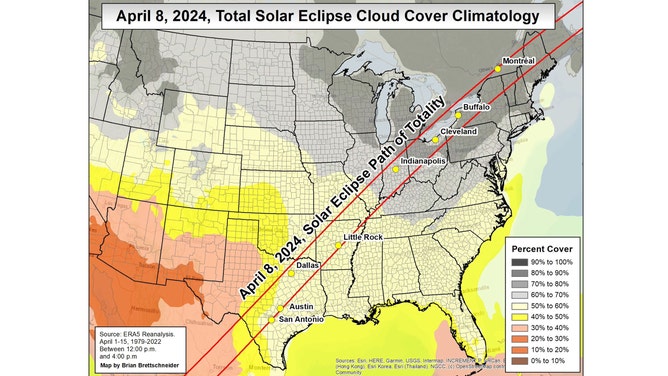
What will I do during those 100 or so sacred seconds? Will I prepare a ritual? Just revel in it? Hug my kids? I have no idea yet, aside from infusing my Cosmala with the shadow of our Moon, Luna.
Or would the descent into darkness (and then the return of the light) be better times for ritual activity? After all, those times are ~90 minutes long each, and that would make the whole time of totality part of my ritual if I started before totality and ended after it. Pagans who can’t make it (including those on other continents than North America), might want to hold a ritual at a chosen moment during the eclipse. All religions have sacred times and sacred places. For those of us with a naturalistic spirituality (as well as for many others), reality itself – and especially our Earth, Moon and Sun – show us those sacred times. For many of us (and certainly me), this April 8th will be one of those most sacred times. What will those ~180 seconds be like for you? I don’t think that can be predicted – we can’t decide when the sacred will touch us, but we can give it more opportunities. Blessed be.
The Author: Jon Cleland Host
Starstuff, Contemplating: We are assemblages of ancient atoms forged in stars – atoms organized by history to the point of consciousness, now able to contemplate this sacred Universe of which we are a tiny, but wondrous, part.

Dr. Jon Cleland Host is a scientist who earned his PhD in materials science at Northwestern University & has conducted research at Hemlock Semiconductor and Dow Corning since 1997. He holds eight patents and has authored over three dozen internal scientific papers and eleven papers for peer-reviewed scientific journals, including the journal Nature. He has taught classes on biology, math, chemistry, physics and general science at Delta College and Saginaw Valley State University. Jon grew up near Pontiac, and has been building a reality-based spirituality for over 30 years, first as a Catholic and now as a Unitarian Universalist, including collaborating with Michael Dowd and Connie Barlow to spread the awe and wonder of the Great Story of our Universe (see www.thegreatstory.org, and the blog at evolutionarytimes.org). Jon and his wife have four sons, whom they embrace within a Universe-centered, Pagan, family spirituality. He currently moderates the yahoo group Naturalistic Paganism.
See Starstuff, Contemplating posts.
See all of Dr. Jon Cleland Host’s posts.



 Naturalistic Paganism
Pingback: Happy Samhain! Now, Eclipses highlight the Beltane/Samhain Pairing! | Naturalistic Paganism