Naturalistic Paganism
“10,000 Pagans Raise Their Voices For Environmental Action”: Help make this a reality

“10,000 Pagans Raise Their Voices For Environmental Action”
This might be the headline this summer.
Help us get 10,000 signatures by Summer Solstice this year (June 21) for “A Pagan Community Statement on the Environment”.
Why 10,000?
It’s been 2 weeks since “A Pagan Community Statement on the Environment” was published and already over 2,000 people have signed from all over the world. 10,000 Pagans represents just 1% of the Pagans in the United States. Since we are collecting these signatures from all over the world, the goal is even more realistic.
Why the Summer Solstice?
The Pope’s environmental encyclical is going to be published this summer. It is expected to be historical, and it is already drawing a lot of media attention. A previous environmental encyclical by Pope Benedict explicitly contrasted Catholic earth stewardship with “neo-paganism” and another statement by Pope Francis suggests he may have a similar perspective on paganism. Regardless of whether Pope Francis explicitly mentions paganism this summer, there is going to be talk in the press about paganism, and this is an ideal opportunity to share a Pagan vision of ecological sustainability with the world.
Here’s what you can do:
- If you belong to a Pagan organization that has a mailing list, email list or newsletter, ask someone in the organization to promote the statement to its members.
- Share the statement with 5 Pagan friends in a personal email or personal Facebook message. We need signatures, not Facebook likes (so a post on your wall is good, but not enough). So ask your friends to go to ecopagan.com to sign the statement.
- If you haven’t already done so, go to ecopagan.com to sign the statement.
HP Pride: Meet Debra Macleod

HP Pride is a new monthly column where we interview members of the Humanistic Paganism community and other like-minded friends. One or more interviews will be published every month. If you are not a “Big Name Pagan”, or if you have never written online before, all the better! We want to hear from everyone! If you’d like to be interviewed, just click this link and follow the instructions.
Today we are interviewing Debra Macleod. You can visit Debra’s private practice at DebraMacleod.com or her Vesta website at NewVesta.com.
What do you call the religion you practice?
New Vesta. It is a re-introduction and renewal of the ancient Roman cult/tradition of Vesta, goddess of the home and hearth. Read More
Call for Essays: Non-Theistic Religion
Our theme for the month of May is non theistic religion. Humanistic Pagans may be atheists, pantheists, or even animists. Not all Humanistic Pagans use theistic language, but some do. Some Buddho-Pagans or otherwise influenced by non-theistic Buddhism. Buddha Day is a holiday observed traditionally by Buddhists on different days in different countries, but usually in the month of May. Send your submissions about Buddhism or other forms of non-theistic religion to humanisticpaganism [at] gmail [dot] come.
Monthly hemes for the rest of 2015:
- June: Ancient Paganism and the Neo-Pagan revival
- July: Individualism and religious tradition, and feminism and gender issues
- August: Atheism and meaning
- September: Gaia philosophy and the Earth
- October: Superstition and reason, or belief and skepticism
- November: Pantheism and cosmology
- December: Science and the science-religion intersection
May Cross-Quarter: Vernal Equitherm
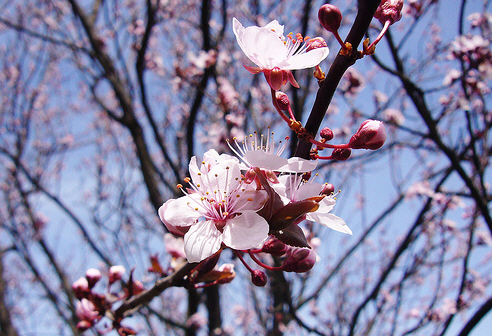
Today is the May Cross-Quarter. It is the midpoint between the spring equinox and the summer solstice. It is one of eight stations in our planet’s annual journey around the sun. For those in the Northern Hemisphere, spring is well and truly come and summer is around the corner. Flora is bursting to life even in the most northern climes, and fauna frolicks in the verdure. Those in the Southern Hemisphere experience the opposite, as autumn passes into winter.
In the Northern Hemisphere, May 1st time is traditionally celebrated in the Neo-Pagan Wheel of the Year as Beltane. The name derives from the Irish Gaelic Bealtaine or the Scottish Gaelic Bealtuinn for “Bel-fire”. Beltane is reputed as a day of unabashed sexuality, visible in the phallic symbolism of dancing round the Maypole. Read More
The Wheel of Evolution, by Eric Steinhart: Beltane

Dr. Eric Steinhart draws on his philosophical background to create a naturalistic foundation for the Pagan Wheel of the Year. To better understand axiarchism, the philosophy on which Dr. Steinhart draws to create a Naturalistic Pagan theology, see Part 1 and Part 2 of his essay “Axiarchism and Paganism”.
At Beltane, the light, which has concentrated itself into life, now concentrates itself into a novel kind of life. Evolution builds on itself. During Beltane, life reaches a new level of self-engagement: it becomes self-aware. Perhaps life achieves self-awareness on millions of planets in our galaxy. But our self-awareness includes only the history of life on earth. It is arguable that many species have reached self-awareness here on earth; and, even if they have not, in the future, they might. Human self-awareness is not the only possible kind of self-awareness. Nevertheless, it is the only kind we can authentically discuss. So, at Beltane, Pagan naturalists focus on the development of humanity.
Beltane begins with the first members of the genus Homo. As Beltane progresses, modern humans very quickly appear. These first humans reproduce, bringing the next generation into being. The wheels of human progress start rolling uphill. During Beltane each previous generation of humans is surpassed by the next generation. And while the wheels of human progress may sometimes crash down into valleys during Beltane, it is a remarkable fact that they generally roll uphill. The series of generations of humans keeps climbing the hill of human progress, towards higher heights of flourishing and prosperity. As humanity rolls through Beltane, our lives and societies on average get better and better. Nevertheless, our lives and societies suffer from terrible defects. And human self-awareness brings a new kind of suffering into the universe: it brings moral suffering, which is closely linked with social and political suffering.
The Author

Eric Steinhart is a professor of philosophy at William Paterson University. He is the author of four books, including Your Digital Afterlives: Computational Theories of Life after Death. He is currently working on naturalistic foundations for Paganism, linking Paganism to traditional Western philosophy. He grew up on a farm in Pennsylvania. He loves New England and the American West, and enjoys all types of hiking and biking, chess, microscopy, and photography.
Buy Godless Paganism (paperback)

Buy Godless Paganism (ebook)


Pagan Coming Out Day – May 2nd