 Naturalistic Paganism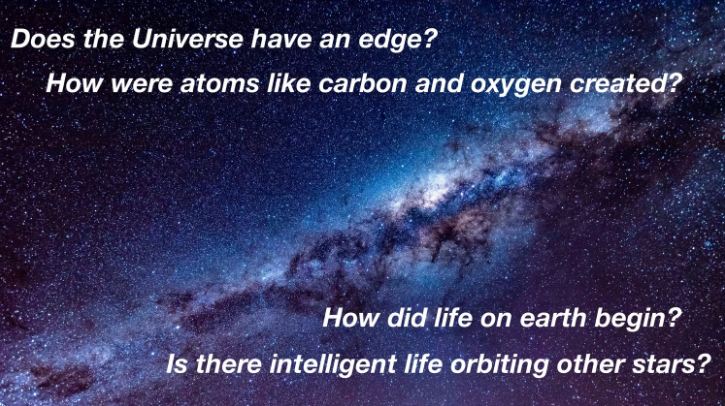
To gaze into the night sky fills us with awe. Like so much in nature, that feeling is deepened profoundly by when done with more understanding of what we are seeing. In addition to that, so many aspects of our knowledge of the night sky help us understand the basics of how our world works – changing our view of our own lives.
For instance – for a lot of my life, I understood the colors we see as, well, of course the colors that the world is. End of story. But then I heard about infrared light. And ultraviolet light. And found out about the whole “electromagnetic spectrum” – all of which are the same thing – all “light”, just in different colors. Most colors of which we can’t see. To realize that we only see a tiny slice of the colors that exist was mind opening!
Many other basic concepts like that are included in this course (with the electromagnetic spectrum in Lecture #3). Others include why we have tides (Lecture #2), what black holes and Neutron stars are (Lecture #7), why the rocky planets are nearer the Sun (Lecture #3), if the universe has an edge (Lecture #12), how we know the universe started (Lecture #12 also), and many more! Just check out the course topic list below.
The topics Dr. George Roush will explore in 16 classes are:
- Geocentrism, Kepler’s laws, and the Kepler-Newton Law
- Eclipses, tides, solar system formation, planet tilts, and planet densities
- The rocky and giant planets, the moon, escape velocity, the electromagnetic spectrum, and planet atmospheres.
- How old is the solar system? Comets, asteroids, Newton’s laws, gravitational and centripetal acceleration, and distances via parallax.
- Distances via Cepheid Variable stars, the discovery of other galaxies, the sun, fusion, and the HR diagram.
- Star birth, Wien’s law, star temperatures, and star luminosity.
- Star mass, star lifetimes, the creation of neutron stars and black holes, and the creation of elements from star explosions.
- Pulsars, telescopes, adaptive optics, space telescopes, and telescope arrays.
- Enjoying the night sky, galaxy classification, star clusters, active galactic nuclei, and synchrotron radiation
- The expanding universe, the Hubble-Lemaitre law, the Cosmological Principle, and dark matter.
- Special and general relativity, tests of general relativity, gravitational red shift, black holes, and the cosmic microwave background.
- Does the universe have an edge? How do we know there was a Big Bang? The universe’s age and the universe’s fate.
- Inflation, the 4 forces of nature, string theory, the Anthropic Principle, and women astronomers.
- Are there extraterrestrial civilizations in the universe? Habitable exoplanets, astrobiology, and K-type star lifetimes
- Are there extraterrestrial civilizations on Earth? What is the evidence? Are the witnesses reputable?
- Review and course highlights.
More details (and how to register) at the website, here!
Classes are on zoom, Tuesday evenings from January 20th to May 12.
It’s free for high school students, and just $100 for everyone else (that works out to ~$4 per hour).




 Naturalistic Paganism