 Naturalistic Paganism
In this series, “No-Nonsense Paganism”, I have been striving to strip Paganism down, take away its ancient or faux-ancient terminology, its mythological and legendary pretensions, its foreign (to wherever you are) folk practices, its superstitious and pseudo-scientific justifications, and its esoteric ritual structures, and get down to the phenomenological core of pagan experience: our interaction with the earth and the other-than-human beings who we share it with. You can check out previous posts in this series here.
I was recently talking to a Pagan friend about seasonal celebrations, and they mentioned their love of that time of the year when acorns fall from the oak trees and they hear them hitting their roof. I said that would be a great moment to memorialize ritually. But they wondered about the timing, since this usually happens sometime between the fall equinox (Mabon) and the mid-autumn thermistice (Samhain/All-Hallows/Halloween).
First of all, I think it’s great they knew approximately when this happened every year. It shows they pay attention to the more-than-human world around them. I responded that they should create their own “Wheel of the Year” and celebrate the falling of the acorns whenever they notice it.
I celebrated my own autumn ritual this week, even though it’s half way between the two standard points on the Pagan Wheel. It was still pretty warm on fall equinox this year where I live, around 80. And it remained in the 70s for the next two weeks. It just didn’t feel like autumn, though I definitely had noticed the days getting shorter.
The temperature started to fall about two weeks ago, a week into October. And it’s been in the 60s for about two weeks and will be for another week or so. It’s that perfect autumn temperature, where you feel the world hovering on the edge of winter. The trees are just starting to turn. We’re going to having highs in the 40s by the end of the month. Autumn doesn’t last long here.
Yesterday, I came home and noticed my Burning Bush (Euonumus alatus) exploding with color. It just hit me all at once, like it does every year. (Yes, I know they are not native.) I cut a small branch with crimson leaves and picked up a few fallen leaves from my Red Maple (Acer rubrum).
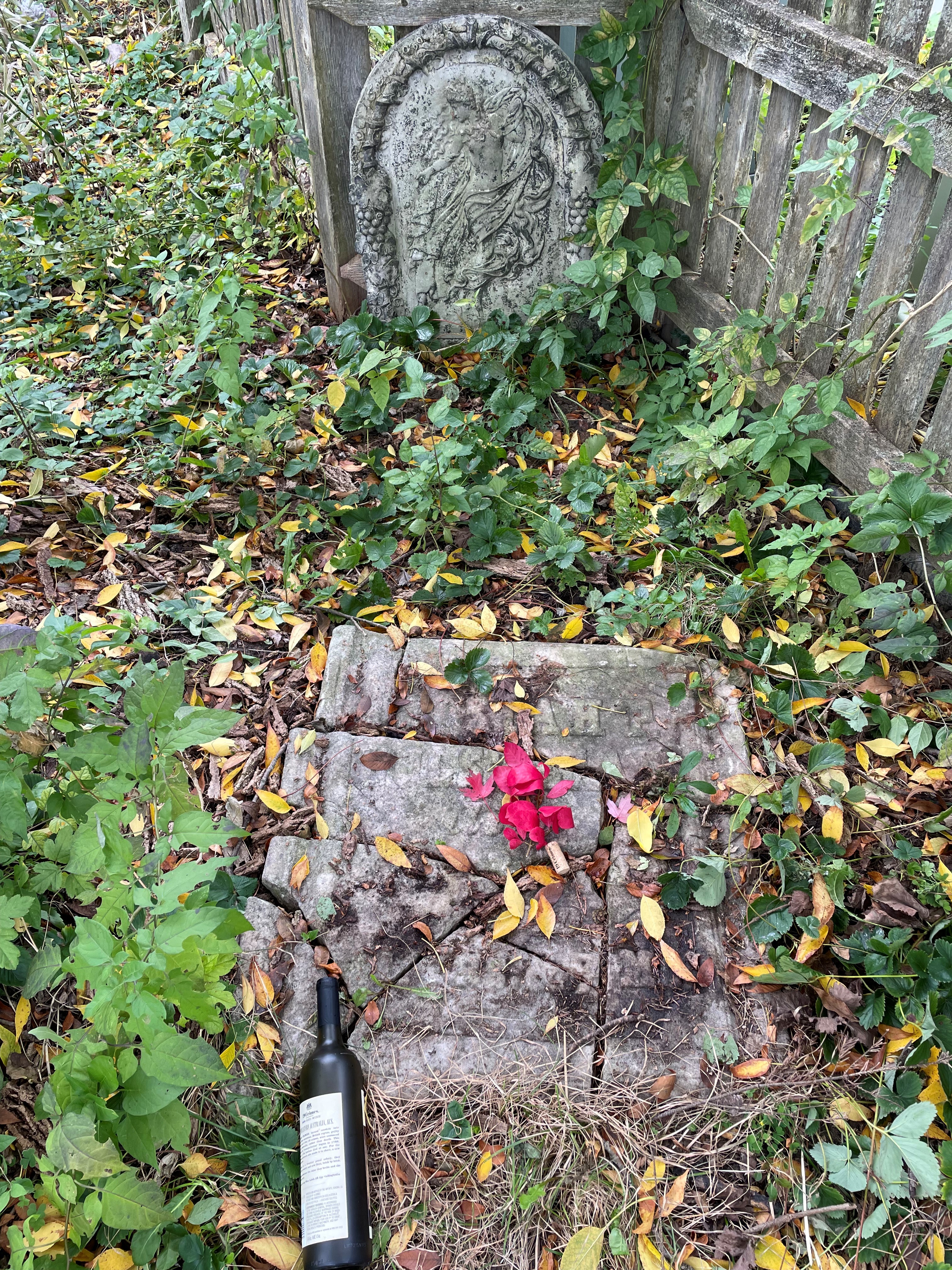
I brought the leaves and a bottle of red wine I had purchased the week before to one of my outdoor shrines. It’s in a corner of my backyard, under my Ash tree, where I have a headstone for my great-great-great grandfather (there’s a newer headstone on his actual tomb) and a stone frieze of a Greco-Roman styled woman.
I placed the red leaves on the headstone and poured out a libation of red wine while reciting my favorite reading for this time of the year, a mishmash of an ancient Irish poem and the modern “Thoreau”, Annie Dillard:
“Yesterday green was the hill where lovers played.
Today it is red as blood and white as bone.
The sea is a cup of death and the earth is a bloody altar stone.”
It was a simple ritual to help me mark this time of transition. I share it here as an example of how pagan rituals can (and I think should) be performed in response to our experience of world around us, rather than an assigned time of a calendar.
The calendar does have its use for this pagan. It reminds me to pay attention. When I see the autumn equinox approaching, I remember to look around for signs of change. This year, they came a few weeks later. I am glad for the reminder. But I’m also glad I waited for the moment when I really experienced autumn for the first time this year before I did my ritual.
As I wrote at the beginning of this series, Pagan (or pagan) ritual should arise out of our experience of the more-than-human the world around us. It requires paying attention, really listening, to the places where we live, cultivating relationship with those places and the other-than-human beings we share it with, taking the instinctive feeling of wonder or gratitude that arises and turning it into a simple but powerful rituals that celebrate being alive and help us feeling more human.
JOHN HALSTEAD

John Halstead is a native of the southern Laurentian bioregion and lives in Northwest Indiana, near Chicago. He is one of the founders of 350 Indiana-Calumet, which worked to organize resistance to the fossil fuel industry in the Region. John was the principal facilitator of “A Pagan Community Statement on the Environment”. He strives to live up to the challenge posed by the statement through his writing and activism. John has written for numerous online platforms, including Patheos, Huffington Post, PrayWithYourFeet.org, Gods & Radicals, now A Beautiful Resistance. He is Editor-at-Large of HumanisticPaganism.com. John also edited the anthology, Godless Paganism: Voices of Non-Theistic Pagans. He is also a Shaper of the Earthseed community which can be found at GodisChange.org.



 Naturalistic Paganism