Naturalistic Paganism

[A Pedagogy of Gaia] “Honoring the Past, Living in the Present, Shaping the Future” by Bart Everson

“The first step in starting a new religion is to claim it’s the old religion.”

So said my friend and neighbor Michael, as we sat around the dinner table after our equinox feast. It was some years ago — I can’t even recall if it was vernal or autumnal — but the comment stuck with me.

He was joking, I think. Michael happens to be a theologian with a curmudgeonly sense of humor. I’m not sure what he was referencing, exactly, but my mind immediately leaped to Neo-Paganism, a new religion which (sometimes) claims to be an old religion. Read More

“Atheopaganism and the Broader Pagan Community” by Mark Green

This essay was originally published at the Atheopaganism website.

It’s never going to be a completely comfortable fit.

Just as the suggestion of religious ritual and other symbolic, poetic, metaphorical practices will always be dismissed by some in the atheist community, Atheopaganism is always going to be viewed by some in the Pagan community as not rightfully belonging.

Let me stop there and say that in my experience, that is a distinctly minority position. Most of the Pagans I have come out to as Atheopagan have been curious and interested in talking about the details of what I believe and do, but they have shown no interest in showing me the door. So let’s start there: this appears only to be an issue for those who are either preternaturally cranky or who take offense (or feel defensive) at the idea that we don’t believe in their gods.

Still, nobody likes being confronted with that sort of thing, and it’s a little uncomfortable when it occurs. So why should Atheopagans want to continue to be participate as a part of the broader Pagan community? Read More

Neopaganism FAQ by Eric S. Raymond

A longer version of this essay was originally published at Eric S. Raymond’s website Oct. 22, 2010.

I. Introduction

The neopagan phenomenon is a loose collection of religious movements, experiments, and jokes combining some very new thinking with some very old sources.

This FAQ, originally prepared in 1992 at the request of a number of curious net.posters, offers a brief description of neopagan thought and practice.

II. What is a neopagan?

I used the term `religious’ above, but as you’ll see it’s actually more than somewhat misleading, and I (like many other neopagans) use it only because no other word is available for the more general kind of thing of which the neopagan movement and what we generally think of as `religion’ are special cases.

Neopaganism is `religious’ in the etymological sense of `re ligare’, to rebind (to roots, to strengths, to the basics of things), and it deals with mythology and the realm of the `spiritual’. But, as we in the Judeo/Christian West have come to understand `religion’ (an organized body of belief that connects the `supernatural’ with an authoritarian moral code via `faith’) neopaganism is effectively and radically anti-religious. I emphasize this because it is important in understanding what follows.

Common characteristics of almost all the groups that describe themselves as `neopagan’ (the term is often capitalized or hyphenated) include: Read More

Call for Submissions: July’s themes are individualism, religious tradition, gender issues

This month (July 12) is “Malala Day”, which honors Malala Yousafzai, the young Pakistani activist who survived an assassination attempt and nominated for the Nobel Peace Prize in 2014.

EmersonThoreau2Also this month, we are a couple of important anniversaries in the Transcendentalist movement.  The Transcendentalist Henry David Thoreau was born this month (July 12) in 1817.  Another Transcendentalist, Ralph Waldo Emerson, gave his “Divinity School Address” the same month (July 15) in 1838.  The address is regarded by some as the beginning of the Transcendentalist movement, which represented an individualist challenge to traditional religion.

In honor of the Transcendentalists and Malala, our themes for the month of July will be individualism and religious tradition.  We’ll also be looking for articles on gender issues.

Send your submissions to humanisticpaganism [at] gmail [dot] com.

Help Support “Universe Story Car Decal”

Help Create Car Decal to Share the History of the Universe and Build a Sustainable Future!

The Universe Story on Your Car!

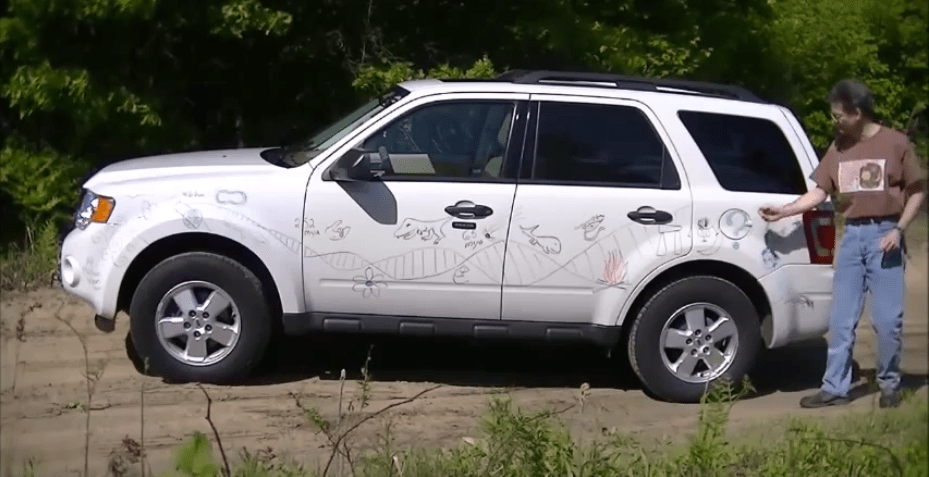
I’m Jon Cleland Host – an educator, scientist, and father.  I’ve been active in helping build a better world for future generations, marching in the Great Climate March, contributing future focused blog posts, and helping kids learn about our world.  My wife Heather and I authored the book “Elemental Birthdays” to empower all parents to hold science related birthday parties, and much of my work can be found online.   I realized how much an understanding of our deep time history energized me to work for a better future, and that one way to share this knowledge would be to create a car decal depicting the history of the Universe and pointing toward the future.

Imagine seeing the history of the Universe as you drive down the road on the car next to you – I’ll be bringing that experience to hundreds of people here in Michigan, and to thousands more as we make this artwork available to everyone.

The decal will consist of a DNA strand winding from the front of a car to the back with 18 events from the Big Bang into the future, depicted along its length.  The decal will show the first stars, the formation of the Earth and Moon, the extinction of the dinosaurs, the history of humanity, the possible sustainable future, and more.  I’ll make the decal available online, so anyone can download it, take the file to an auto detailer, and have it put on their car as well.  Vinyl, other decal material, or maybe removable magnet sheet could be chosen. Read More